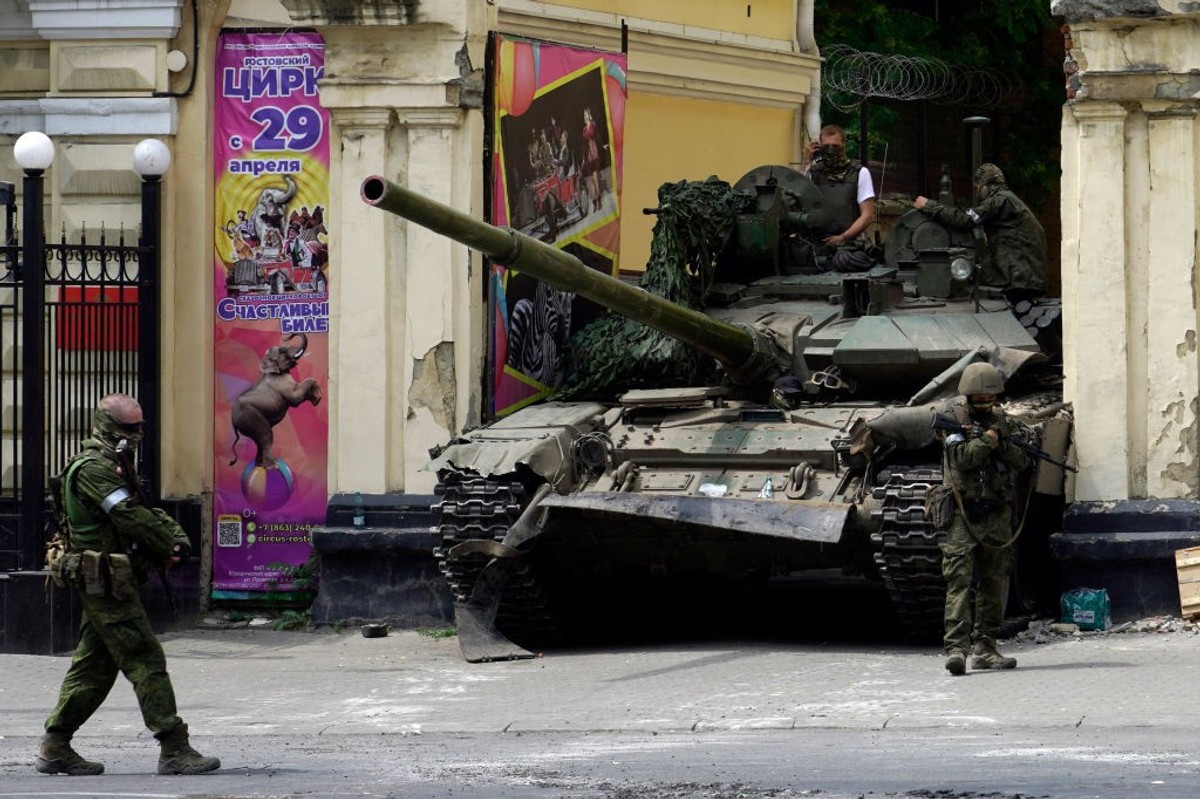



DEEP DIVE — Nearly three years into the most comprehensive sanctions regime ever imposed on a significant economy, Russia’s defense industrial base has not just survived — it has expanded at a rate that has stunned Western officials.
In spite of Western import controls, Moscow maintains wartime levels of military production by using shell companies, third-country middlemen, and financial workarounds.
In early 2026, the war will enter its fourth year, and Russia will still have access to critical battlefield technology that was banned by Western authorities. These components power the Lancet loitering munitions hitting Ukrainian positions, Kalibr cruise missiles striking infrastructure, and electronic warfare systems jamming NATO communications.
Throughout 2025, Russia produced an estimated 250,000 artillery shells monthly — 3 million annually — according to NATO intelligence, while manufacturing over 1.5 million drones and more than 2,400 cruise and ballistic missiles per year. President Vladimir Putin claimed in April that Russia’s defense industry more than doubled production of weapons, communications, reconnaissance, and electronic warfare systems over the previous year, with ammunition production increasing more than 22-fold since 2022.
NATO Secretary General Mark Rutte also assessed in January 2025 that Russia has fully switched to a “war economy” and produces, in three months, the weapons and ammunition that the European Union makes in a year; a production advantage enabled by sanctions-evasion networks spanning three continents.
“Evasion of Western restrictions has helped Russia ramp up production of certain military equipment and munitions, such as cruise and ballistic missiles, to a greater degree than Western governments initially expected,” John Hardie, Deputy Director of the Russia Program at the Foundation for Defense of Democracies, tells The Cipher Brief.
The Turkey-UAE-China Triangle
Three countries have emerged as critical nodes in Russia’s procurement network. Over the past year, Turkey, the United Arab Emirates, and China continued to dominate Russia’s sanctions evasion infrastructure, collectively accounting for 86.2 percent of total battlefield goods shipments and 78.6 percent of critical components shipments to Russia.
The trade patterns reveal how entrenched these channels have become, and how enforcement efforts under the Trump administration have largely stalled. In the first nine months of his administration, President Trump imposed no new sanctions on Russia and declined to join the UK, EU, and other allies in targeting Russian evasion networks. Only in October 2025, after canceling peace talks with Putin, did the Trump team impose its first direct sanctions on Russia, targeting oil giants Rosneft and Lukoil while threatening secondary sanctions primarily against India, despite China being the largest importer of Russian oil globally.
“China is by far the most important enabler of that evasion,” Hardie explained. “China serves as both a direct supplier of critical inputs — such as CNC machines, microelectronics, and nitrocellulose — as well as a jurisdiction for Russian illicit procurement of Western products.”
China remains the dominant supplier, accounting for up to 90 percent of Russia’s microelectronics imports. By August last year, Beijing exported a record 328,000 miles of fiber-optic cable and nearly $50 million worth of lithium-ion batteries to Moscow in a single month. According to Germany’s Foreign Ministry, up to 80 percent of Russia’s sanctions circumvention now involves Chinese entities. Russia is paying the price for this dependence: Chinese suppliers charged Russia an 87 percent markup on sanctioned goods between 2021 and 2024, compared to just 9 percent from other suppliers.
In addition, the UAE has become the primary transshipment hub, with electronic component exports to Russia growing more than fifteenfold since the invasion. Dubai-based companies supply everything from aviation parts to Starlink terminals, which Russian forces buy for around $2,200 each. By mid-2024, UAE imports of EU airplane parts hit 23.6 million euros — a fifteenfold jump — while Turkey’s climbed by a third to 12.7 million euros, even as Russia’s direct purchases fell to zero.
Central Asia’s Shell Company Explosion
Central Asian states have become essential transit corridors, with Kazakhstan and Kyrgyzstan serving as primary hubs. Throughout 2025, these channels have grown more sophisticated rather than diminished. From 2021 to 2022, Kyrgyzstan’s exports to Russia exploded by 250 percent, with machinery exports to Russia spiking by 41,000 percent — a figure that “cannot be attributed to market demand” but represents “economic statecraft hidden in plain sight,” according to analysis published in June 2025.
Russian buyers keep setting up shell companies in Kazakhstan to purchase electronics and drones from Europe, China, and the United States, then ship them home to Russia’s defense industry. Throughout 2025, Kazakhstan became one of Moscow’s primary backdoors for sanctioned goods. Moreover, Russian marketplace OZON has invested significantly in logistics infrastructure across Kazakhstan, Kyrgyzstan, and Armenia to consolidate parallel-import cargo.
The diversions are obvious. Landlocked Kyrgyzstan continues importing EU maritime navigation equipment with no plausible domestic use — equipment destined for Russian naval systems. Over the course of last year, Western authorities intensified enforcement. In June, the UK warned businesses in five countries that those aiding sanctions evasion would face sanctions themselves.
In October, the EU’s 19th sanctions package targeted eight financial institutions in Tajikistan, Kyrgyzstan, the UAE, and Hong Kong for facilitating circumvention, while four banks in Belarus and Kazakhstan were designated for using Russian payment infrastructures. In January 2025, the UK published enhanced guidance identifying 15 high-risk countries, including Armenia, Kazakhstan, Kyrgyzstan, China, the UAE, and Turkey, for which exporters must conduct enhanced due diligence.
When asked how difficult it is to distinguish legitimate trade from sanctions evasion in Central Asia, Ambassador Daniel Fried, a forty-year career diplomat and Distinguished Fellow at the Atlantic Council, acknowledged the complexity.
“Such action is labor-intensive but worth the effort,” he tells The Cipher Brief. “We should go after the most impactful technologies and targets.”
The Yuan Lifeline: Russia’s Financial Engineering
Meanwhile, the Chinese yuan props up Moscow’s parallel financial system. As of November 2025, 99.1 percent of Russia-China trade settles in rubles and yuan — up from less than 2 percent before the invasion.
When major Chinese banks like Ping An and Bank of Ningbo stopped accepting Russian payments in mid-2024, smaller regional banks stepped in to fill the gap. These “burner banks” can shut down and reopen under new names if sanctioned.
The workaround was part of a broader effort to rewire Russia’s financial system away from the West.
The share of Western currencies in Russian trade decreased from 87 percent to 18 percent between January 2022 and December 2024. Yuan and ruble filled the gap, eliminating Western oversight from the financial system.
Subscriber+Members get exclusive access to expert-driven briefings on the top national security issues we face today. Gain access to save your virtual seat now.
Energy exports remain the bedrock. Beijing became the anchor buyer for Moscow’s hydrocarbons, with crude oil shipments exceeding 108 million tonnes in 2024 — a 30 percent increase since 2022. The Power of Siberia pipeline is reaching full capacity of 38 billion cubic meters annually.
China-Russia bilateral trade hit $245 billion in 2024, more than double 2020 levels, with 99.1 percent now settled in yuan and rubles as of late 2024, creating a sanctions-resistant corridor completely insulated from dollar oversight. Though trade dipped slightly in early 2025 — Russian officials projected around $220 billion for the year due to market adjustments — the financial architecture remains entrenched, with the yuan accounting for 99.8 percent of Moscow Exchange foreign currency trading after summer 2024 U.S. sanctions targeted the platform.
The Enforcement Challenge
There are structural limitations to Western enforcement. The EU lacks the capacity to check each and every export to a third country. Washington’s secondary sanctions strategy aims to catch violators, but effectiveness is uncertain.
Fried suggested targeted measures to disrupt these supply chains. Western enforcement faces structural limitations.
“Targeted sanctions and penalties from the Commerce Department,” he noted. “These are labor-intensive and only partially successful at best, but partial success can have an impact.”
The January 2025 sanctions package targeted nearly 400 entities across more than 20 jurisdictions. Throughout 2024, 70 percent of U.S. designations were Russia-related, with almost 33 percent targeting entities outside Russia — China accounting for 36 percent of third-country designations.
“This is not to say Western sanctions and export controls are useless,” Hardie underscored. “They do make life harder and more expensive for the Russian defense industry. And they have a greater effect on products with obvious military uses, e.g., radiation-hardened “hips for satellites. Sanctions also hamper Russian defense exports, which are an important source of revenue for the Russian defense industry.”
Chinese compliance is particularly complex. Beijing publicly respects Western sanctions yet operates on a principle of “everything not banned is allowed.” Smaller Chinese companies and regional banks keep supplying Russia while staying just within the letter of Chinese law. Beijing tolerates the arrangement as long as it doesn’t constitute a technical violation.
Sign up for the Cyber Initiatives Group Sunday newsletter, delivering expert-level insights on the cyber and tech stories of the day – directly to your inbox. Sign up for the CIG newsletter today.
Hardie noted that enforcement strategies must be sustained to be effective.
“Aggressive, consistent sanctions enforcement — i.e., designating third-country companies and banks supporting the Russian defense industry — is important and should be coupled with diplomatic pressure on foreign governments to crack down on sanctions busting,” he said.
However, political will appears inconsistent.
“Whereas the Biden Treasury Department routinely issued Russia sanctions enforcement packages, the Trump administration hasn’t issued a single one,” Hardie observed. “The Trump administration is especially reluctant to punish Chinese entities involved in Russia sanctions evasion, as it doesn’t want to strain relations with Beijing.”
Hardie also emphasized the role of the private sector.
“Western companies need to be good corporate citizens and invest in strong due diligence, which isn’t always the case,” he said. “One idea FDD has been working on is to require U.S. companies to perform’ enhanced due diligence for shipments of sensitive goods to countries known to be high-risk jurisdictions for Russian evasion.”
The result is a war economy that has adapted to intense pressure. Russia has expanded its defense industry despite sweeping sanctions, leveraging enforcement gaps, asymmetries in global trade, and non-Western intermediaries that facilitate transactions for profit.
Yet, analysts warn that structural strains are increasing.
“While there is evidence for both trends, the stresses on the Russian economy are becoming larger,” Fried noted. “The Soviet experience is instructive; the USSR managed to continue its priority programs through the end, but the overall economy deteriorated little by little, and then all at once.”
For these gaps to be closed, secondary sanctions risk must be dramatically increased, import quotas must be imposed on third countries, or Russia must be granted access to critical technology at a higher cost and with greater complexity.
Hardie, however, warned against relaxing pressure at a critical moment.
“When you need leverage to get Moscow to accept a peace deal, that’s hardly a smart time to make life easier for the Russian war machine,” he added.
The Cipher Brief is committed to publishing a range of perspectives on national security issues submitted by deeply experienced national security professionals. Opinions expressed are those of the author and do not represent the views or opinions of The Cipher Brief.
Have a perspective to share based on your experience in the national security field? Send it to Editor@thecipherbrief.com for publication consideration.
Read more expert-driven national security insights, perspective and analysis in The Cipher Brief because National Security is Everyone’s Business