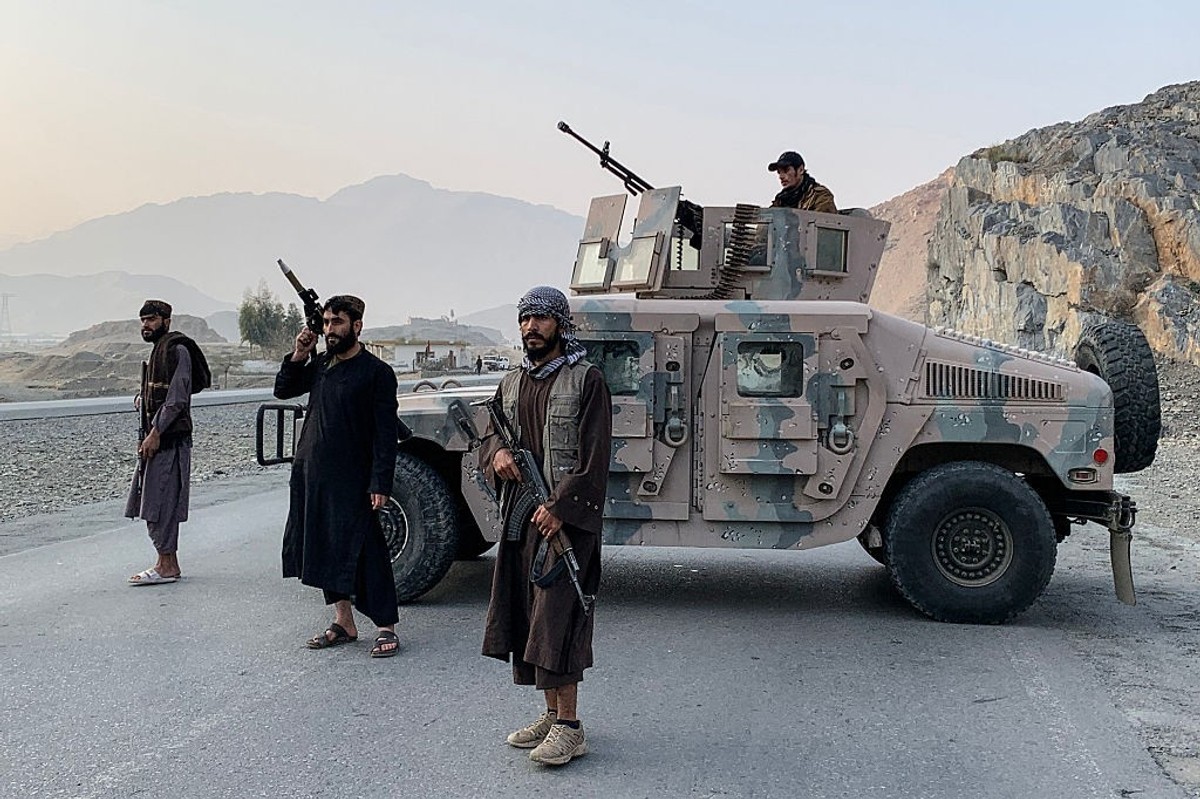


The collapse of Afghanistan in August 2021 is still widely interpreted as a military or political failure. That interpretation is incomplete.
Afghanistan collapsed because it lost the cognitive war long before it lost territory.
Inside the system, we did not face a simple insurgency. We faced a persistent contest over how reality was defined, how legitimacy was perceived, and how decisions were made. The Taliban did not defeat the Afghan state by force alone. Regional actors did not undermine it through proxies alone. The deeper failure was this: the Afghan state never fully aligned its political identity with the way its people understood themselves.
That misalignment became a vulnerability - and in the gray zone, vulnerabilities are not observed; they are exploited.
The Cognitive Gap at the Center of the State
Every state rests on an implicit agreement between its people and its institutions: a shared understanding of identity, legitimacy, and purpose. In Afghanistan, that agreement was never fully stabilized.
The modern state carried the name “Afghanistan,” historically associated with a specific ethnopolitical identity. Yet the lived reality of the country was far more complex-linguistically, culturally, and historically. For many citizens, identity was rooted not in the modern state construct, but in a deeper civilizational memory: Khurasan.
This was not nostalgia. It was cognition.
Khurasan represented a mental map that connected Herat to Nishapur, Balkh to Bukhara, Kabul to a wider intellectual and cultural ecosystem. It was inclusive, fluid, and expansive. Afghanistan, by contrast, became a bounded political construct, defined by borders drawn through imperial competition and reinforced through centralized power struggles.
This divergence created a cognitive gap: the state operated under one identity framework, while large parts of society operated under another.
In a stable environment, such gaps can be managed. In a contested environment - especially under gray zone pressure - they become strategic liabilities.
From Identity Misalignment to Decision Failure
Cognitive gaps do not remain abstract. They translate directly into how decisions are made.
Inside government, this misalignment manifested in three critical ways.
First, trust was fragmented. Decisions that should have been based on competence and mission effectiveness were filtered through identity, faction, and perceived alignment. This weakened institutions at their core.
Second, intelligence was politicized. When leadership does not share a stable understanding of the state it governs, intelligence becomes contested terrain. Information is not only collected - it is interpreted through competing lenses of identity and interest.
Third, legitimacy was shallow. Citizens interacted with the state, but many did not internalize it as fully their own. That distinction is decisive. A state that is not cognitively owned cannot be strategically defended.
These were not theoretical weaknesses. They shaped daily governance, security coordination, and strategic planning. And they created the conditions for external actors to operate with precision.
Gray Zone Exploitation: Attacking the Mind, Not the Border
Afghanistan became a textbook case of gray zone competition.
Regional actors did not need to defeat the state conventionally. They exploited its cognitive vulnerabilities.
Pakistan leveraged identity divisions through the Taliban, framing them as authentic defenders of religion and tradition. Iran used cultural and sectarian narratives to extend influence in parallel networks. Russia and China approached Afghanistan as a space of managed instability, where influence could be expanded without direct confrontation.
These were not isolated actions. They were coordinated forms of cognitive warfare - targeting how citizens perceived their state, their leadership, and their future.
As one senior U.S. official recently noted, modern adversaries are engaged in a “persistent, persuasive campaign of cognitive warfare… shaping how societies see reality, trust, and decide.”
Afghanistan was already vulnerable to such campaigns because its internal narrative was never fully consolidated.
The Taliban’s Cognitive Strategy
The Taliban’s success cannot be understood without recognizing its cognitive dimension.
They did not present themselves only as a fighting force. They presented themselves as a corrective identity, a return to authenticity, faith, and order. At the same time, they framed the Republic as externally imposed, corrupt, and disconnected from the society.
This narrative was not universally accepted. But it did not need to be. It only needed to create doubt.
Cognitive warfare is not about replacing reality. It is about degrading confidence in reality.
As trust in institutions eroded, as leadership appeared divided, and as international commitment became uncertain, the Taliban’s narrative gained relative strength. The battlefield shifted from territory to perception. By the time military collapse came, cognitive collapse had already taken place.
The Strategic Vacuum: Who Defines Khurasan?
One of the most dangerous developments today is the appropriation of the term “Khorasan” by extremist groups such as ISIS-K.
This is not accidental. It is strategic.
When legitimate actors fail to define identity, adversaries will weaponize it. ISIS-K uses “Khorasan” to project a mythical, apocalyptic narrative designed to attract recruits and legitimize violence.
This creates a second-order threat. Not only is the state weakened, but its deeper civilizational identity is being redefined by actors who reject its intellectual, cultural, and inclusive legacy.
In cognitive warfare, naming is power.
If Khurasan is defined by extremists, it becomes a tool of radicalization. If it is reclaimed as a civilizational identity rooted in knowledge, trade, and coexistence, it becomes a counterweight to both extremism and fragmentation.
The Failure of State-Building as Cognitive Strategy
The international intervention between 2001 and 2021 achieved significant tactical and developmental gains. But it failed to address the cognitive dimension of state-building.
Institutions were built. Capacity was developed. Elections were held. But the deeper question - how the state was understood and internalized by its people - was never fully resolved.
This produced a structural imbalance:
- A state that functioned administratively but not psychologically
- A security force that fought effectively but lacked a unified narrative
- A political system that operated formally but remained contested internally
In effect, we built a state without fully securing its cognitive foundation.
Toward Cognitive Realignment
Any future strategy for Afghanistan - and the broader region - must begin with cognitive realism.
First, policymakers must recognize that identity is not symbolic. It is operational. It shapes legitimacy, decision-making, and resilience under pressure.
Second, engagement must move beyond traditional state-building toward cognitive alignment. Governance structures must reflect the diversity and lived reality of the population, not impose narrow frameworks that generate resistance.
Third, investment in cognitive infrastructure is essential. Education, narrative development, and diaspora engagement are not secondary tools, they are central to long-term stability.
Fourth, the region must be reframed. Afghanistan should not be treated solely as a battlefield or buffer. Historically, as Khurasan, it functioned as a connector of regions, ideas, and economies. That perspective remains strategically relevant.
Conclusion: Stabilizing Meaning
The lesson of Afghanistan is not that state-building is impossible. It is that state-building without cognitive alignment is unsustainable.
For two decades, we focused on stabilizing territory, institutions, and security forces. We underestimated the importance of stabilizing meaning - how people understood the state, and whether they believed in it.
In modern competition, that is where advantage is decided.
The next battlefield is not territory. It is perception. It is cognition. It is the ability to shape how societies interpret reality and make decisions.
Afghanistan did not lose only because it was attacked. It lost because it could not fully define itself in a contested cognitive environment.
Reclaiming Khurasan, therefore, is not about returning to the past. It is about restoring a coherent, inclusive framework of identity that can withstand manipulation, resist fragmentation, and support legitimate governance.
Until that alignment is achieved, any political structure - no matter how well funded or defended - will remain vulnerable.
Because in the end, states do not collapse only when they lose control of land.
They collapse when they lose control of meaning.
The Cipher Brief is committed to publishing a range of perspectives on national security issues submitted by deeply experienced national security professionals. Opinions expressed are those of the author and do not represent the views or opinions of The Cipher Brief.
Have a perspective to share based on your experience in the national security field? Send it to Editor@thecipherbrief.com for publication consideration.
Read more expert-driven national security insights, perspective and analysis in The Cipher Brief