


As an Africa watcher, I have long told the story of two continents, juxtaposing the region’s plight with its opportunities, often arguing that the West should prepare for the continent's strategic risks and opportunities. This is a decades-old mantra from across the Africa-watcher community. Alas, repeating these arguments over decades suggests we must work to deliver our message in a more compelling way. So, this is my attempt to tell the story of African issues more visually, with the hope that experts in geopolitics will gain a greater appreciation for the stories from the continent that carry compelling US implications.
The Effectiveness of Maps
For nearly three decades, I have grappled with the most compelling way to hook a reader, whether at the CIA, the Department of Defense, the State Department, in the university classroom, or working with industry partners. One consistent reality is that a good graphic is optimal for making a story stick. And in my experience, the map is the king of graphics. Indeed, in the countless briefings I delivered as an intelligence officer, I brought one or more maps along every time. Similarly, I have used at least one map in every class meeting with my students. Maps orient the reader geographically, grant easy visual context, and ground a story in scale.
Orientation: A reader can best relate to a story when they can see where it is taking place
Context: A map can provide a reader with helpful, visual facts, whether through data or comparison
Scale: The size and value of a specific trait are easily observable on a map
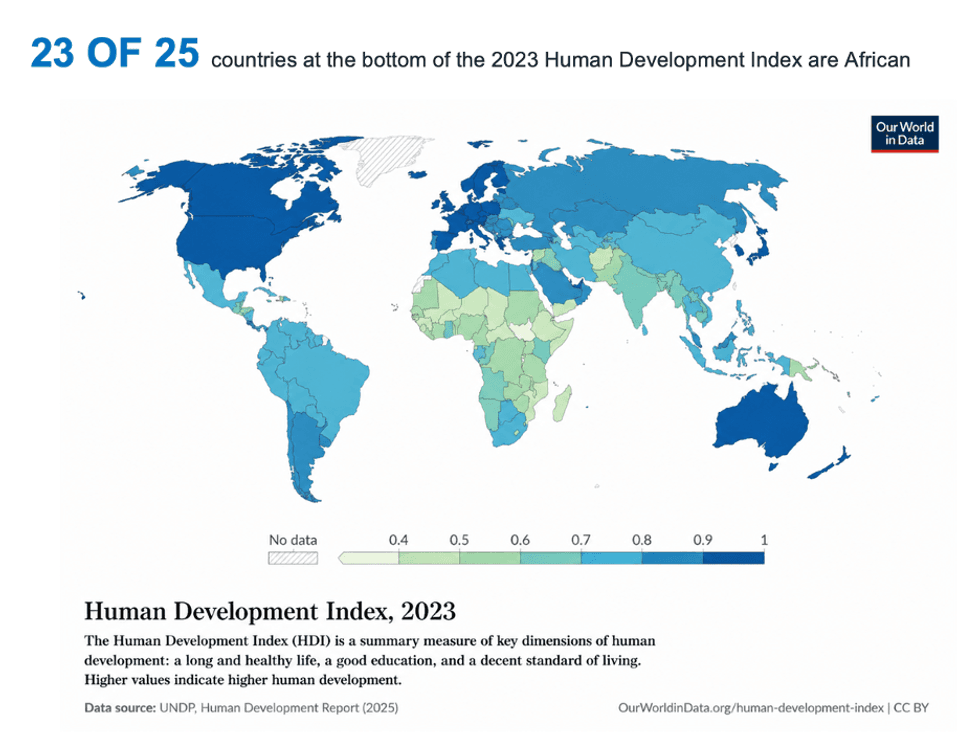
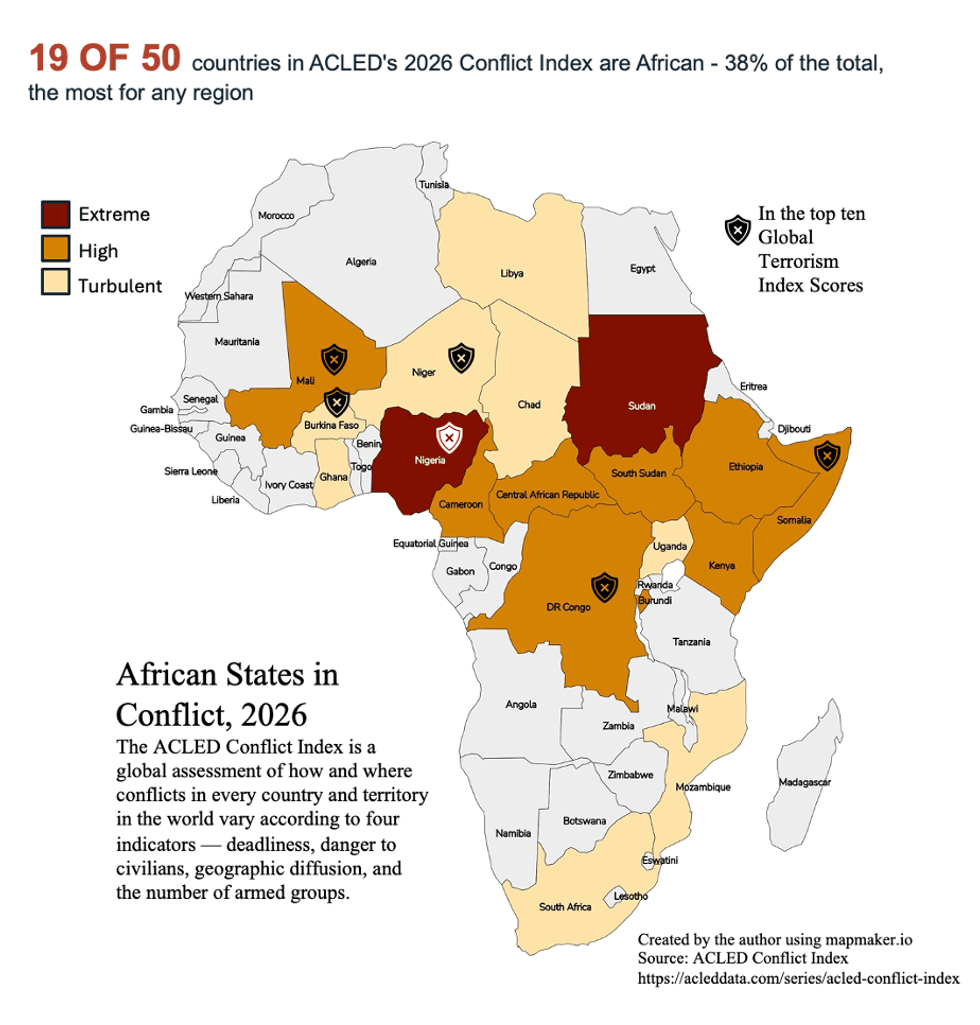
The Risk Side: Development Gaps and Conflict Reinforce Each Other
CRITICAL CONTEXT
Health
Poor healthcare infrastructure exacerbates communicable disease outbreaks, like Ebola in Congo in 2026 and West Africa in 2014, challenging global aid capacity.
Security
Lax development creates an environment ripe for extremism, creating a cycle where insecurity exacerbates underdevelopment that in turn fosters insecurity.
Geopolitics
Conflicts attract outside actors, creating a hotbed of geopolitical competition devoid of local interests and reducing African agency.
Why It Matters to Washington
Africa is the last entry in Washington’s National Security Strategy, reflecting a plan to allocate fewer resources to the continent, but Africa's crises often force unforeseen commitments. The Ebola outbreak in Congo underscores that weak health systems can turn outbreaks into global threats, compelling a US response. Insecurity due to extremist violence has prompted new and expanded US military action in Nigeria and Somalia, respectively. The continent leads the world in terrorist-related casualties, with more than half of global fatalities occurring in the Sahel, posing an enduring threat to greater African stability and attracting renewed US focus. This deepening malaise and Sudan’s civil war have become a magnet for regional and global competition, including increased intervention from Russia and China and adversarial action between US allies Saudi Arabia and the UAE.
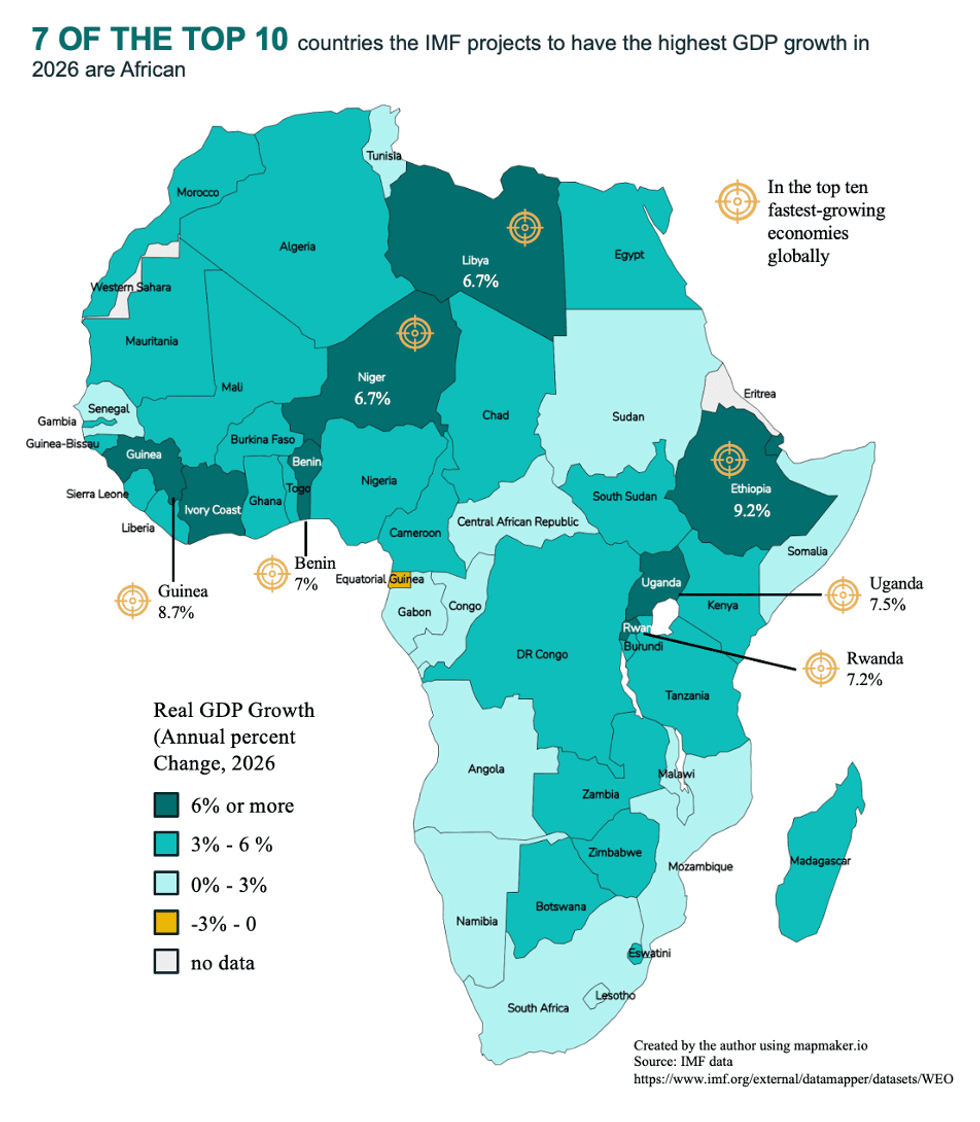
The Opportunity Side: Economic Growth and Demographics Are Standout
Strengths
CRITICAL CONTEXT
Growth Potential
Less developed countries have more room for economic growth. Africa has outperformed global growth by approximately 0.5 to 1.5 percentage points since 2000.
Imports
As economies and populations grow, so do imports. Africa is on track to outpace the rest of the world in merchandise import growth during 2026.
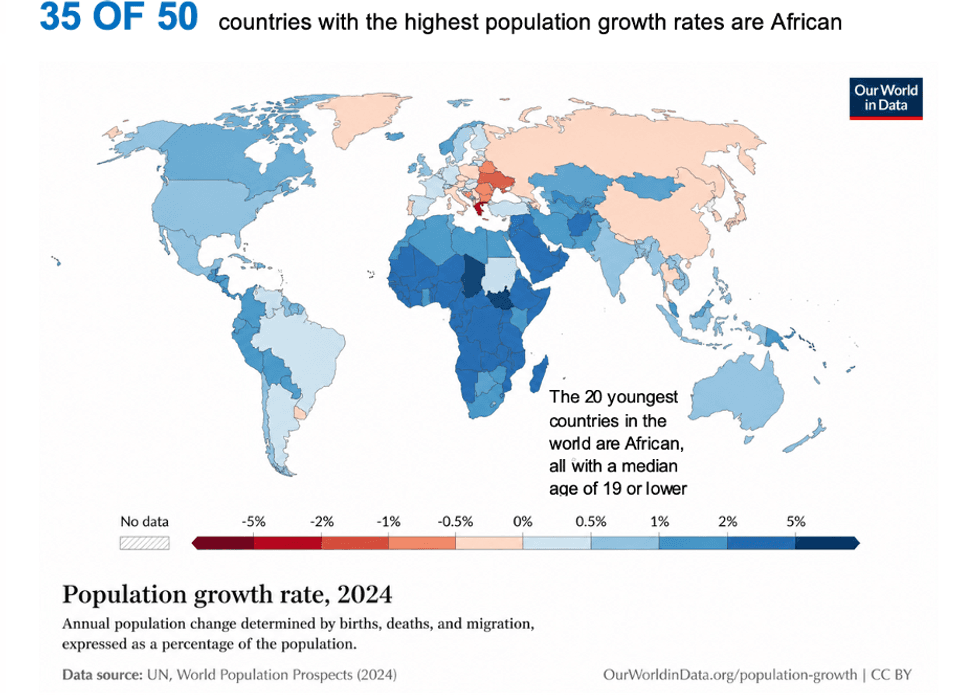
Workforce
Africans are the world’s future workforce. The OECD estimates that the continent’s working-age population (15-64 years old) will rise from about 850 million today to more than 1.5 billion in 2050, accounting for 85% of the global workforce increase.
Why It Matters to Washington
Africa’s GDP growth represents the high upside potential of the continent’s many comparatively less developed countries. Because African economies are not saturated, they have greater room to grow, making them attractive for investment gains. This coincides with the world's youngest population, which presents a range of reasons for outside nations to work with Africa, including circular migration deals for labor to sustain growth and to find markets for exports—60 countries are set to shrink in population this year alone, including economic juggernauts China, Germany, Japan, Italy, Russia, Spain, and South Korea.
- More pointedly for US implications, the country has been below the replacement fertility rate of 2.1 children per woman for nearly two decades (1.6 in 2024). Mexico, the top provider of immigrant workers to the US, has been below replacement fertility for about a decade (1.9 in 2024), suggesting Africa is positioned to serve as a sought-after source of workers.
- For example, Washington could leverage Kenya’s plan to broker agreements for 1 million of its citizens to work abroad annually. Nigeria is on track to surpass the US as the world’s third-largest country by population within the next three decades and will almost certainly have to find foreign destinations for its workforce.
- Canada stands out as having conspicuously higher population growth in North America, the result of purposeful legal migration, which is 3 times that of the US as a percentage of the overall population.
All statements of fact, opinion, or analysis expressed are those of the author and do not reflect the official positions or views of the U.S. Government. Nothing in the contents should be construed as asserting or implying U.S. Government authentication of information or endorsement of the author's views.
The Cipher Brief is committed to publishing a range of perspectives on national security issues submitted by deeply experienced national security professionals. Opinions expressed are those of the author and do not represent the views or opinions of The Cipher Brief.
Have a perspective to share based on your experience in the national security field? Send it to Editor@thecipherbrief.com for publication consideration.
Read more expert-driven national security insights, perspective and analysis in The Cipher Brief