

“After long and difficult negotiations with Senators, Congressmen, Secretaries, and other Political Representatives, I have determined that, for the Good of our Country, especially in these very troubled and dangerous times, our Military Budget for the year 2027 should not be $1 Trillion Dollars, but rather $1.5 Trillion Dollars. This will allow us to build the ‘Dream Military’ that we have long been entitled to and, more importantly, that will keep us SAFE and SECURE, regardless of foe.”
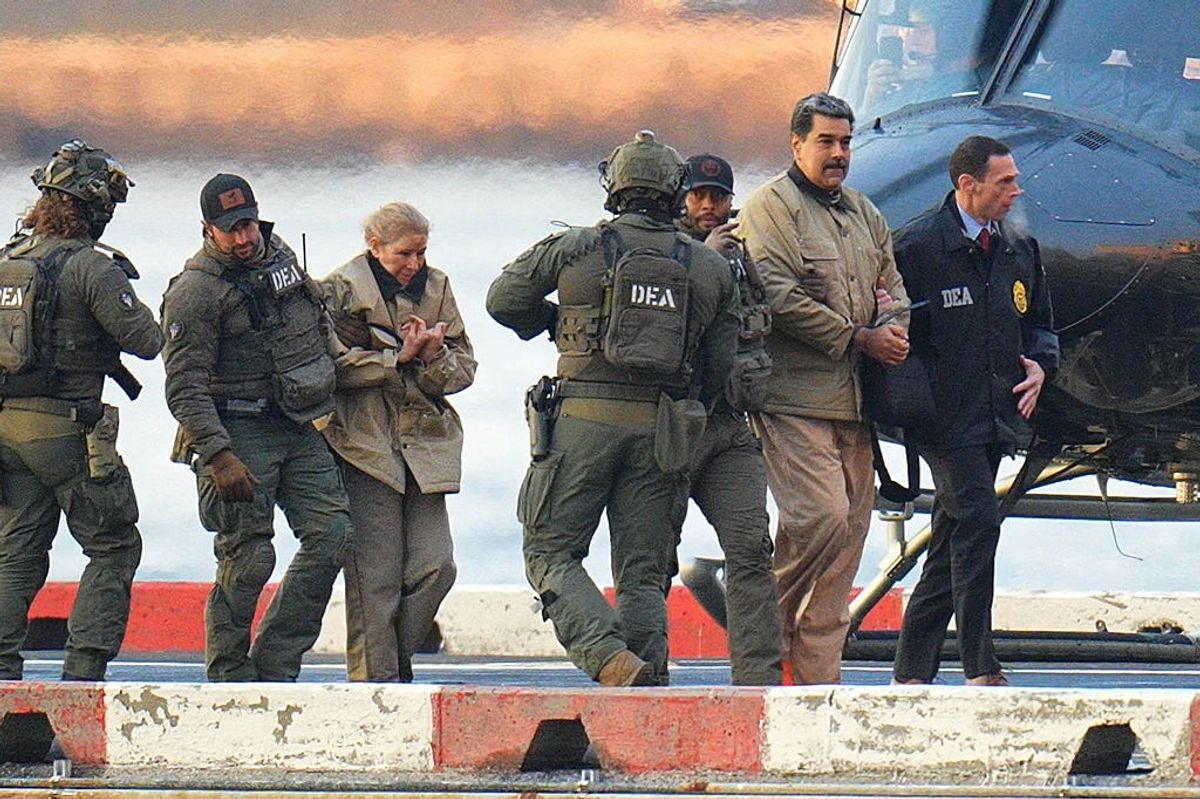
That was part of a Truth Social message from President Trump posted last Wednesday afternoon and illustrates the emphasis on increasing U.S. military power by him and top administration officials since the successful U.S. January 3, raid in Venezuela that captured its former-President Nicolas Maduro and his wife.
As it should, public attention has been focused on Trump’s apparent desire to project force as he publicly savors the plaudits arising from not only the Venezuela operation, but also the June 2025 Operation Midnight Hammer bombing of three Iranian nuclear facilities.
Most focus this past week has been paid to remarks Trump made to New York Times reporters during their more than two hour interview last Thursday.
At that time, when asked if there are any limits on his global powers, Trump said, "Yeah, there is one thing. My own morality. My own mind. It’s the only thing that can stop me.”
Trump added, “I don’t need international law. I’m not looking to hurt people.” Asked about whether his administration needed to abide by international law, Trump said, “I do,” but added, “it depends what your definition of international law is.”
Attention is also correctly being paid to remarks Trump’s Deputy Chief of Staff Stephen Miller made last Tuesday during an interview with CNN.
“We live in a world in which you can talk all you want about international niceties and everything else,” Miller told CNN’s Jake Tapper, “But we live in a world, in the real world … that is governed by strength, that is governed by force, that is governed by power. These are the iron laws of the world.”
It is against that Trump open-stress-on-power background that I will discuss below a few other incidents last week that could indicate future events. But first I want to explore Trump’s obsession with taking over Greenland, which was also illustrated during the Times interview.
The Cipher Brief brings expert-level context to national and global security stories. It’s never been more important to understand what’s happening in the world. Upgrade your access to exclusive content by becoming a subscriber.
In 1945, at the end of World War II fighting in Europe, the United States had 17 bases and military installations in Greenland with thousands of soldiers. Today, there is only one American base – U.S. Pituffik Space Base in northwest Greenland, formerly known as Thule Air Base.
From this base today some 200 U.S. Air Force and Space Force personnel, plus many more contractors, carry out ballistic missile early warnings, missile defense, and space surveillance missions supported by what the Space Force described as an “Upgraded Early Warning Radar weapon system.” That system includes “a phased-array radar that detects and reports attack assessments of sea-launched and intercontinental ballistic missile threats in support of [a worldwide U.S.] strategic missile warning and missile defense [system],” according to a Space Force press release.
The same radar also supports what Space Force said is “Space Domain Awareness by tracking and characterizing objects in orbit around the earth.”
Under the 1951 U.S.-Denmark defense agreement, the U.S., with Denmark’s assent, can create new “defense areas” in Greenland “necessary for the development of the defense of Greenland and the rest of the North Atlantic Treaty area, and which the Government of the Kingdom of Denmark is unable to establish and operate singlehanded.”
The agreement says further: “the Government of the United States of America, without compensation to the Government of the Kingdom of Denmark, shall be entitled within such defense area and the air spaces and waters adjacent thereto to improve and generally to fit the area for military use.”
That apparently is not enough freedom for President Trump, still a real estate man. As he explained last week to the Times reporters, “Ownership is very important, because that’s what I feel is psychologically needed for success. I think that ownership gives you a thing that you can’t do with, you’re talking about a lease or a treaty. Ownership gives you things and elements that you can’t get from just signing a document.”
This long-held Trump view that he must have Greenland was explored back in 2021. After his first term as President, Trump was interviewed by Susan Glasser and Peter Baker for the book they were writing, and they asked Trump at that time why he wanted Greenland.
Four years ago, Trump explained, “You take a look at a map. So I’m in real estate. I look at a [street] corner, I say, ‘I gotta get that store for the building that I’m building,’ et cetera. You know, it’s not that different. I love maps. And I always said, ‘Look at the size of this [Greenland], it’s massive, and that should be part of the United States.’ It’s not different from a real-estate deal. It’s just a little bit larger, to put it mildly.”
For all Trump’s repeated threats to seize Greenland militarily, it’s doubtful that will happen. Secretary of State Marco Rubio is scheduled to meet with Danish and Greenland counterparts this week, and afterwards the situation should become clearer.
Context is another test for analyzing Trump statements, and that seems to be the case when looking at his call for a $1.5 trillion fiscal 2027 defense budget.
Need a daily dose of reality on national and global security issues? Subscriber to The Cipher Brief’s Nightcap newsletter, delivering expert insights on today’s events – right to your inbox. Sign up for free today.
Last Wednesday, hours before Trump made his Truth Social FY 2027 budget statement, the White House released an Executive Order (EO) entitled, Prioritizing The Warfighter In Defense Contracting. The EO called for holding defense contractors accountable and targeted those who engaged in stock buybacks or issued dividends while “underperforming” on government contracts. According to one Washington firm, the Trump EO represented “one of the most aggressive federal interventions into corporate financial decisions in recent memory.”
The EO caused shares of defense stocks to fall. Lockheed Martin fell 4.8%, Northrop Grumman 5.5%, and General Dynamics 3.6% during that afternoon’s stock exchange trading in New York. After the stock market closed, Trump released his Truth Social message calling for the $1.5 trillion FY 2027 defense budget and the next day, January 8, defense stocks experienced a sharp rebound. Lockheed Martin rebounded with gains of around 7%; Northrop Grumman rose over 8%; and General Dynamics gained around 4%.
Trump has not spoken publicly about the $1.5 trillion for FY 2027, but in his first message, he said the added funds would come from tariffs. He wrote, “Because of tariffs and the tremendous income that they bring, amounts being generated, that would have been unthinkable in the past, we are able to easily hit the $1.5 trillion dollar number.”
If that were not enough, Trump added that the new funding would produce “an unparalleled military force, and having the ability to, at the same time, pay down debt, and likewise, pay a substantial dividend to moderate income patriots within our country!”
What can be believed?
The nonpartisan Committee for a Responsible Federal Budget (CRFB) said the $500 billion annual increase in defense spending would be nearly twice as much as the expected yearly tariff revenue, and the spending increase would push the national debt $5.8 trillion higher over the next decade. CRFB added, “Given the $175 billion appropriated to the defense budget under the [2025] One Big Beautiful Bill Act (OBBBA), there is little case for a near-term increase in military spending.”
I should point out that the FY 2026 $901 billion defense appropriations bill has yet to pass the Congress.
One more event from last week needing attention involves Venezuela.
Last Tuesday January 6, 2026, as Delcy Rodriguez, former Vice President, was sworn in as Venezuela's interim president, General Javier Marcano Tabata. the military officer closest to Maduro as his head of the presidential honor guard and director of the DGCIM, the Venezuelan military counterintelligence agency, was arrested and jailed, according to El Pais Caracas.
Marcano Tabata was labeled a traitor and accused of facilitating the kidnapping of Maduro by providing the U.S. with exactly where Maduro and First Lady Cilia Flores were sleeping, and identifying blind spots in the Cuban-Venezuelan security ring protecting them, according to El Pais Caracas.
What’s the U.S. responsibility toward Marcano Tabata if the El Pais Caracas facts are correct ?
I want to end this column with another Trump statement last week that stuck in my mind because of its implications.
It came up last Friday after Trump, in the White House East Room, started welcoming more than 20 oil and gas executives invited to discuss the situation in Venezuela.
“We have many others that were not able to get in…If we had a ballroom, we'd have over a thousand people. Everybody wanted. I never knew your industry was that big. I never knew you had that many people in your industry. But, here we are.”
Trump then paused, got up and turned to look through the glass door behind him that showed the excavation for the new ballroom saying, “I got to look at this myself. Wow. What a view…Take a look, you can see a very big foundation that's moving. We're ahead of schedule in the ballroom and under budget. It's going to be I don't think there'll be anything like it in the world, actually. I think it will be the best.”
He then said the remark I want to highlight, “The ballroom will seat many and it'll also take care of the inauguration with bulletproof glass-drone proof ceilings and everything else unfortunately that today you need.”
Who, other than Trump, would think that the next President of the United States would need to hold his inauguration indoors, inside the White House ballroom, with bullet-proof windows and a roof that protects from a drone attack?
The Cipher Brief is committed to publishing a range of perspectives on national security issues submitted by deeply experienced national security professionals. Opinions expressed are those of the author and do not represent the views or opinions of The Cipher Brief.
Have a perspective to share based on your experience in the national security field? Send it to Editor@thecipherbrief.com for publication consideration.
Read more expert-driven national security insights, perspective and analysis in The Cipher Brief, because national security is everyone’s business.