

China uses a layered approach in the South China Sea that blends military power, paramilitary forces, legal instruments, and political signaling. Beijing has asserted “historic rights” over most of the waterway in the past two decades or so, via the nine-dash line strategy. This strategy overlaps the exclusive economic zones (EEZs) of several Southeast Asian states. A 2016 international law tribunal convened under UNCLOS ruled overwhelmingly against these claims. However, China rejected the ruling and continues to behave as before, trying to assert de facto control in the area. This strategy is reinforced by the use of 'official maps', textbooks, and diplomatic statements aiming to slowly set down the notion that the territorial waters there are under a Chinese sphere.
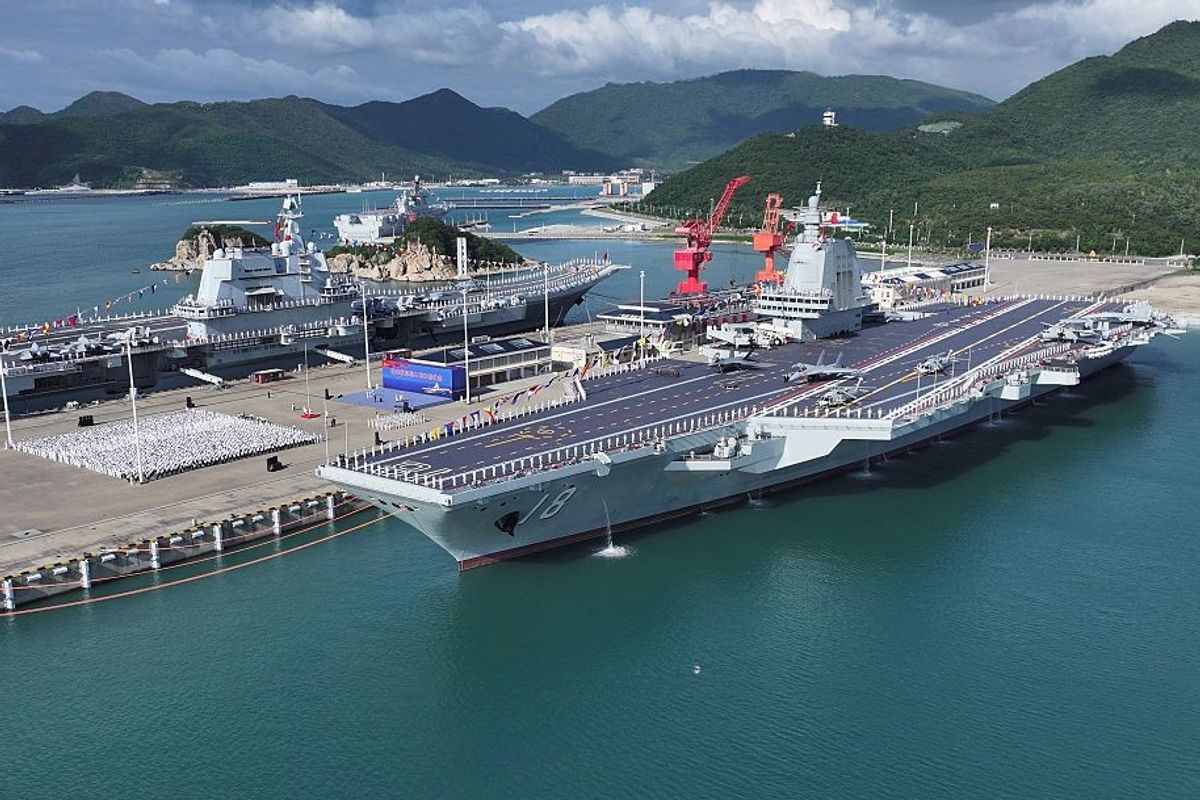
In the Spratly and Paracel Islands, China has transformed reefs since the early to mid 2010s into large artificial islands, where it constructs airfields, ports, radars, and missile sites, dramatically expanding China’s ability to monitor and, if necessary, contest and harass surface and air traffic across much of the South China Sea. They also serve as logistics hubs that support the constant presence of Coast Guard, navy, and militia vessels.
China is testing just how much military risk the United States is willing to face in order to protect its regional allies. Their primary target? The Philippines, an avid American ally in the region.
Chinese coercion directed at Manila is carried out daily not just by destroyers but by white-hulled Coast Guard ships and ostensibly civilian vessels organized as a maritime militia. These platforms ram, water-cannon, block, or sideswipe Philippine vessels and increasingly use tools like signal jamming and close-in maneuvers against Philippine resupply missions to Second Thomas Shoal and patrols near Scarborough Shoal. Actions are calibrated to be intimidating, sometimes injurious, but still below the threshold of what most governments would label “armed attack.”
These efforts go beyond short-term tactics. They are strategic in nature. China appears less focused on legal recognition than on practical control. If foreign militaries and commercial operators must factor in Chinese reactions for transiting, fishing, or exploration, Beijing achieves much of what formal sovereignty would deliver.
For Beijing, the South China Sea is part of the “near seas” in Chinese maritime doctrine, making it a defensive bastion that must be secured. But by employing artificial island bases and sending out to sea a number of maritime patrols, China seeks to disrupt American and allied activities in the South China Sea while advancing its own power projection further east and south, into the Pacific and Indian Oceans.
What national security news are you missing today? Get full access to your own national security daily brief by upgrading to Subscriber+Member status.
Control over “blue national territory” is tightly linked to Chinese Communist Party narratives of national rejuvenation. By standing firm in the South China Sea, it bolsters PRC leadership legitimacy and makes compromise politically costly internally. Essentially, Xi Jinping appears to be aiming for a Sino-centric maritime order in which neighboring states de facto - if not de jure at some point - accept Chinese rule as a fact of life and where outside powers operate only on terms that Beijing deems acceptable.
Washington’s declared aims in the South China Sea are the preservation of the freedom of navigation and overflight according to international law.
To achieve these goals the United States uses a combination of naval power, alliance creation and military capability development. The United States Navy ships often come close to Chinese-held land and other maritime areas that China or others claim illegally. It does the latter to demonstrate that America will not tolerate any of these claims. These are high-profile but relatively short-lived operations. The above policy is enforced by the U.S. 7th Fleet (based in Japan). There are also more bases throughout the region in partnership with the Philippines.
Big, complicated exercises and joint patrols with the Philippines, Japan, Australia and others build interoperability as well as signal that any serious conflict would not take place strictly on a bilateral basis.
American officials who point out to the 2016 decision, stress that disagreements must be settled in compliance with international law and publicly reiterate that the United States - Philippines Mutual Defense Treaty pertains to American armed forces, public ships or aircraft coming under attack in the South China Sea. This has been a more frequent trend in recent years.
Subscriber+Members get exclusive access to expert-driven briefings on the top national security issues we face today. Gain access to save your virtual seat now.
What the U.S. Should Do
The United States should embed U.S. presence in sensitive missions, when Manila consents. Instead of sending out stand-alone destroyer transits, the U.S. ought to incorporate freedom of navigation operations (FONOPs) as part of logistics missions or surveillance patrols and multilateral exercises. Publicly, Washington should continue to declare that significant attacks on Philippine government ships and aircraft comes under the Mutual Defense Treaty. The U.S. should reiterate privately to Chinese officials what responses it may evoke from the United States - economic sanctions, change in military posture, joint deployments - so that Chinese leaders know where they are headed if they keep these tactics up.
In addition to donating patrol boats, the United States and allies should also assist the Philippines and potentially other claimant states in fielding new coastal defense missiles, unmanned systems and integrated maritime domain awareness networks. Such instruments make it easier for frontline states to detect and respond to incursions with both greater speed and credibility.
China likes to negotiate one on one — and that’s when it has its own leverage. The United States needs to cultivate overlapping coalitions rather than a simple hub-and-spoke model. Institutionalize 'mini-lateral' groupings; U.S. - Japan - Philippines and U.S. - Australia - Philippines patrols, exercises, and intelligence-sharing agreements would make it more difficult for China to pressure any one state without having to face several others.
Communication links with Beijing such as political and operational hotlines should be tested to ensure they will work under stress. The aim is to be predictable and resolute, to minimize the chances that miscalculation leads to uncontrolled escalation.
The South China Sea has turned into a laboratory for the interaction among power, law and norms in an age of strategic contention. China’s use of maritime power looks to transform disputed waters into a zone over which China can make effective, if not legally exclusive, rules and enforce them through militarized outposts, continuous presence, and the narrative fiction of historical rights.
U.S. policy has preserved core principles - freedom of navigation and treaty commitments - but has not prevented Beijing from strengthening its position or normalizing gray-zone coercion. Washington’s task is not to contain China in absolutist terms, but to ensure that coercive changes to the status quo do not become the region’s operating default. That requires more concrete deterrence at key flashpoints, deeper empowerment of frontline states, and a denser web of regional cooperation - combined with realistic crisis planning to manage the risks that come with sustained great-power competition at sea.
The Cipher Brief is committed to publishing a range of perspectives on national security issues submitted by deeply experienced national security professionals.
Opinions expressed are those of the author and do not represent the views or opinions of The Cipher Brief.
Have a perspective to share based on your experience in the national security field? Send it to Editor@thecipherbrief.com for publication consideration.
Read more expert-driven national security insights, perspective and analysis in The Cipher Brief, because national security is everyone’s business.