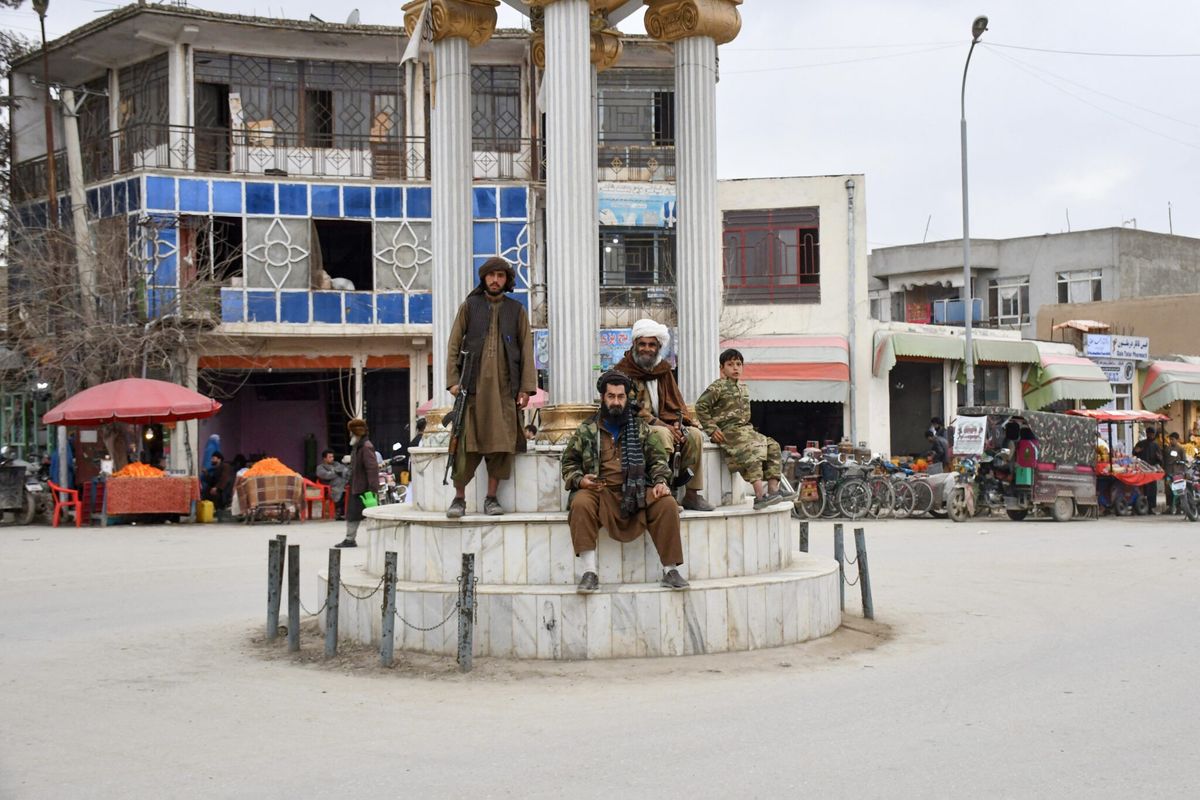


The rifts among Taliban factions had been growing for some time, bubbling up as the deception over their leader’s death continued.
They boiled over last month - not by accident - on the eve of a second round of peace talks, forcing the Taliban to acknowledge that its supreme commander and religious leader, Mullah Muhammad Omar, was indeed dead.
The end to this deception has unleashed an internal power struggle in the Taliban that threatens to weaken a movement already divided over negotiating with the Afghan government. At the same time, it could be clarifying some significant issues, forcing the question of peace and compelling Afghan President Ashraf Ghani to confront Pakistan’s support for the insurgency. If Pakistani support is curtailed, the Taliban could be even further diminished.
“As the Taliban were persuaded to sit down at the talks, everybody knew this was going to cause some splintering,” said Graeme Smith, a senior analyst with the International Crisis Group, who was reached in Kabul. “I don’t think anybody understood the splintering would be this profound.”
In the aftermath of the revelation of Omar’s death, the pace of events has been rapid. His de-facto deputy Mullah Akhtar Muhammad Mansur quickly was named the new Taliban leader and religious commander, prompting a walkout by opponents. Sirajuddin Haqqani - whose father Jalaluddin Haqqani is chief of the closely allied Haqqani network and is also rumored to be dead - was named Mansur’s deputy.
Some opponents of Mansur threw their support behind Omar’s 27-year-old son Yaqub - unknown to many outsiders. It’s unclear whether recent reports that Yaqub was assassinated are true.
What is clear is that Omar represented a powerful centralizing force in the Taliban network, something Mansur is struggling to replicate, said Thomas Johnson, a professor in the Department of National Security Affairs at the Naval Postgraduate School.
“We know the election of Mansur completely split the Taliban leadership,” Johnson said. Johnson also mentioned that there are indications that the Taliban leadership was already weakened and has not had control over commanders in the field for years. Leaders were further split over peace efforts.
“It’s going to take a while for the dust to settle,” Johnson said. “Mansur is trying to shore up some of the splits in the Taliban. I think he recognizes that the big winner could eventually be ISIL. They could pick up a lot of commanders if Mansur doesn’t play his cards right.”
On Thursday, Al-Qaeda leader Ayman al-Zawahiri pledged his support to Mansur in an audio message posted online, bolstering Mansur’s leadership.
Meanwhile a spate of bombings and complex attacks this month in Kabul has left more than 55 people dead and hundreds wounded. Three of the attacks took place in a 24-hour period on Aug. 7, among the worst days of civilian casualties in the capital since 2001.
The Taliban claimed responsibility for several of the attacks, including an Aug. 10 bombing in a crowded checkpoint area outside Kabul International Airport that killed five people. The group said it was targeting “foreign forces.”
The attacks, coming so quickly after the revelations of Omar’s death, could have been planned already. They could also have been a show of force by Mansur directed at some of the more discouraged Taliban forces, said James Dobbins, a former U.S. Ambassador and Special Representative for Afghanistan and Pakistan and now a senior fellow and distinguished chair in diplomacy and security at the RAND Corporation.
“They may be read as him establishing his credentials,” Dobbins said. “They may well have been intended as signals that the war will go on and thus an effort to rally the troops who may have been demoralized by the passing of their leader.”
Mansur postponed the second round of peace talks, raising questions about how sustainable the process was. There are doubts the Taliban would accept anything but the re-establishment of an Islamic emirate in Afghanistan. And the Qatar-based Taliban leadership - which is supposed to be its diplomatic office - did not partake in the talks.
If the movement does break apart, dialogue will be difficult.
“He was the Scotch tape holding things together,” said Shuja Nawaz, a distinguished fellow at the Atlantic Council’s South Asia Center and an expert on the region. “It’s always easier to deal with a single group than more disparate groups.”
Dobbins and others say the fact that the Taliban was persuaded to come to the table likely raised so many questions among its troops that Mansur had little choice but to finally reveal Omar’s death.
Still, Dobbins said, Taliban leaders and the Afghan government sitting across the table from each other - along with generals from the Pakistani intelligence service ISI, U.S. and Chinese representatives - should not be understated. The process “will be a difficult long term effort, requiring probably years of talks to lead to substantial results,” he said. But this was a significant first step, making it easier for them to do it again.
“I think momentum has been lost,” he added. “I don’t think that means the process has been irretrievably stalled. But I don’t expect it to resume in the near future. I think the Taliban leadership needs to regroup.”
Following Monday’s airport attack, President Ghani lashed out in unequivocal terms at Pakistan for giving support to the Taliban and allowing Taliban sanctuaries in Pakistan.
“We hoped for peace, but war is declared against us from Pakistani territory,” he said. “This in fact puts into display a clear hostility against a neighboring country.”
It was a much harder line for Ghani, who had pressed for Pakistan-sponsored talks and is now calling for negotiations initiated only through Afghanistan. Still, Ghani sent a delegation to Islamabad in mid August, suggesting that, although angry, he was not shutting down lines of communications.
American military officials also voice a deep distrust of Pakistan’s motives, saying it is riding both sides of the fence - on the one hand, pressing the Taliban to come to the table, but on the other, continuing to give the network sanctuary and support.
“Guessing why the Pakistanis do what they do is a risky game; they are perfidious, unscrupulous, immoral,” said U.S. Army Col. Robert Cassidy, a military professor at the U.S. Naval War College and a former advisor to the top U.S. operations commander in Afghanistan. “Pakistan may exhibit intention to cooperate more. Nevertheless, the sanctuary and support from Pakistan provides the insurgency the ability to act.”
Without that influence, he said “the Taliban leadership will wither.”
“It is a strategic stalemate and it’s probably not going to go away until something propels Pakistan to stop,” he said.
U.S. Army Chief Ray Odierno said recently that he saw the Pakistanis doing some “good work against the Taliban.” Nawaz said the chief of the Pakistan Army had overseen significant efforts to chase the Taliban out of North Waziristan. But others read into this that Pakistan is not so much changing, as trying to fight its own insurgency, while balancing support for the Afghanistan Taliban.
This is a critical period, Nawaz said. Pakistan faces internal threats, and it is also realizing that Afghanistan could disintegrate once U.S. and NATO forces leave at the end of 2016. That would further threaten Pakistan. The momentum under the current leadership in both Afghanistan and Pakistan should not be lost, he said.
“There is an opportunity for both Afghanistan and Pakistan to realize how dependent they are on each other,” Nawaz said. “The sooner the conversation is restarted, the better.”
Another issue to look at, said Smith, is funding for the development of the Afghan security forces, which has dropped from $12 billion to $5.5 billion. If donor countries tighten their purses further, it could give the Taliban an enormous boost, he said.
Whether or not Pakistan can bring the Taliban back to the table will be telling, Smith said.
“I think it’s already forcing people to lay down their cards,” Smith said of the current turmoil.
“If Mansur and Siraj are back at the negotiating table with ISI generals and a negotiating team, it will be clear that Pakistan has the influence to effect a cease fire,” he said. “This is the moment we find out.”
Dianna Cahn is a staff writer for the Virginian-Pilot.