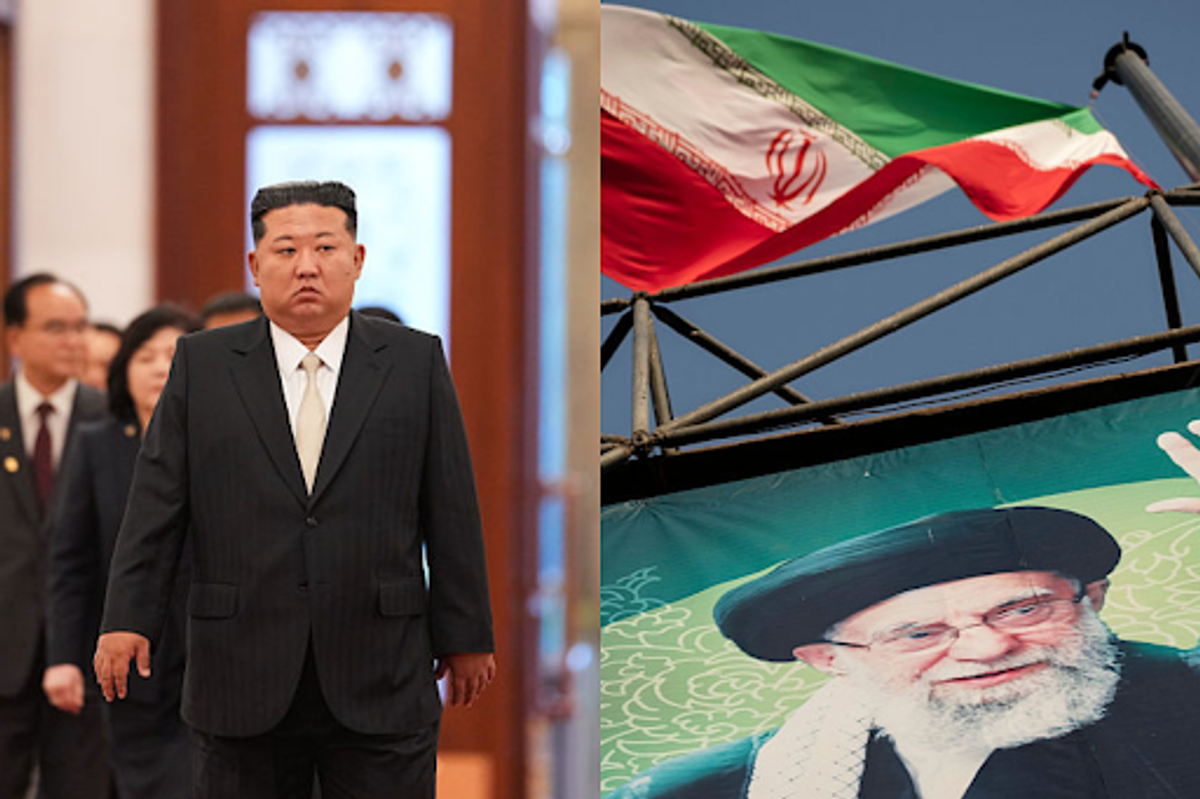


South Korea’s Korea Institute for Defense Analysis recently publicly stated that we underestimated North Korea’s nuclear weapons program. According to their analysis, North Korea has between 127 and 150 nuclear weapons (not 50 to 60 nuclear weapons), and by 2030 they will have 200 nuclear weapons, reaching 400 nuclear weapons by 2040.
At the eighth Central Committee of the Workers’ Congress in late 2022, North Korean leader Kim Jong Un ordered the exponential expansion of North Korea's nuclear arsenal and the development of a more powerful intercontinental ballistic missile. Mr. Kim reportedly said: “They are now keen on isolating and stifling North Korea…and the prevailing situation calls for redoubled efforts to overwhelmingly beef up our military muscle.”
During this six-day meeting of the Central Committee, Mr. Kim not only called for an “exponential increase in North Korea’s nuclear arsenal”, but he also called for the mass production of battlefield tactical nuclear weapons targeting South Korea, and a new ICBM with a “quick nuclear counterstrike capability; a weapon that could strike the mainland U.S.”
North Korean leaders usually say what they plan to do. Indeed, this is the case with Mr. Kim. Not only has he apparently done this with his arsenal of nuclear weapons, but in October 2025, at the parade celebrating the 80th anniversary of the Korean Workers’ Party, the Hwasong-20, a solid fuel, mobile three stage ICBM capable of targeting the whole of the U.S., was introduced to the international community. The Hwasong-20 possibly could also be capable of launching multiple nuclear warheads at different targets, a capability that would challenge any missile defense system. So, the arsenal of ICBMs that could strike the U.S. – Hwasong-18 and 19 – has also grown exponentially with the Hwasong-20, as Mr. Kim said in 2022.
North Korea has also been working on its submarine program, to include a nuclear-powered submarine. This is in addition to its extensive work on hypersonic and cruise missiles, all representing a challenge to any missile defense system.
North Korea is also developing a second-strike capability, with programs to ensure the survivability of some of North Korea’s nuclear weapons and the progress North Korea has made with solid-fuel mobile ICBMs and nuclear-armed submarines, providing a mobile launch platform. Moreover, North Korea’s doctrine for the use of nuclear weapons has changed to a preemptive, first use of nuclear weapons if a nuclear attack against the leadership or command and control systems is imminent or perceived to be imminent.
The Cipher Brief brings expert-level context to national and global security stories. It’s never been more important to understand what’s happening in the world. Upgrade your access to exclusive content by becoming a subscriber.
Russian President Vladimir visited Pyongyang in June 2024, when he and Mr. Kim signed a mutual defense treaty, part of a “Strategic Comprehensive Partnership” between Russia and North Korea, ratified in November 2024. Article 4 of the treaty states that should either nation “put in a state of war by an armed invasion, the other will provide military and other assistance with all means in its possession without delay”
In October 2024, NATO claimed North Korean soldiers arrived in Russian Kursk Oblast to join Russian forces in its war of aggression with Ukraine. Additionally, North Korea was providing Russia with artillery shells and ballistic missiles. That assistance to Russia continues.
In return, it’s likely that in addition to energy and food assistance, Russia is providing North Korea with assistance with its satellite and ballistic missile programs and, also, with its nuclear program. Indeed, Russia could help with North Korea’s nuclear-powered submarine program, especially with the design, materials and components for such a technically challenging program.
North Korea’s mutual defense treaty with Russia, and its participation in the war with Ukraine, was a major failing of the U.S. and South Korea. We should have seen movement in this direction and did more to prevent it from happening. Of course, there is irony in Russia now saying North Korea should have nuclear weapons when in the Six Party Talks with North Korea, Russia, with China, Japan, South Korea and the U.S., was in sync arguing that North Korea should not have nuclear weapons.
North Korea’s nuclear and ballistic missile programs are an existential threat to the U.S. and its allies. Our past policy to “contain and deter” North Korea and to be “strategically patient” with North Korea didn’t work. They failed, as evidenced by North Korea’s robust nuclear and ballistic missile programs and their allied relationship with Russia – and China. Indeed, efforts should be made by the leadership in the U.S. and South Korea to get Mr. Kim to reengage, especially with President Donald Trump.
As South Korean President Lee Jae Myung said, North and South Korea are in a “very dangerous situation” where an accidental clash is possible at any time.
This column by Cipher Brief Expert Ambassador Joseph DeTrani was first published in The Washington Times
Read more expert-driven national security insights, perspective and analysis in The Cipher Brief because National Security is Everyone’s Business.