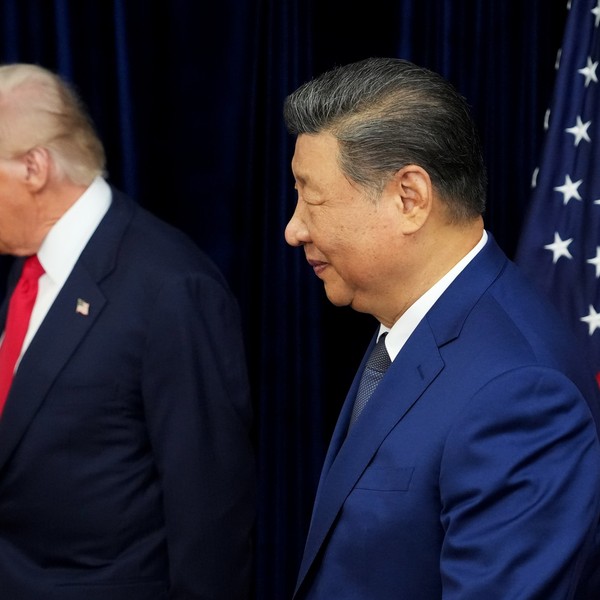

The historic “G-3” meeting in Shenzhen, China provided a fascinating glimpse into the world of great leader diplomacy. President Trump, the charismatic, was working hard to use his charm on the other two leaders. President Xi, the Machiavellian, used his talent as a methodical orchestrator of major events to demonstrate that he now has the power to convene a Yalta-like meeting. Putin got to restore his place at the superpower summit but, in several ways, had to pragmatically accept third place. Through orchestrated events, Xi made sure that Trump saw Putin as dependent on Xi’s goodwill. All three understood the world was riveted to the meeting and that they were sending a combined signal that superpower supremacy is alive and well.
Putin asked for this meeting. Both the U.S. and Chinese Presidents were somewhat reluctant and had very different ideas about its content. Putin has been characterized as the leader of a former superpower, at best running third behind the Chinese and American giants. He undoubtedly hopes that the three-way summit demonstrates he is back in the exclusive superpower club. One victory for Putin was the sentence in the joint statement released after the meeting that, “The three heads of state recognized that the principle of state consent and respect for immunities of State officials are of paramount importance and concurred that the International Criminal Court and other similar bodies must not abuse their jurisdiction.” This was a shared rebuke of the March 17, 2023, ICC arrest warrant for Putin over alleged war crimes in Ukraine. By common consent among the three most powerful leaders on earth, the ICC’s pretensions could be ignored.
Putin also sought to use the occasion to drive a wedge between Washington and Kyiv and make Ukrainian President Volodymyr Zelensky, who is already wary of Trump’s posture on a peace deal, even more unsure of his international support. In his autobiography, Putin described his job while working for the KGB as a case officer as: “I was a specialist in human relations.” The Russian president certainly has the cool self-possession, analytic objectivity, and interpersonal insight needed to be a “specialist in human behavior.” Empathy, not so much.
The most effective case officers combine high authentic empathy with equally committed chronic mistrust; it makes them paradoxical and very interesting people. In the case of Putin, the mistrust takes the form of aloofness and cold calculation. As was noticeable at APEC, he lacks warmth, except for his chosen circle of intimates and his affinity for animals of every kind, with which he shares unusual rapport.
Xi Jinping orchestrated both the APEC summit and the trilateral to enhance both his international and domestic standings. Xi sent the signal that China is now the equal of the United States, and in this, President Trump accommodated his Chinese counterpart by showing Xi (and therefore China) a level of unprecedented respect, a sharing of equals. If there is a pair of co-equals at the apex of power, it is always useful to have an aspirant to the summit (or former equal who has slid down the slope) by way of shining more glory on the two at the top. Xi not-so-subtly sent a signal that Russia is a step down, welcomed but secondary in the Trump and Xi dynamic. Xi met Trump at the airport but did not for Putin. He sent another member of the Politburo Standing Committee, who was perhaps by design an unusually tall Chinese man who towered over the diminutive Putin in the photo. Xi is famously touchy about his height so the significance in highlighting Putin’s stature relative to the other two leaders makes interesting theater in the domain of “human relations,” to quote Putin. Notably, a mere retired foreign ministry official was sent to the airport to greet the Japanese Prime Minister, leaving no doubt about the state of deep tensions between China and Japan.
Along the same lines, at the grand APEC banquet, Xi and Trump were seated side by side, but Putin sat between Xi’s wife and the President of Indonesia. Trump may well have been gratified at this public, if unspoken, demonstration that his co-equal status with Xi remains undisputed and that he will not be expected to “rehabilitate” Putin (or Russia’s) status at the expense of his own prestige. Putin maintained his flat imperturbable façade, though we must be wary of the Russian President’s seemingly robotic demeanor, because, in contrast to Xi, Putin’s passions run deep as seen in his conduct in doubling down on the war in Ukraine. All of this was calibrated to “rehabilitate” Putin while not at the same time siphoning power and prestige away from the duo in charge.
We have previously written about Xi Jinping and Donald Trump and how their personalities might create opportunities alongside very real danger. We characterized Xi as a steely, introverted Machiavellian, and Trump as an extrovert and singularly gifted charismatic. Machiavellians such as Xi – and Putin -- are detached, controlled, and ever watchful, orchestrating future action with precision and an uncanny attention to details that others might miss, or not know how to manipulate (such as sending a tall official to greet the short and physically prideful Russian leader).
In many ways, this was a three-way meeting akin to a conclave of seasoned and conflict hardened mafia dons. They share the same philosophy of power and ruthlessness in deploying it to further their political agendas. We can expect them to test, push, jockey and guard their supremacy and expect this from each other as a matter of respect. But these are three aging mafia dons. They have all entered the “Lion in Winter” phase of life -- or more accurately, they are at the stage of leadership where the dominant Eagle, Dragon, or Bear feels the press of time eroding their protean powers and are fully aware that the days of their youthful elan, boundless energy and vitality, and eventually their hold on the future are over, or soon to be over. Still, at present, all three remain incredibly powerful and have the capability to shape world events, either cooperatively or through uglier means as seen in each of their domestic choices in Ukraine, in Western China, and on the U.S. domestic immigration issues.
At present, if they desire, they have the collective power to end the Ukraine War and probably force Iran to make concessions that end that conflict. The hope is that, as they look to their personal legacies – thinking of how history will write the final chapter phase of their tenures before the torch moved on or was seized by younger aspirants to the summits of political power – Presidents Trump, Xi, and Putin will find a way to make positive contributions to world peace. Trump has laid down a marker on nuclear arms control that is laudable. He admits that this is tough but like Reagan and Gorbachev these leaders might surprise us.
All statements of fact, opinion, or analysis expressed are those of the author and do not reflect the official positions or views of the US Government. Nothing in the contents should be construed as asserting or implying US Government authentication of information or endorsement of the author's views.
The Cipher Brief is committed to publishing a range of perspectives on national security issues submitted by deeply experienced national security professionals. Opinions expressed are those of the author and do not represent the views or opinions of The Cipher Brief.
Have a perspective to share based on your experience in the national security field? Send it to Editor@thecipherbrief.com for publication consideration.
Read more expert-driven national security insights, perspective and analysis in The Cipher Brief