


For US allies, the combination of geopolitics, ever-expanding risk surface and an unsustainable dependence on hyperscale cloud providers has created significant excitement about the potential value of AI data centers and sovereign digital infrastructure. Many of those nations and critical infrastructure owners are now starting to realize that the token, not the data centre, is the atomic unit of AI value. Whoever prices the token actually controls the economics and value creation of every AI-dependent industry irrespective of sovereign cloud, data center or AI factory.
This growing realization will require a material shift in sovereign policy and capability development for those nations combined with short-term patience and recalibration from US partners. The shift will result in both greater sovereign benefit and a more productive, resilient Western Alliance for all.
Why Sovereign Infrastructure Means Little Without Controlling Tokens, Intelligence & Equity
Most Sovereign AI Frameworks are consistent in identifying common levers for success:
-Digital Infrastructure
-Skills and Talent
-Research, development and innovation RDI
-Industry development and commercialisation
-Governance and Equity
Having spent the last 15+ years helping allied nations design their compute, AI and security capabilities, I believe that the rapidly escalating global demand for sovereign digital infrastructure does starts to address where compute is controlled, however, it does little to solve what that compute costs and how value is created and equitably distributed.
Given that whomever prices the token, controls the economics and value creation of every AI-dependent industry irrespective of sovereign infrastructure, nations should treat token supply the way they treat energy supply - as a strategic reserve requiring stockpiles, contracts and dedicated domestic production capacity. It’s sadly ironic that some of these same nations most vocal about sovereign digital infrastructure have been less than diligent in developing and maintaining energy security.
The Rapidly Evolving Discipline of Tokenomics
While many leaders still think of LLMs in terms of infrastructure (more requests require more compute and therefore cost more), the reality is more complex. Users and use cases can create vastly different types of requests which have highly varied infrastructure and cost implications.
The smallest current production unit for LLMs are tokens – a fundamental unit of data that an AI model reads, generates or uses equating to roughly 4 characters per token. Over the last 3 years inference costs have reportedly fallen roughly 1,000-fold, with inference now accounting for two-thirds of all AI compute demand.
By any normal utility logic, falling unit prices should mean smaller monthly bills for users, however new models are both more token-intensive at increased prices while usage has skyrocketed, leading many to consume their entire annual AI and tech budgets in only a matter of months. This seems clear proof of Jevons Paradox where decreased unit cost is significantly outweighed by material and accelerating increase in use.
In addition, recent BCG research indicates that only 5% of their clients interviewed are creating substantial and sustainable value from AI.
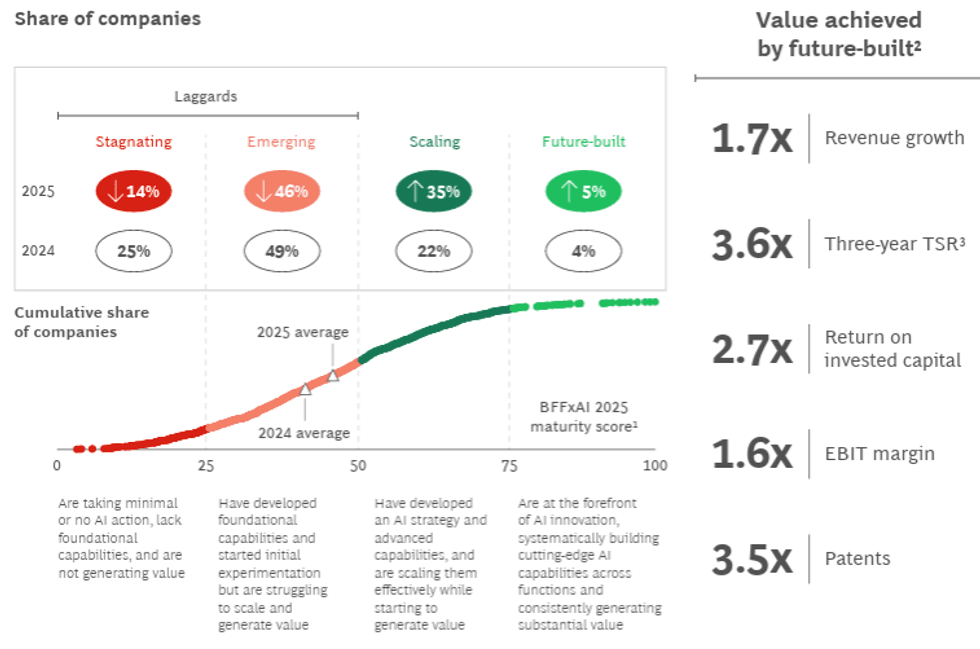 BCG Build for the Future 2025 Global Study (n = 1,250).
Government and enterprise leaders have now seen more than enough exemplars and representative AI use cases – demand is accelerating to show a true return on investment “ROI” for those programs, which fundamentally means an ROI on token usage.
This discipline of financial accountability to AI use and governance has earned the name of “Tokenomics”, meaning the demand for ROI during a period of increased usage, risk and associated costs has created a triple whammy for policy makers, regulators and users.
Sovereign Clouds, Rented Intelligence & Lost Value.
What does all of this mean for a nation state, alliance or critical infrastructure owner?
While an esteemed British colleague and I recently considered the Sovereignty 2.0 cloud and data center location and legal control aspects for the World Economic Forum, we didn’t answer the pricing question ie. who sets the cost and terms of the thing produced (token) running on that stack which dictates the sustainable value proposition?
This is the sovereignty risk the digital infrastructure debate has largely missed but we expect to rapidly evolve over coming months.
A nation can host its own data centre, run its own hyperscaler partnerships, satisfy every metric in a Cloud, Data Center or AI Sovereignty Framework BUT still be entirely price-taking on the tokens flowing through it without a dedicated available reserve if, or when, the supply chain is disrupted. The subsidy era of new foundation models is coming to an end with Anthropic's 2026 enterprise pricing shift the most public example of consumption growth outpacing cost declines. Operational control of the rack means little if the marginal cost of intelligence itself is set outside of a sovereign legal and commercial jurisdiction.
Perhaps even more sobering are the concerns of US and allied intelligence communities that the increased costs of token usage are causing critical public and private sector users to move to highly capable “open weight” models predominantly developed and sourced outside of the trusted Western alliance. This week’s launch of the Moonshot Kimi K3 with comparable capability to recent Anthropic and OpenAI versions has further entrenched the systemic risk.
Greater independence of allied sovereign objectives at the infrastructure AND intelligence layers may require a shift for some policy makers, agencies and technology vendors, however, the strategic value from greater trust, intelligence, innovation and resilience would be significant.
Closing the Tokenomics Gap
While rightfully asserting digital sovereignty, America’s allies must stop treating sovereign compute and intelligence as a real estate problem and start treating it as a strategic commodity problem similar to the way we manage oil, grain or semiconductors.
That creates some meaningful challenges from both policy and practice perspectives:
-Create a national token reserve/s via prebuilt capacity insulating critical government and infrastructure workloads from price and availability shocks the way strategic petroleum reserves insulate against supply shocks
-Mandate transparent token cost disclosure in critical-sector procurement, so cost-per-outcome (not cost-per-CPU/GPU) becomes the sovereignty metric regulators actually score. “Commercial in confidence” wont be good enough for an agentic world.
-Create an active domestic AI model routing capability, so government workloads can shift between frontier and commodity models rather than being locked to a single provider's pricing curve.
-Plan for AI inference at the edge – while large urban Data Centers take up the headlines and capital, it won’t necessarily be how we consume and create value domestically and across the alliance.
-Demand a social license of all who participate – many nations have exported a significant portion of the value created during the internet era to hyper-scale foreign companies and demanded little in return other than occasional headlines about “strategic investment”. New strategies and structures must be created where the value created of this agentic token-driven world accrue directly to the communities that use them and not to be reallocated or misspent as a new form of taxation. Oil-driven Sovereign Wealth Funds may provide an effective blueprint fit for the Agentic Age.
A token reserve is the logical and necessary next stage for Sovereign AI
None of these policies replace the need for sovereign digital infrastructure. As token prices fall but total AI spend climbs, the value to nation states deriving from infrastructure alone is incomplete and does not achieve multiple core objectives. Nations that control where compute resides but not what tokens cost and deliver will remain intelligence and price-takers in the AI economy. For America’s partners, a sovereign token reserve is the next necessary step toward genuine digital autonomy and an even stronger Western Alliance.
The Cipher Brief is committed to publishing a range of perspectives on national security issues submitted by deeply experienced national security professionals. Opinions expressed are those of the author and do not represent the views or opinions of The Cipher Brief.
Have a perspective to share based on your experience in the national security field? Send it to Editor@thecipherbrief.com for publication consideration.
Read more expert-driven national security insights, perspective and analysis in The Cipher Brief