



"All of them point to a very serious increase in the capabilities of [North Korea] in the area of nuclear weapons production," the IAEA Inspector General Rafael Grossi said during a mid-April visit to Seoul.
The new enrichment facility would be North Korea’s second and allow Pyongyang to grow an arsenal already estimated at 50 nuclear warheads. Experts say the regime has made strides on the delivery side as well – with new intercontinental ballistic missiles (ICBMs) and launch systems. Just five days after Grossi’s statements, North Korea carried out a series of ballistic missile tests.
Victor Cha, the CSIS Korea Chair, said the recent developments reflect a core ambition of North Korean leader Kim Jong Un: to match the capability of some of the world’s major nuclear powers.
“Kim Jong Un intends to develop a modern nuclear weapons arsenal the size of France or the United Kingdom, each of which has over 200 nuclear weapons,” Cha, who served as deputy head of the U.S. delegation at the Six-Party Talks with North Korea, wrote in Foreign Affairs. “And he is well on his way…North Korea has blown past even the most pessimistic predictions.”
The North’s latest nuclear muscle-flexing comes as the U.S. wrestles with a major piece of unfinished business in its war against Iran – the future of that country’s enrichment facilities and stocks of uranium. Some experts worry that the Iran war is drawing attention away from North Korea.
“Now North Korea is not just in possession of the nuclear capability – it is becoming more of a nuclear weapons state, and they can use those weapons against us and our allies,” Joseph DeTrani, who was the U.S. Special Envoy for the Six-Party Talks, told The Cipher Brief.
“People may see Iran as very hostile because they say the U.S. is the enemy,” DeTrani added. “Well, the North Koreans say the U.S. is the enemy too – that’s in their constitution – and I fear that we’ve become very complacent with North Korea.”
A race for more weapons
The new enrichment facility at Yongbon has been under construction for more than a year; satellite imagery analysis by the CSIS showed signs of work at the site as early as mid-December 2024.
On March 2 of this year, Grossi told the IAEA’s Board of Governors that the “the new building is externally complete, and internal fitting is likely underway,” and in early April, the CSIS said new imagery “shows the facility essentially complete, including a probable standby generator, administration/engineering support, and vehicle shed buildings.”
Experts aren’t certain that the facility is operational, but they say that when it is, it will boost the North’s production of enriched uranium and ultimately its stocks of nuclear weapons as well. According to the Stockholm International Peace Research Institute, the North’s arsenal is estimated at 50 nuclear warheads, with enough fissile material to produce up to 40 more.
“They will have more fissile material than ever with this new facility,” DeTrani said. “And so they will likely be producing more nuclear weapons than ever before.”
Beyond Pyongyang’s push for more weapons, there have been other worrying signs.
On April 19, North Korea launched five short-range ballistic missiles armed with cluster munitions against an island target in the Sea of Japan. It was the second test-firing of delivery systems in less than a month. According to North Korean state media, Kim Jong Un and his daughter – who many analysts believe is his heir apparent – supervised the launches in person.
Cha says that North Korea has developed nearly 20 different delivery systems, including long-range ICBMs that can reach targets in the United States. According to the CSIS and others, the regime is also pursuing ballistic missiles that can be launched from nuclear submarines.
Then there is the Russia factor. Not long ago, China was the North’s chief ally and lone supplier of military and financial support; in 2024, Russia sought North Korean help for its war against Ukraine, and the resulting agreement has given Russia thousands of North Korean troops and supplies of ammunition and ballistic missiles, in exchange for technological help for the North’s nuclear program.
“They are learning things from the Russians – that’s another great fear,” John Parachini, Senior International and Defense researcher at RAND, told The Cipher Brief. “They’ve provided weaponry and blood to Russia and I’m sure they’ve gotten something in exchange for it.”
DeTrani warned of a dangerous and unprecedented combination: North Korea’s growing arsenal of weapons, its improved delivery systems, and the burgeoning technical assistance from Russia.
“This is exponentially a different equation when it comes to North Korea and their nuclear weapons program,” he said.
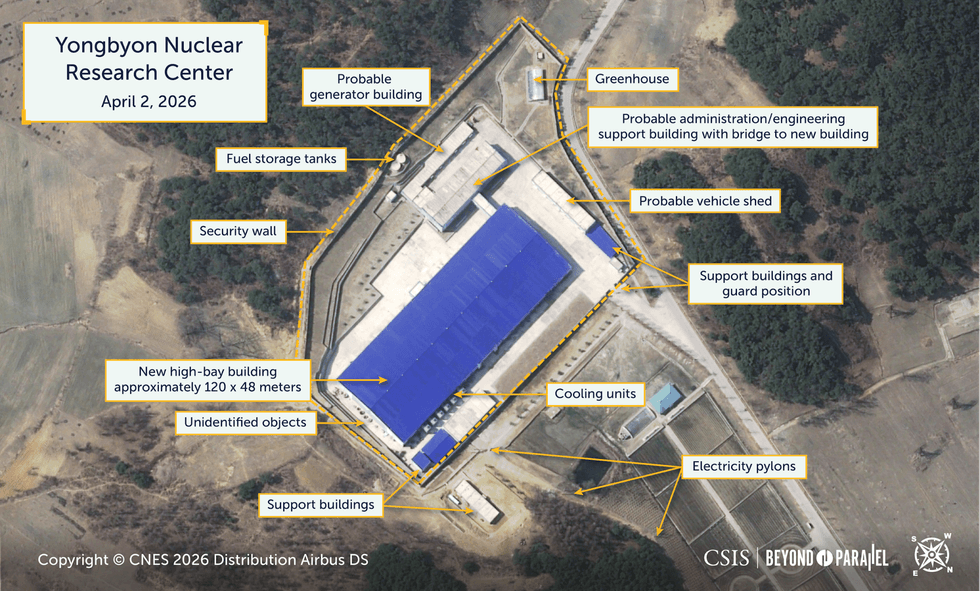 Close-up image of the new building at Yongbyon, April 2, 2026. Copyright © CNES 2026, Distribution Airbus DS. Image may not be republished without permission. Please contact imagery@csis.org.
Kim’s long game
North Korea’s latest moves follow a series of pledges to scale up its nuclear capabilities.
In 2023, Pyongyang ordered an “exponential” expansion of its arsenal – effectively a shift from developing and testing existing weapons to creating more of them. A CSIS study of statements from North Korea’s news agency between 1998 and 2023 documented a shift from defense (i.e., keeping a nuclear stockpile to maintain deterrence) to offense (the potential use of nuclear weapons during a war). And in a speech to his parliament last month, Kim declared the country “will continue to consolidate our absolutely irreversible status as a nuclear power.”
As Treston Wheat, chief geopolitical officer at Insight Forward, told The Cipher Brief in November, North Korea has evolved to “a maturing nuclear war fighting state,” with doctrine “trending toward first-use options in extreme regime-threat scenarios.”
Experts say Kim’s strategy is based on the belief that a nuclear arsenal helps guarantee his regime’s survival – and that the U.S.-Israeli war against Iran has buttressed that belief.
This is exclusive Subscriber+Member content.
During the first weeks of the war, Kim boasted that North Korea had been able to resist outside pressure and avoid enemy attacks – and that this validated his refusal to make major concessions at the negotiating table.
“The present situation clearly proves,” Kim said, “how just the strategic option and decision of our state were in rejecting the enemy’s cajolery and perpetuating our nuclear possession.”
“He’s basically saying, we made the right decision to not dismantle, and not denuclearize,” DeTrani said of Kim’s statement. “We made the right decision to keep our nuclear weapons program, and we definitely made the right decision to enhance those capabilities and build more nuclear weapons and delivery systems. We weren’t fooled by the sweet talk, mainly from the United States.”
“The U.S. war on Iran confirms what North Koreans have thought since the bombing of Libya, the invasion of Iraq, and indeed all the way back to the Korean War,” said Yonsei University Professor and Korea expert John DeLury. “Having a nuke is perhaps the only way to prevent being attacked by the United States.”
Recent U.S. dealings with Iran and North Korea support that notion. In the case of Iran, President Trump launched a war with the stated aim of ensuring that the country never obtains a nuclear weapon; in the case of North Korea, Trump held three summits with Kim Jong Un during his first term and has spoken positively since then about their relationship.
“If you’re Kim, and you look at what happened to Iran…Kim is saying to himself that I have really safeguarded my country and I have safeguarded my regime,” Parachini said. “With that nuclear capability, he has survival as I believe he sees it.”
Wanted: Out-of-the-box ideas
Ever since the North first produced a nuclear weapon (in 1994, according to the CIA), U.S. strategy has hinged on a single word: denuclearization. As Cha notes, “American negotiators dealing with North Korea have repeated the same mantra: ‘With denuclearization, all things are possible. Without denuclearization, nothing is possible.’” That has been the approach, more or less, over seven American administrations – a blend of carrots and sticks that has offered humanitarian and other financial aid to Pyongyang in exchange for incremental concessions, while imposing increasingly heavier sanctions for noncompliance.
Experts say that while the strategy has produced occasional “wins” – a freeze on reactor operations, declarations of nuclear inventory, and pledges to pursue denuclearization – these have proved temporary at best. And the North has reneged on every promise to scale back its arsenal.
If anything, experts say Pyongyang may be in a better position now than it was during President Trump’s first term.
“They are in a different space now, because of their military capabilities, their nuclear capability and now they’ve got Russia as their backer,” Parachini said. “They have an ability to reject everything that’s put forward until there’s real fundamental change.”
For all these reasons, experts say the time has come for a recalibration.
“The size and sophistication of North Korea’s nuclear arsenal today shows that these approaches have failed,” Cha said. “No prior combination of hardline measures and incentives has worked.”
Cha and other experts argue that the U.S. should no longer insist on complete and verifiable denuclearization. Instead, they say, the aim should be for lower-threshold concessions.
Everyone needs a good nightcap. Ours happens to come in the form of a M-F newsletter that keeps you up to speed on national security. Sign up today.
“There is, in my view, no longer a negotiated path to denuclearization,” DeLury said. “If the United States and South Korea want to reengage in diplomacy and find a modus vivendi with North Korea, it will have to be done on the basis of the [North] being a nuclear armed state. No amount of sanctions will convince Kim otherwise, and arguably the coercive pressure only gives motivation and rationale for further improvements to the nuclear weapons program. A radical change in policy is needed.”
DeTrani agrees. “We have to change the paradigm,” he said. “What can we offer North Korea? What can we give to North Korea that’s important for Kim Jong Un that would entice him to look at possibly freezing his nuclear weapons program? Stop talking about giving up nuclear weapons – they’re not giving up their nuclear weapons.”
What might a new paradigm look like? Some ideas mirror Cold War-era policies that reduced the risk of U.S.-Soviet confrontation: a graduated lifting of sanctions in exchange for a freeze on uranium enrichment, a halt to nuclear testing, and limits on missile production or testing; a strengthening of multilateral deterrence – in this case with Japan and South Korea; and new communications hotlines and other crisis management mechanisms (Parachini noted that early in his career he had operated the so-called “MOLINK” between Moscow and Washington – a hotline established in 1963 to keep regular communication flowing between the Cold War capitals).
“Let’s talk about arms control with the North Koreans,” DeTrani said. “And make clear: if you stop these things, here’s what we can do for you.”
Among more out-of-the-box ideas, Cha says the U.S. military presence in South Korea could be included in future negotiations. Pyongyang has made no secret of its wish for an end to that deployment – which today numbers 28,500 – and while Cha doesn’t suggest withdrawing all the troops, or doing so simply to appease Pyongyang, he notes that the U.S. has already encouraged South Korea to increase its defense spending and assume more of the burden of defending the peninsula. In other words, if some of the American forces may be coming home anyhow, the U.S. could include the drawdown as part of an incentive package for the North.
Parachini went so far as to suggest that the U.S. pursue a peace treaty and the establishing of diplomatic relations. “It’s kind of a Nixon-goes-to-Beijing move, it’s doing the unlikely, it’s doing the unconventional, it’s taking a big risk,” he said. “But I think that would at least begin to change the dynamic, because that’s what the North Koreans want – and I think what the South Koreans want is stability.”
And while none of the experts believe military action is a viable response – as Cha put it, “North Korea is not Iran: it is a proven nuclear weapons state that could retaliate against the United States and its allies” – they all suggested a bulking up of missile defenses and other deterrent capabilities with Japan and South Korea, and a clear message to Pyongyang that any nuclear strike would bring a devastating response.
“The world would be a safer place if North Korea shed its nuclear weapons,” Cha said. “But getting it to give up its arsenal is simply not within reach any time soon, and proceeding as if it would be detrimental to national security. The best strategy for avoiding a hot war with a nuclear North Korea is to preserve a cold peace.”
The Cipher Brief is committed to publishing a range of perspectives on national security issues submitted by deeply experienced national security professionals. Opinions expressed are those of the author and do not represent the views or opinions of The Cipher Brief.
Have a perspective to share based on your experience in the national security field? Send it to Editor@thecipherbrief.com for publication consideration.
Read more expert-driven national security insights, perspective and analysis in The Cipher Brief