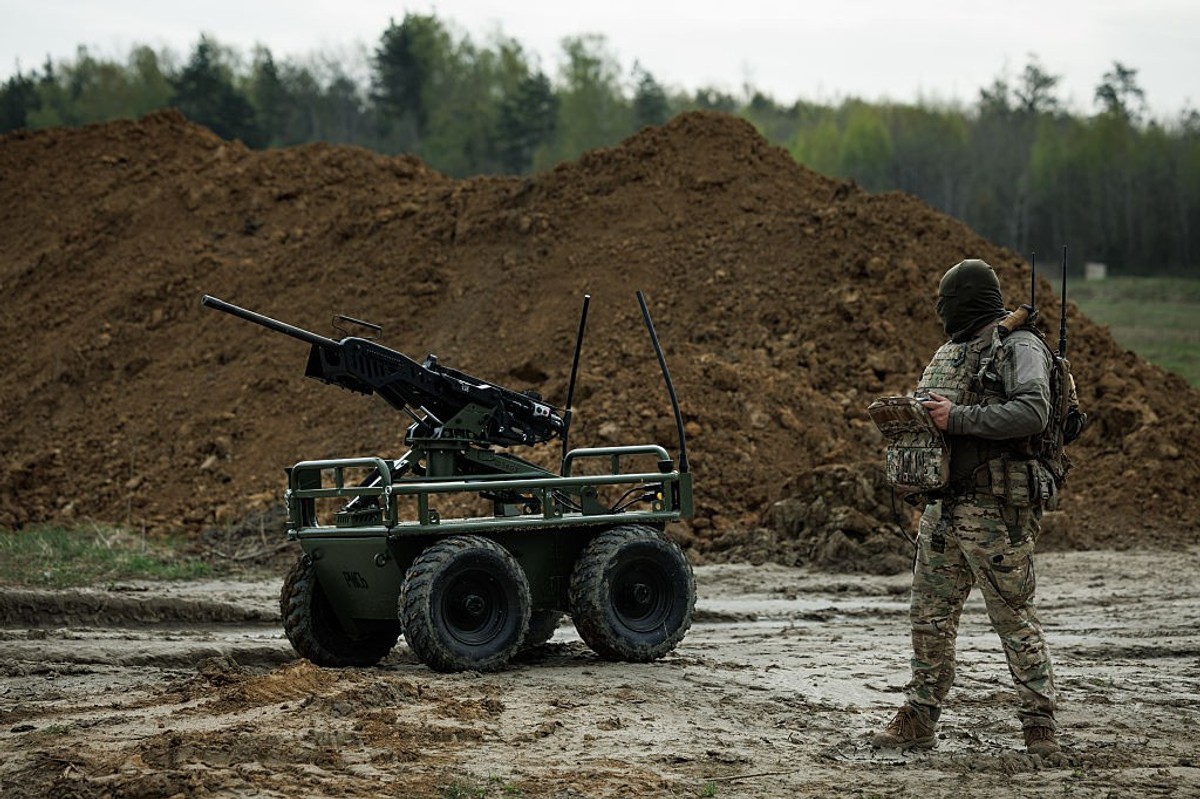


Washington made three decisions this week, and none of them has an end date. On the night of October 14, Ukrainian units in the field found that their Starshield terminals had been capped at a speed, 160 kilometers an hour by the published figure, 70 by President Zelensky's account two days later, which cuts off any strike drone that flies faster than the cap. Reuters reported, citing American and Western officials, that the order came from inside the White House; a senior official said the President had made no such request. Service was reported partly restored by October 15. No terms were ever published. The restriction followed a week in which American negotiators had warned Kyiv that intelligence sharing could be suspended if strikes on Russian energy targets continued, and in which the President announced an "energy ceasefire," which President Zelensky said was "news for me." Ukraine paused its refinery campaign for three days. On October 15, Zelensky told the Financial Times, "We're done," and that morning Rosneft's Ryazan refinery burned. The same day, CNN reported that Ukraine had run out of Patriot interceptors.
Two days later, on Friday afternoon, the President signed an executive order implementing the sanctions act passed by Congress in September. Its second section imposes what the law required by October 18: a 500 percent duty on Russian goods and a 100 percent duty on goods from any country that continues buying Russian crude or gas. Its fourth section waives both, along with eleven other sections of the act, until the President or the Secretary of State decides otherwise. The order names no country, mentions no fuel, and sets no date. The White House said enforcement now "would impede" the search for peace. Diesel in the United States stood at $6.33 a gallon on Saturday, higher than on the day the Russian diesel license was issued.
Last week, in these pages, I argued that no single authority in Washington was charged with weighing the sanctions against the price of fuel, and that whichever claim had the nearest deadline would win. This week, the President himself weighed the claims, and the ranking is visible in the two documents: the diesel license and the peace track outranked the statute, and the ally's campaign was slowed to protect them. Washington gave the peace track as its reason for the first and denied ordering the second. Whatever each was meant to do, both eased the pressure on Moscow in the weeks before November 3. That is a decision, and it bound the only party it could reach, the ally. It is also the week's lesson, because of what it did not contain.
It contained no horizon. The waiver has no end date. The throttle has no published terms. The diesel license runs through April. Each can be reversed by the same hand on any morning, which means none of them bind the party across the table; they inform him. Moscow learned that a license and a telephone call can buy a pause in the campaign against its refineries. Beijing, which must decide by November 10 whether to extend the suspension of its rare-earth licensing rules for American buyers, learned the price at which American pressure lifts, a month before the President arrives in Shenzhen. New Delhi, the act's principal target, received a waiver that asks nothing of it. And every ally that fights on an American-controlled communications or targeting layer learned that the layer can be set to a speed, without announcement, and that the setting is deniable. The European Union's foreign policy chief said the following day that Europe cannot replace Starshield in the short term.
The parties for whom the pressure was built spent the week waiting. Russia's first licensed diesel cargo, 40,000 tons loaded at Primorsk, sailed for Morocco. The volumes could not have moved the American price in any case: the 300,000 tons promised "immediately" are less than a day of American consumption. Tehran kept the American counterproposal under review and held to its sequence, the strait first and enrichment after, while flows through Hormuz ran at 11.6 million barrels a day, down from a pre-war 17.2, and a Singapore-flagged container ship sank, its port authority confirmed, after being struck. The International Energy Agency reported the world's oil stocks 509 million barrels below their pre-war level and agreed on Thursday to release what remains of the barrels pledged in March. Economic warfare is now being fought on two clocks. The West's runs to its elections and its inventories. The other side's runs to neither.
There is precedent for winning a contest of this kind, and it was won by time rather than force. In June 1948, the Soviet Union closed the roads and railways to West Berlin. The Western allies responded with an airlift. The blockade was lifted on May 12, 1949, after eleven months, not because the aircraft had defeated anything, but because Moscow concluded that the West could hold its position longer than Moscow could sustain the blockade. The instrument that prevailed was the horizon, and the West had shown it could keep it.
The remedy I named last week, a single authority to rank competing claims, turns out to be necessary but not sufficient. The authority existed this week and used itself. What it lacked was a commitment that outlasts the next election: a stated date and condition under which the pressure lifts, a provision of fuel and interceptors that carries the country to that date, and an officer beneath the President charged with holding the ranking when the price of diesel argues for changing it. In practice that is a sunset clause: the waiver expires on a date unless the President certifies to Congress why it should not. A sanction without a horizon is a disclosure. A satellite link without published terms is a lever on the ally rather than the adversary.
If you advise on these instruments, the decision you owe this quarter is a horizon. Before the next sanction is signed, the next license issued, or the next allied system switched on, put the date in the document: the condition under which the pressure ends, the provision that carries you there, and the office that holds the line until it arrives. The side that can wait chooses the day. This week, it was not ours.
Richard Berry is the founder and principal of Stratnova Advisors and a former Senior Executive who led the Commander's Action Group at U.S. Indo-Pacific Command; he publishes the weekly assessment Strategic Horizons.
The Cipher Brief is committed to publishing a range of perspectives on national security issues submitted by deeply experienced national security professionals. Opinions expressed are those of the author and do not represent the views or opinions of The Cipher Brief.
Have a perspective to share based on your experience in the national security field? Send it to Editor@thecipherbrief.com for publication consideration.
Read more expert-driven national security insights, perspective and analysis in The Cipher Brief