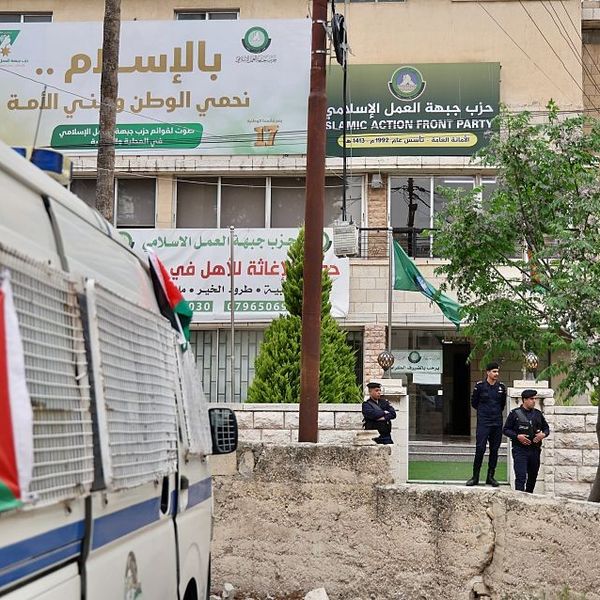


The White House this past November issued a Presidential action statement designating certain Muslim Brotherhood “chapters” as terrorist organizations. On Tuesday, the U.S. State Department and U.S. Treasury Department announced the designations of the Lebanese, Jordanian, and Egyptian chapters of the Muslim Brotherhood as terrorist organizations. The Egyptian and Jordanian chapters received a Specially Designated Global Terrorist (SDGT) designation. The Lebanese chapter received both the SDGT designation and a Foreign Terrorist Organization (FTO) designation.
In the spring of 2019, Washington, responding to mounting pressure by Egyptian President Abdel Fattah al-Sisi, decided to brand the Egyptian Muslim Brotherhood (MB) a terrorist organization. There was no mention of “chapters” outside Egypt.
Having followed the MB and interviewed many of its members for years during my government service, I published an article in 2019 questioning the underlying assumptions of the plan. This article is a revised version of my 2019 piece.
I argued in the 2019 piece that the administration’s decision at the time did not reflect a deep knowledge of the origins of the Muslim Brotherhood and its connection to Muslim societies and political Islam.
In the fall of 2025, the leaders of the United Arab Republic, Jordan, Bahrain, and Lebanon pressured the administration to label the MB a terrorist group.
The Cipher Brief brings expert-level context to national and global security stories. It’s never been more important to understand what’s happening in the world. Upgrade your access to exclusive content by becoming a subscriber.
Context
The Egyptian Muslim Brotherhood was founded by schoolteacher Hassan al-Banna in 1928 in response to two fundamental realities: First, Egypt was under the influence of British colonialism embodied in the massive British military presence near the Suez Canal. Second, under the influence of the pro-Western corrupt monarchy lead first by King Fuad and later by his son King Faruk, the MB’s founder believed that Muslim Egypt was drifting away from Islam. Egypt of course is the home of Al-Azhar University, the oldest Muslim academic center of learning in the world.
In addition, Al-Azhar University represents the philosophical and theological thought of the three major Schools of Jurisprudence in Sunni Islam—the Hanafi, the Maliki, and the Shafi’i Schools. The fourth and smallest School of Jurisprudence—the Hanbali—is embodied in the Wahhabi-Salafi doctrine and is prevalent in Saudi Arabia.
Al-Banna’s two founding principles were: a) Islam is the solution to society’s ills (“Islam hua al-Hal”), and b) Islam is a combination of Faith (Din), Society (Dunya) and State (Dawla). He believed, correctly for the most part, that these principles, especially the three Arabic Ds, underpin all Sunni Muslim societies, other than perhaps the adherents of the Hanbali School.
In the past 98 years, the Muslim Brotherhood has undergone different reiterations from eschewing politics to accepting the authority of Muslim rulers to declaring war against some of them to participating in the political process through elections.
Certain MB thinkers and leaders over the past nine decades, including the Egyptian Sayyid Qutb, the Syrian Muhammad Surur, and the Palestinian Abdullah Azzam, adopted a radical violent view of Islamic jihad and either allied themselves with some Wahhabi clerics in Saudi Arabia or joined al-Qa’ida. The organization itself generally stayed away from violent jihad. Consequently, it would make sense to label certain leaders or certain actions as terrorist but not the entire group or the different Islamic political parties in several countries.
Need a daily dose of reality on national and global security issues? Subscriber to The Cipher Brief’s Nightcap newsletter, delivering expert insights on today’s events – right to your inbox. Sign up for free today.
In the early 1990s, the Egyptian MB rejected political violence and declared its support for peaceful gradual political change through elections, and in fact participated in several national elections. While Islamic Sunni parties in different countries adopted the basic theological organizing principles of the MB on the role of Islam in society, they were not “chapters” of the MB.
They are free standing Islamic political groups and movements, legally registered in their countries, which often focus on economic, health, and social issues of concern to their communities. They are not tied to the MB in command, control, or operations.
Examples of these Sunni Islamic political parties include the AKP in Turkey, the Islamic Action Front in Jordan, Justice and Development in Morocco, al-Nahda in Tunisia, the Islamic Constitutional Movement in Kuwait, the Islamic Movement (RA’AM) in Israel, PAS in Malaysia, PKS in Indonesia, the Islamic Party in Kenya, and the National Islamic Front in Sudan.
During my government career, my analysts and I spent years in conversations with representatives of these parties with an eye toward helping them moderate their political positions and encouraging them to enter the mainstream political process through elections. In fact, most of them did just that. They won some elections and lost others, and in the process, they were able to recruit thousands of young members.
Based on these conversations, we concluded that these groups were pragmatic, mainstream, and committed to the dictum that electoral politics was a process, and not “one man, one vote, one time.” Because they believed in the efficacy and value of gradual peaceful political change, they were able to convince their fellow Muslims that a winning strategy at the polls was to focus on bread-and-butter issues, including health, education, and welfare, that were of concern to their own societies. They projected to their members a moderate vision of Islam.
Labeling the Muslim Brotherhood and other mainstream Sunni Islamic political parties as terrorist organizations could radicalize some of the youth in these parties and opt out of electoral politics. Some of the party leaders would become reticent to engage with American diplomats, intelligence officers, and other officials at U.S. embassies.
Washington inadvertently would be sending a message to Muslim youth that the democratic process and peaceful participation in electoral politics are a sham, which could damage American national security and credibility in many Muslim countries.
The Cipher Brief is committed to publishing a range of perspectives on national security issues submitted by deeply experienced national security professionals.
Opinions expressed are those of the author and do not represent the views or opinions of The Cipher Brief.
Have a perspective to share based on your experience in the national security field? Send it to Editor@thecipherbrief.com for publication consideration.
Read more expert-driven national security insights, perspective and analysis in The Cipher Brief, because national security is everyone’s business.