

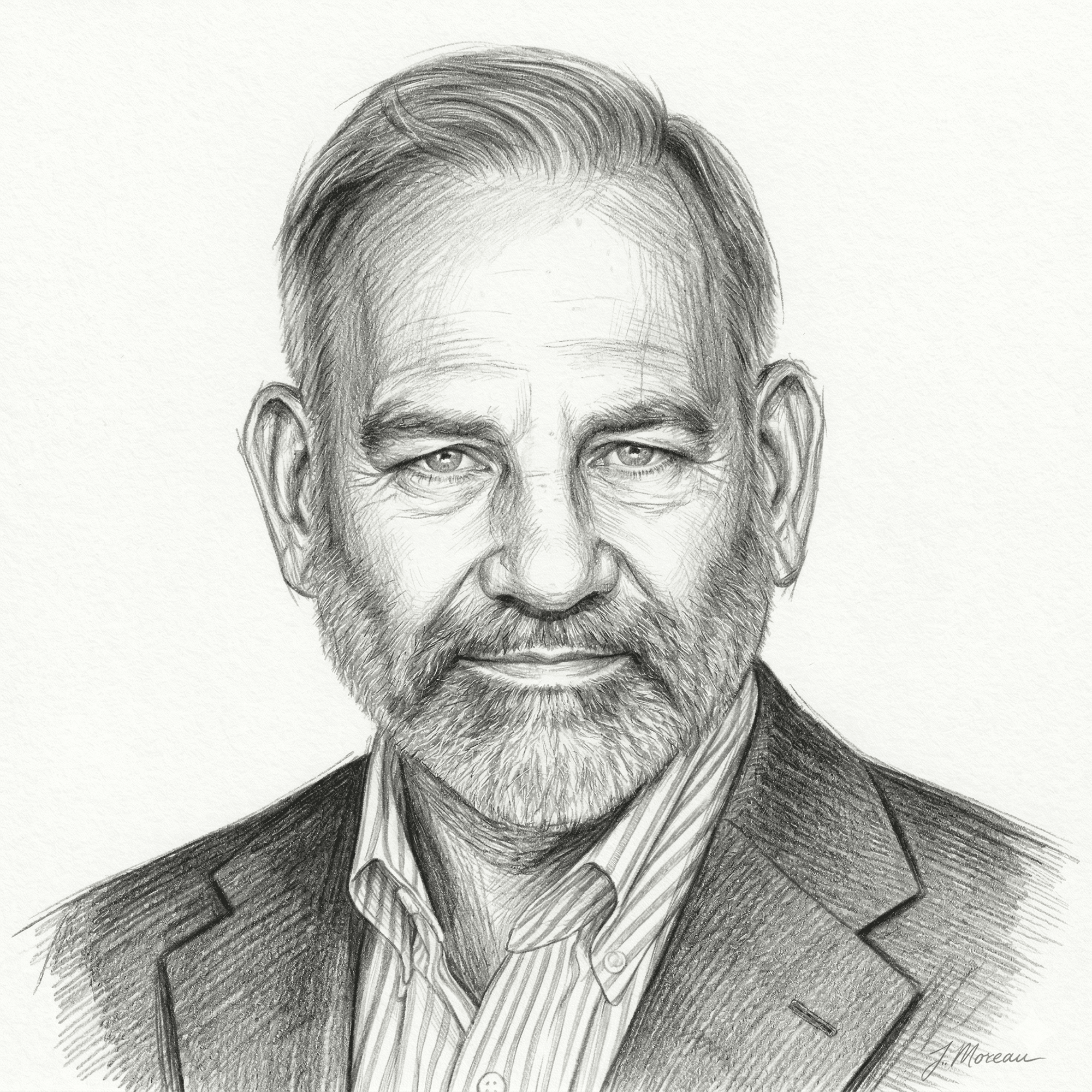
This is the talk Dave Pitts gave at the Sarajevo Security Conference in September 2026, which was based on the talk presented at the Cognitive Security Institute Conference in August 2026. Dave has identified Decision Autonomy as a key battle in the cognitive domain and a new front in strategic competition.
In 2022, Russia expected Ukraine’s political leadership to fracture in the face of pervasive disinformation, subversion, efforts to decapitate the government and to persuade Russian-speaking Ukrainians to support Russia. It expected fear, confusion, and chaos to result in surrender, flight, or capitulation. There was one problem—Ukraine resisted.
President Zelensky's refusal to flee, combined with unified military and civilian resistance—critical decisions—enabled Ukraine to hold in those critical early hours and days. How did such a small number of people resist such extraordinary pressure and make such consequential decisions?
In 2024, a mature Russian plot to assassinate Armin Papperger, CEO of Rheinmetall, a major producer of artillery shells for Ukraine, was discovered and disrupted by German and Western intelligence. More recently, German reporting described a suspected Russian-linked plot against Stefan Thumann of Donaustahl, a German drone producer supporting Ukraine.
What could those plots have achieved if successful? What did they actually achieve?
Russian drone incursions, airspace violations, political interference, cyberattacks, undersea cable cutting, GPS jamming, forced migration, sabotage, assassination, and attacks on critical infrastructure—several things have become increasingly clear. Russia’s gray zone attacks have increased since it invaded Ukraine. They have become more brazen, more lethal and more destructive—and spread across an increasing number of European countries.
The real question behind these attacks is why Russia is doing this. There are some obvious answers, but do we have it right?
America directly—and many countries indirectly—face a strategic challenge in the Strait of Hormuz. Iran’s attempts to control the flow of vital global energy as leverage in its conflict with the United States and Israel have created a wicked strategic decision point. Iran’s concurrent attacks on its neighbors may also serve as decision accelerants, compressing the time available to assess options and increasing pressure to act.
What decisions are possible and potentially effective? What are the risks and consequences of each option? And, perhaps most importantly, how much influence over that decision does Iran have?
No single human capacity is more powerful—or more vulnerable—than the ability to make decisions. Throughout history and continuing today, human decision-making has remained a target of those who seek to control the choices of others.
The ability—and the autonomy—to make decisions, from the ordinary choices of everyday life to the most consequential decisions of war and peace, makes us uniquely human. We instinctively resist—and, if necessary, fight—as individuals, groups, and nations when others seek to control our choices, think for us, or suppress this core human capacity.
At first glance, these stories seem completely unrelated.
A President fighting for his nation’s survival
Targeted assassinations of defense executives
Sabotage across the cities of Europe
A high-stakes standoff in the Strait of Hormuz.
They aren't.
They're four stories about the same thing: Decision autonomy. Different actors. Different circumstances. Different outcomes. One framework.
What is Decision Autonomy?
Decision Autonomy is our individual and collective ability to accurately see the world around us, to trust the knowledge we have and the information we receive, and to make independent, confident decisions based on our own judgment. “I decide—we decide.” To be clear, this is about all of us—citizens, private sector leaders, military commanders and officials, and policymakers.
It’s not a perfect state, it isn’t binary, and it exists on a spectrum. Individuals, organizations, and nations are constantly moving along this spectrum—sometimes toward greater autonomy, and sometimes toward greater vulnerability to external pressure.
In the middle of that spectrum is Decision Malleability—a state in which decision autonomy becomes increasingly susceptible to external influences. We see reality less clearly, cognitive clarity erodes, judgment is increasingly influenced, and decisions are increasingly shaped by external pressures.
At the far end of that spectrum is Decision Compromise—a state in which external influences have displaced or constrained independent judgment, resulting in the loss of decision autonomy. Reality is distorted, cognitive clarity is lost, independent judgment is displaced, and decisions are no longer fully your own.
Our adversaries understand this. They don't have to completely compromise our decision-making to succeed. They simply have to move us toward greater decision malleability—just enough to delay a decision, divide an organization, increase uncertainty, create hesitation, or influence a false choice.
If we accept that the ultimate objective of cognitive warfare is to undermine, degrade, and compromise decision autonomy, then understanding what our adversaries are doing to achieve that goal is important. This battle—the battle for Decision Autonomy—is becoming the new front in strategic competition.
What external pressures are our adversaries using in this battle? There are many, but I want to focus on four primary pathways.
First—deception. Deception distorts our understanding of the world around us—reality itself—by persuading us that false realities are real, to doubt the truth we actually see, or simply misperceive the environment in which we are making decisions. What does deception sound like?
“Ukraine is run by Nazis.”
“We are not attacking you—we are protecting you.”
“They started it.”
“Joining NATO would be a hostile act.”
Second—manipulation. Manipulation influences our judgment by exploiting our emotions, identities, biases, and motivations, steering how we evaluate information and the decisions we make. Fear, anger, exhaustion, hopelessness, or hope can override deliberate reasoning. What does manipulation sound like?
“The West doesn’t respect who you are.”
“America will abandon you.”
“China offers a future that NATO can’t.”
“Why should those from outside the region tell you how to run your country?”
Third—coercion. Coercion constrains our freedom to choose by threatening or imposing unacceptable consequences if we do not make the decision our adversaries desire. The logic is simple: “you do X and we’ll respond forcefully.” What does coercion sound like?
“Join and we will take action.”
“Recognize Taiwan and there will be consequences.”
“Support our enemies and your interests will not be safe.”
“Advance our interests in the region or lose access to our markets.”
Fourth—cognitive overload. Cognitive overload overwhelms our ability to think clearly and rationally by exceeding our capacity to process information, evaluate competing narratives, and anticipate the consequences of our decisions. What does cognitive overload feel like?
“An endless stream of conflicting narratives.”
“One video says one thing—another says the opposite.”
“Experts disagree.”
“Anonymous sources contradict official sources.”
“Too many decisions, too much information, too little certainty, too little time.”
Our adversaries seek to create cognitive overload; our objective is to preserve cognitive clarity.
Cognitive clarity isn’t merely the absence of confusion. It’s the ability to remain intellectually focused, emotionally composed, and deliberately engaged despite uncertainty, complexity, competing information, information overload, and attempts to shape judgment.
In terms of these decision states, let’s test the framework against the five examples I opened with.
In Ukraine, President Zelensky and Ukraine maintained decision autonomy. They held firmly to reality, resisted deception, manipulation, and coercion, and made independent decisions despite extraordinary pressure. In this case, decision autonomy prevailed.
Russia’s assassination plots failed to remove key decision makers or undermine support for Ukraine. In fact, exposure of the plots appears to have had the opposite effect—hardening political resolve, increasing intelligence collaboration, strengthening protective measures around critical industrial leaders, and prompting defense companies to increase production. In this case, exposing Russia’s deception sharpened the view of reality and strengthened decision autonomy rather than degrading it.
Russia’s sabotage campaign has been heavy and costly. It is hard to assess if decision autonomy has been degraded. What is clear is that shared operational awareness has increased, defense collaboration is on the rise, an awareness that Russia favors Endless Warfare over peace is settling in, and a goal of shared strategic deterrence has emerged. If there’s a lesson here, it’s that an adversary can create enormous pressure without necessarily achieving decision compromise.
Iran’s disruption of the Strait of Hormuz has revealed the limitations of conventional military power against an adversary employing gray and asymmetric warfare methods. More importantly, it demonstrates how even a superpower finds its decision space constrained by a committed adversary.
The U.S. and its allies are moving along the decision continuum as they seek a decision to resolve this crisis. The question is whether this movement along the continuum reflects normal strategic decision-making under pressure—or a degradation of decision autonomy.
All these examples identify five key points that can protect decision autonomy:
Protect reality.
Seek evidence. Challenge assumptions. Verify before believing.
Preserve independent judgment.
Don't outsource your thinking to algorithms, echo chambers, crowds, or even experts that speak at conferences.
Maintain cognitive clarity.
Slow down. Reduce noise. Watch for fatigue, anger, urgency, despair, and overload.
Recognize and resist coercion.
“Am I choosing this—or am I being pressured into it?”
Continuously assess your decision autonomy.
Where am I on the continuum right now—autonomy, malleability, or compromise?
Is this relevant to the great power competition we all play a role in today?
Imagine these same pathways—deception, manipulation, coercion, and cognitive overload—employed deliberately and systematically by our adversaries over years or even decades, supported by intelligence services, state media, proxies, cyber capabilities, artificial intelligence, economic leverage, and military power. Scale changes everything.
Let’s talk about Russia, China, and Iran. All three countries use all four pathways, but each tends to emphasize them differently.
Russia has increasingly adopted a strategy of persistent confrontation with the West. It recognizes that it cannot match the United States, NATO, and its allies across every dimension of national power, so it competes asymmetrically and in the Gray Zone.
Russia seeks advantage by increasing uncertainty, delaying decisions, dividing alliances, employing proxies, and raising the perceived costs of action. It exploits negotiations to shift blame, abruptly change positions, and weaponize deception, delay, and distraction.
Russia understands that it doesn't have to defeat its adversaries militarily if it can influence their decisions before military force is ever employed. Deception and coercion define its approach.
Deception through disinformation, false narratives, active measures, and reflexive control.
Coercion through nuclear signaling, red lines, energy leverage, sabotage, assassination, and intimidation.
For China, patience is a strategic weapon. Rather than seeking to influence a single decision, China seeks to shape the long-term decision environment so that decisions favorable to Beijing gradually become the norm and ultimately viewed as being in the target's own interest.
As leading foreign policy expert Elizabeth Economy has observed, “China is executing a patient, multi-decade campaign to dominate the "new frontiers of power"—a continuous effort to set conditions, rewrite rules, and erode Western advantages below the threshold of open conflict.
Manipulation and coercion define this approach.”
Manipulation through United Front activities, influence operations, elite networks, and weaponized narratives.
Coercion through economic leverage, market access, technology dependence, sanctions, military expansion, and aggressive maritime tactics.
Iran views its struggle against the West as enduring and existential. Rather than seeking decisive military victory against stronger powers, it relies on persistent gray-zone competition, asymmetric warfare, and proxies to preserve regime security while constraining the decision of its adversaries.
Iran seeks to narrow the choices of the U.S. and its regional allies—"accommodate its interests or accept an unending and costly regional conflict.”
Manipulation and coercion define its approach.
Manipulation through ideological narratives, proxy media, and the exploitation of political divisions, sectarian identities, and regional instability.
Coercion through threats to global energy supplies, proxy violence, direct attacks on neighbors, hostage-taking, and terrorism.
Although their approaches differ, all three share a common objective: to shape how we perceive reality, exercise judgment, and ultimately make decisions that advance their interests over our own.
Of course, our adversaries still try to shape specific beliefs, but the longer-term payoff comes from shaping the conditions under which those beliefs form—to keep us consistently closer to Decision Malleability on issues most important to them.
So, what do we do about it? Let me close with what I believe are the human foundations of cognitive security—protecting cognition and decision autonomy.
This is often where we start talking about structural fixes—new organizations, whole-of-government approaches, media literacy, and technology. Some may be necessary; some remain aspirational. But I'd like to leave that conversation for another day and focus on the more human side of cognitive security: protecting cognition and decision autonomy.
Today, a clear view of reality can resemble a wilderness of mirrors—seeing isn't believing. If adversaries can replace facts with disinformation and synthetic realities, they gain a decision advantage.
Most of us have too many sources of information flooding our professional and private lives—I certainly do. It is easy to rely on so-called experts, chatbots, social media, comfortable echo chambers, and ubiquitous algorithms to do our thinking for us. It can become a blissful rut. When we knowingly or unknowingly cede judgment and decision space to others—we begin to lose decision autonomy.
We are living in a cognitive storm—a chaotic and unreliable global information environment where a single operator with a laptop can reach millions at the speed of global communications, where countless media sources are almost impossible to vet in real time, and where adversaries deploy AI-enabled networks of surrogates, fake sites, cybercriminals, hacktivists, and bots to target all of us and our institutions. It is easy to feel overwhelmed.
Russia, China, Iran, and even North Korea use redlines, threats and intimidation as tools of persuasion. The fear of escalation can be powerful, and our adversaries will seek to use coercion to move us along the continuum toward malleability and compromise. Coercion changes how we see the cost of our decisions and what we are willing to risk.
Our goal is to recognize coercion for what it is and not allow the fear of consequences—real or manufactured—to become the basis for our decisions.
We do have to accept certain things.
We cannot eliminate deception.
We cannot eliminate manipulation.
We cannot eliminate coercion.
We cannot eliminate cognitive overload.
But before making our most consequential decisions—in a military command post, a policy meeting, during a crisis, or in negotiations with our adversaries—we can stop—and ask four questions. I call this the Decision Autonomy Diagnostic: four questions to instantly evaluate where you stand on the continuum.
Do I accurately see and understand the world around me?
or - Do I know what’s true?
Am I evaluating the information objectively, or is something shaping my judgment?
or - Can I recognize manipulation?
Have I preserved cognitive clarity despite uncertainty, complexity, and overload?
or- Can I still think and deliberate clearly?
Can I decide independently despite external pressures?
or - Can I resist false threats and real pressure?
Finally, decision autonomy is ultimately about sovereignty. For nations, sovereignty is the freedom to determine their own future without external influence or interference—self-determination.
For individuals, decision autonomy is the expression of that same principle—personal sovereignty—the freedom to see reality clearly, exercise independent judgment, and make decisions that remain our own. Sovereignty gives us the right to decide. Decision Autonomy gives us the ability to decide.
No human capacity is more powerful—or more vulnerable—than our ability to make decisions—as individuals, as people, as nations—together, we must go to great lengths to protect it.
All statements of fact, opinion, or analysis expressed are those of the author and do not reflect the official positions or views of the U.S. Government. Nothing in the contents should be construed as asserting or implying U.S. Government authentication of information or endorsement of the author's views.
The Cipher Brief is committed to publishing a range of perspectives on national security issues submitted by deeply experienced national security professionals. Opinions expressed are those of the author and do not represent the views or opinions of The Cipher Brief.
Have a perspective to share based on your experience in the national security field? Send it to Editor@thecipherbrief.com for publication consideration.
Read more expert-driven national security insights, perspective and analysis in The Cipher Brief