


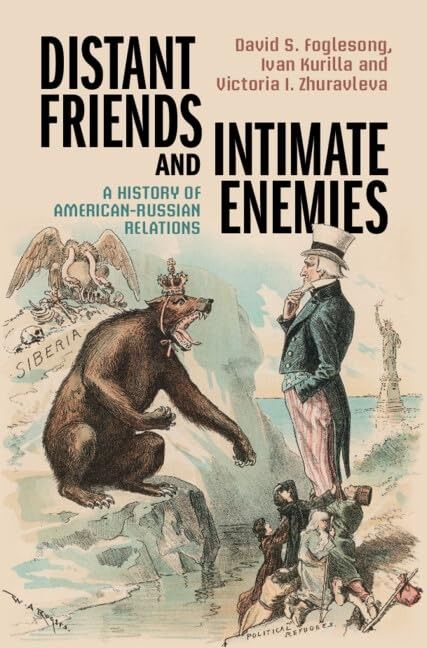
BOOK REVIEW: Distant Friends and Intimate Enemies: A History of American-Russian Relations
By David S. Fogelsong, Ivan Kurilla and Victoria Zhuravleva/ Cambridge University Press
Reviewed by: Michael Sulick
The Reviewer: Michael Sulick is a consultant on counterintelligence and global risk. He served as Chief of Counterintelligence and Director of the Clandestine Service at CIA* and is the author of Spying in America: Espionage From the Revolutionary War to the Dawn of the Cold War and American Spies: Espionage Against the United States from the Cold War to the Present.
REVIEW — A Cold War cliché was that neither the U.S. nor Soviet Union understood each other, and the misperceptions from this mutual ignorance often contributed to the recurrent confrontations during the period. Like most clichés, this one was true to some extent. The authors of Distant Friends and Intimate Enemies, two Russians and one American, explore these misperceptions in a comprehensive history of both nations’ interactions from initial contact in the 17th century to the present day. The sweeping narrative reviews in depth the numerous pendulum swings between confrontation and conciliation and also attempts to correct the often simplistic explanations of the sometimes fraught and sometimes friendly bilateral relationship.
The lengthy narrative is not limited to foreign policy but also weaves in the attitudes and influence of multiple sectors in the societies of both countries, ranging from media, scholars and filmmakers to ballet dancers, athletes and political cartoonists, among others. Since the authors are both American and Russian, the book provides a unique perspective not found in other similar studies.
Despite current adversarial relations, the U.S. and Russia exhibited similar characteristics in their earlier history. Both believed in their own expansionist destiny yet were tarnished by forced labor, slavery in the U.S. and serfdom in Russia. At the same time, their governments were polar opposites. As the authors note, any friendship between an autocratic monarchy and a democratic republic was a paradox. Yet at various times in their histories, each found qualities in the other to admire and emulate that led to cooperation.
More importantly, as the authors note, bilateral relations were at their friendliest when the national interests of both nations converged and trumped any ideological and cultural differences. As one example, despite the geopolitical and ideological contradictions between the two, their mutual interest in expanding exports of American goods, capital, and technologies to Russia often helped balance bilateral relations.
The authors also note that the foreign policy of each has not existed in a vacuum. The interaction between the U.S. and Russia was also heavily influenced by relations with other countries. Cooperation between the U.S. and Russia was conditioned by their mutual wariness of Great Britain in the 19th century. Similarly, President Franklin Roosevelt turned a blind eye to Soviet communism in the 20th century because he sought a counterbalance to a bellicose Germany and Japan.
What national security news are you missing today? Get full access to your own national security daily brief by upgrading to Subscriber+Member status.
The relationship was also complicated since opinions of the “Other” in both countries were not monolithic, and the authors deftly explore the positive and negative views of each country toward the other. As examples, leaders, including Lenin, admired U.S.’ technological prowess at the same time that they decried the country’s racism and materialism. U.S. hawks in political parties and the media condemned Russian autocracy, yet many others in the U.S. sympathized with the Soviet Union when communism became an attractive alternative during and after the Great Depression.
The Cold War conflict has been amply treated by scholars and the media, but Distant Friends’ treatment of bilateral relations over a span of almost three centuries examines events less known to the general public: Russian support of the Union in America’s Civil War, cooperation in World War I, and a pre-WW II trade relationship in which the U.S. became the leading exporter to the USSR.
Since many Cipher Brief readers are current or former intelligence and national security officers or students of the discipline, they may be interested in the two nations’ history in that arena. The intelligence rivalry was an essential part of the bilateral conflict from the 1930s to the present but is downplayed by the authors. They claim Soviet espionage against the U.S. in the pre-World War II era has been “overblown” and criticism of the USSR fails to note that the majority of Americans who spied were ideologically motivated. They gloss over the fact that over 500 Americans committed espionage for Russia, a scale unsurpassed in U.S. history, and espionage is still betrayal regardless of the motivation. Distant Friends also underplays the value of Soviet espionage, dismissing the fact that USSR gained sufficient insight into the Manhattan Project to build its own bomb, which later emboldened Stalin to support the war with North Korea.
In a similar vein, the authors note that President Reagan eventually softened his hardline rhetoric toward the Russians due to the influence of voices ranging from his wife to peace activists. All true, but Reagan was especially struck by intelligence that UK Prime Minister Thatcher shared with him from a senior KGB officer. Oleg Gordievsky, chief Soviet intelligence officer in the UK, who advised the British that Soviet leaders were truly frightened war with the U.S. was imminent. While the other voices certainly had an impact on Reagan, information from inside the Kremlin played a major role in the President’s change of heart.
Some readers will quibble with certain conclusions in the study. The authors assert that increasing U.S. hostility to Russia was more due to U.S. media and politicians’ “inflamed” portrayal of Russia as a global menace than interference in the U.S. election. The issue is certainly debatable, but such brazen intrusion into the heart of a country’s political system is clearly inflammatory.
This reviewer highly recommends the book. The authors belief that U.S. and Russia conflicts were “a product of exaggerations of threats, mismanagement of politics, and unwise decisions by flawed human beings.” A careful reading of this history may well teach future generations in both countries to avoid these pitfalls in the future – that is, if the confrontation sparked by Putin’s invasion of Ukraine can ever be resolved.
*** All statements of fact, opinion, or analysis expressed are those of the reviewer and do not reflect the official positions or views of the U.S. Government. Nothing in the contents should be construed as asserting or implying US Government authentication of information or endorsement of the reviewer’s views.
The Cipher Brief participates in the Amazon Affiliate program and may make a small commission from purchases made via links.
Sign up for our free Undercover newsletter to make sure you stay on top of all of the new releases and expert reviews.
Read more expert-driven national security insights, perspective and analysis in The Cipher Brief because National Security is Everyone’s Business
Distant Friends and Intimate Enemies earns an impressive 3.5 out of 4 trench coats