

BOOK REVIEW: A Forever War: Israel, Palestine and the Struggles for Statehood
By Colin Shindler / Swift Press
Reviewed by: Jean-Thomas Nicole
The Reviewer — Jean-Thomas Nicole is a Policy Advisor with Public Safety Canada. The opinions expressed are those of the author and do not reflect the official policies or positions of Public Safety Canada or the Canadian government.
REVIEW — Colin Shindler is an emeritus professor at the School of Oriental and African Studies (SOAS), University of London, where in 2008 he pioneered the UK’s first chair dedicated to Israel Studies. A year later he helped formalize the field’s scholarly community as founding chair of the European Association of Israel Studies (EAIS).
Across his career, Shindler has written extensively on modern Israel’s political currents—especially the rise of the Israeli Right, the Left’s evolving attitudes toward Israel in Europe and Britain, and the Soviet Jewry movement.
Colin Shindler’s A Forever War reads like a guided walk through a century and a half of decisions that hardened into destiny. The finished product contained in this small but potent book is indeed the history of how Israel and the Palestinians have arrived at an intractable position of impasse in the twenty-first century.
Shindler has tried to focus on the self-evident aspects of the tortuous Israel–Palestine imbroglio – what he calls the ‘Forever War’, which means this work deals with the parallel claims of both sides to the same territory and the wishful thinking that each side believes it is entitled to take all of it.
The book is also a history of how the world has changed dramatically but remains still unable to fit the Jews and the Palestinians into a coherent framework of understanding.
From the first stirrings of Zionism and Arab nationalism—both children of nineteenth‑century emancipation and empire—Shindler shows how overlapping claims on the same land created not just rivalry, but incompatible political grammars.
Britain’s wartime ambiguity becomes the book’s opening motif: promises made to Arabs and Jews in different registers metastasize into mistrust, then into a habit of maximalism that outlives the empire that seeded it.
Against that backdrop, Shindler keeps returning to a simple organizing premise: partition has been the only workable horizon, yet each moment when it approached tangibility—Peel in 1937, UNGA 181 in 1947, Oslo’s interim-ism in 1993—was undone by actors who either worshiped the whole or weaponized ambiguity.
The narrative gains momentum as it moves from ideas to instruments. Shindler’s treatment of 1948 is judicious rather than polemical: war produces refugees, refugees produce memory, memory produces politics. By the time we reach 1967, the book’s central tension is fully visible.
Victorious Israel carries a new map and a new psychology, and the West Bank is recoded simultaneously as strategic depth, socialist canvas, and sacred inheritance. That multiplicity matters, because it explains why subsequent Israeli leaders—Begin, Shamir, Sharon, Rabin, Peres, Netanyahu—speak the language of security while maneuvering in coalitions where theology, demography, and party arithmetic can make or break a concession.
Shindler is particularly sharp on Netanyahu’s “zig‑zag”: conditional nods to two states under U.S. pressure, followed by domestic recalibration around reciprocity, settlement tempo, and the politics of coalition partners. It is not a caricature; it is a pattern.
Palestinian politics receive equal seriousness. The secular nationalism that learns, slowly and painfully, that Israel will not evaporate is juxtaposed with Islamism’s rise and its explicit rejection of partition. Shindler is unsparing in showing how suicide bombing campaigns collapse trust, scramble Israeli electoral coalitions, and convert interim arrangements into political liabilities.
Yet he also names the feedback loops—closures, shattered labor markets, the hardening of enclave governance—that make each next step harder than the last. If there is a moral in these chapters, it is that violence does not just kill; it warps sequencing.
Religion is not an accessory in this story; it is a driver. The book’s middle chapters trace how messianic frames transform land from negotiable asset into divine obligation, and how that shift alters the meaning of compromise. Shindler resists the easy move of treating all religious actors as monoliths: he shows rabbis who caution as well as those who sanctify, the internal disputes inside religious Zionism, and the evolving, transactional alliance between ultra‑orthodox parties and secular nationalists that reconfigures the state’s priorities over decades—from education and conscription to social transfers and legal boundaries.
The canvas widens again across the region. Iran’s revolution, proxy networks, cyber operations, and missile age turn the conflict system into a set of interlocking theatres, where Gaza, Lebanon, Syria, and Yemen are not separate stories, but facets of one. Shindler’s account of the JCPOA years and the post‑2018 unravelling is notable for its clarity: technology, covert action, and deterrence all shift at once; domestic politics in Washington, Jerusalem, and Tehran overlay strategy with ideology; and every “freeze” or “pause” becomes an instrument to gain time rather than to close distance.
The 2024–2025 episodes he narrates carry the risk of present‑tense history, but they are deployed to show trajectory rather than to pronounce final verdicts.
The final chapters knit U.S. religion and politics back into the Middle East. Dispensationalist evangelicalism is rendered not as a curiosity but as a worldview that has practical consequences: it privileges sovereignty rhetoric over partition mechanics, celebrates symbolic moves (embassy, recognitions), and mistrusts interim arrangements that depend on restraint.
Shindler’s portraits of ambassadorial figures who carry theology into statecraft illuminate how media ecosystems and faith networks can move the Overton window of policy, even when the majority of American Jews vote the other way.
What emerges from this synthesis is neither cynicism nor naïveté. Shindler believes partition remains the least bad path, and he makes that case by showing how every non‑partition experiment—unilateralism, strategic ambiguity, managed stalemate—has tended to strengthen the rejectionists who thrive on absolutes.
If you prefer confederation or “functional separation,” you may want more comparative design work than the book offers; if you seek ethnography of Palestinian institutions, you may want a deeper sociological cut. But as a political history that explains how the center keeps being eroded—by bombs, by settlements, by sermons, by soundbites—A Forever War is a clarifying read.
It tells a hard truth in clear prose: the conflict endures not because people don’t know the destination, but because too many powerful actors have repeatedly made the middle road impassable, and too many moments of elastic possibility have been snapped by those who prosper when compromise fails.
The book closes in early November 2025, as Israel marked 30 years since Yitzhak Rabin’s assassination (1995), the moment served as a stark reminder of the path not taken. At a massive rally in Tel Aviv, former hostage Gadi Moses offered a rare voice of hope, insisting that war is not destiny and that peace remains a choice—one still within reach.
His message was simple but profound: if someone who endured 482 days of captivity can stand and call for reconciliation, then an entire nation can choose that future too. His words underline the book’s central theme—that despite the cycles of violence, imagining a different tomorrow is not only possible, but necessary: I must convey this hope and faith. We must convince the people that choosing peace is choosing the future for our children and the revival of the nation.
In 2026, the entire world needs to hear that message now, more than ever, again, and again. All we are saying is give peace a chance! (John Lennon).
Are you Subscribed to The Cipher Brief’s Digital Channel on YouTube? There is no better place to get clear perspectives from deeply experienced national security experts.
Read more expert-driven national security insights, perspective and analysis in The Cipher Brief because National Security is Everyone’s Business.
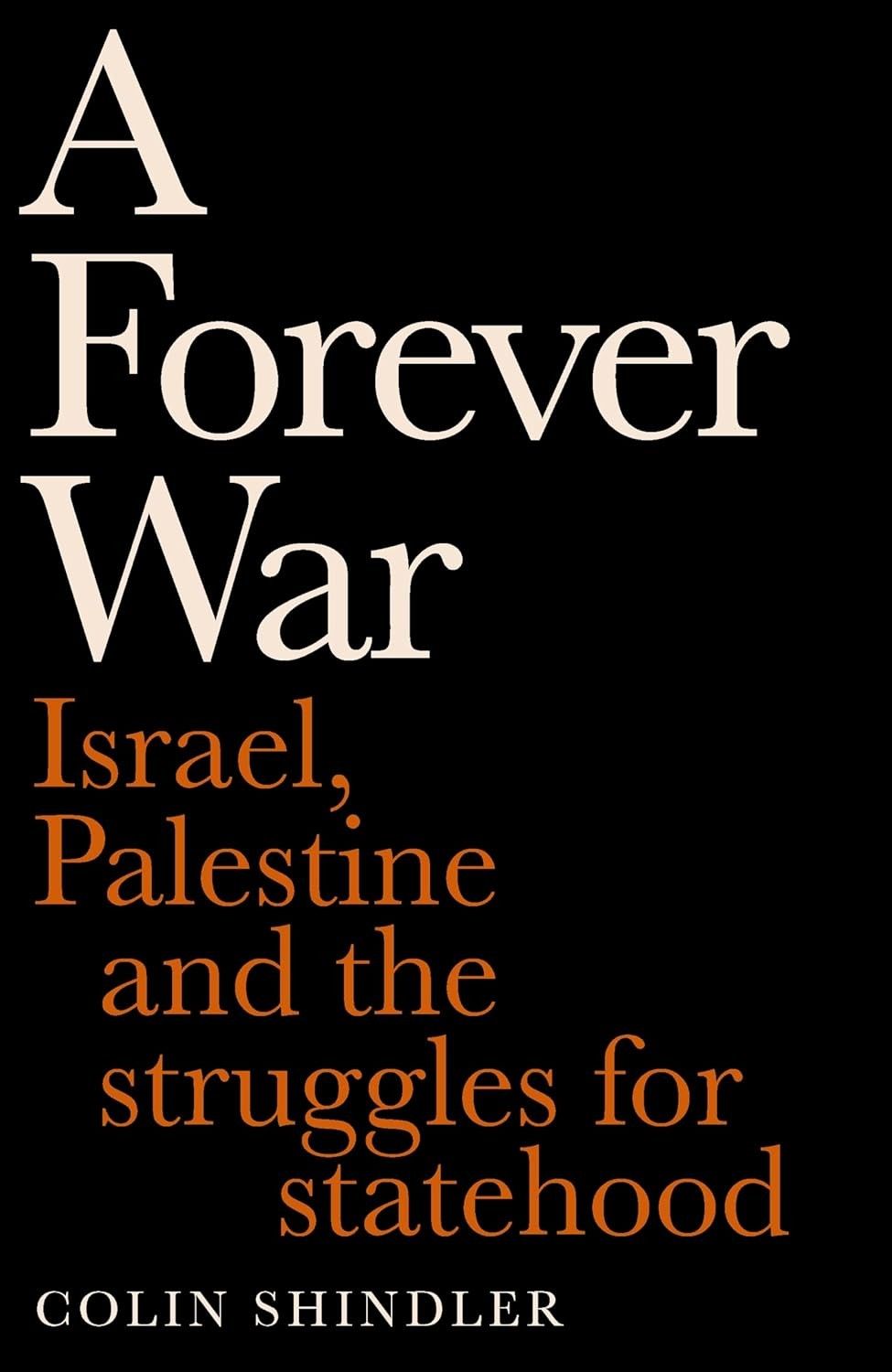
A Forever War: Israel, Palestine and the struggles for statehood earns a prestigious 4 out of 4 trench coats