

BOOK REVIEW: Kennedy's Coup: A White House Plot, a Saigon Murder, and America’s Descent Into Vietnam
By JACK CHEEVERS / SIMON & SCHUSTER
Reviewed by: Joe Zacks
The Reviewer; Joe Zacks is the former Deputy Assistant Director of the CIA for Counterterrorism, the Co-founder and Managing Partner of Aardwolf Global Solutions and a Cipher Brief Subject Matter Expert.
REVIEW — Among the many books written about America's foray in Vietnam, few have focused sustained attention on the event that arguably set the entire catastrophe in motion — the November 1963 coup that overthrew and killed South Vietnamese President Ngo Dinh Diem. In Kennedy’s Coup, Jack Cheevers has given that pivotal episode the treatment it deserves. The publication of this book is especially timely given that President Trump recently green-lighted the ouster of Venezuela’s Maduro and is now facing a potentially consequential decision regarding a military confrontation with Iran that may include an implicit objective of regime change.
The central argument of the book is both straightforward and damning: the Kennedy administration, through a combination of bureaucratic infighting, poor judgment, and a fateful cable sent while the president was on vacation, effectively green-lighted the South Vietnamese generals who overthrew and murdered Diem. That cable — drafted by State Department intelligence chief Roger Hilsman in August 1963 and approved by Kennedy with minimal deliberation — signaled to Ambassador Henry Cabot Lodge in Saigon that Washington would not oppose a change of government. It was, in the book's framing, the original sin that cascaded into nine years of costly and ultimately futile warfare.
What elevates this book above a straightforward political history is Cheevers' skill as a portraitist. The cast of characters he assembles is vivid and memorable. Lodge, the Republican patrician ambassador, comes across as a man driven by political ambition and an instinctive contempt for Diem that clouded his judgment. The CIA operative Lucien Conein — the intermediary who shuttled messages between the American mission and the coup-plotting generals — reads like a figure from a le Carré novel. And Diem himself is rendered with admirable complexity: authoritarian, isolated, and increasingly brutal in his crackdowns on the Buddhist protesters who lit the political fuse, but also a genuine nationalist whose removal left a vacuum that no subsequent Saigon government could fill. Cheevers also splendidly portrays many of the American journalists, notably Peter Arnett, Neil Sheehan, and David Halberstam, who reported from Saigon and whose articles propelled some of the Kennedy administration decision-making. These reporters, particularly The New York Times’s Halberstam, come across both as extraordinarily passionate about the role of the fourth estate in democratic societies and, at times, increasingly bereft of objectivity because of their certitude in their beliefs and convictions.
This is a book rich in detail and depth. The White House infighting that preceded the coup — with hawks and doves battling for Kennedy's ear, and Kennedy himself vacillating in a way that seemed almost paralytic — is reconstructed with a level of granular detail that makes this lengthy book genuinely engrossing. The book also extends into the Johnson administration’s escalation of the U.S. engagement in Vietnam—President Johnson expanded the war in direct contravention to his initial instincts. The reader witnesses exactly how a great power can blunder into catastrophe not through malice but through confusion, miscommunication, sizeable intelligence gaps and the bureaucratic tendency to avoid clear accountability.
The book's thesis that the Diem coup was one of the worst foreign policy decisions in American history is not new, but Cheevers makes the case in a gripping manner. He is careful not to idealize Diem, acknowledging the repressive character of his regime, but he makes a persuasive case that the generals who replaced him were worse, and that the instability unleashed by the coup pulled the United States toward deeper military involvement almost by gravitational force.
The book is an exceptional piece of historical journalism. Kennedy's Coup is carefully researched and compellingly written. It well deserves a read.
*All statements of fact, opinion, or analysis expressed in this review are those of the author and do not reflect the official positions or views of the US Government. Nothing in the contents should be construed as asserting or implying US Government authentication or endorsement of the author’s views.
The Cipher Brief participates in the Amazon Affiliate program and may make a small commission from purchases made via links.
Sign up for our free Undercover newsletter to make sure you stay on top of all of the new releases and expert reviews.
Read more expert-driven national security insights, perspective and analysis in The Cipher Brief because National Security is Everyone’s Business
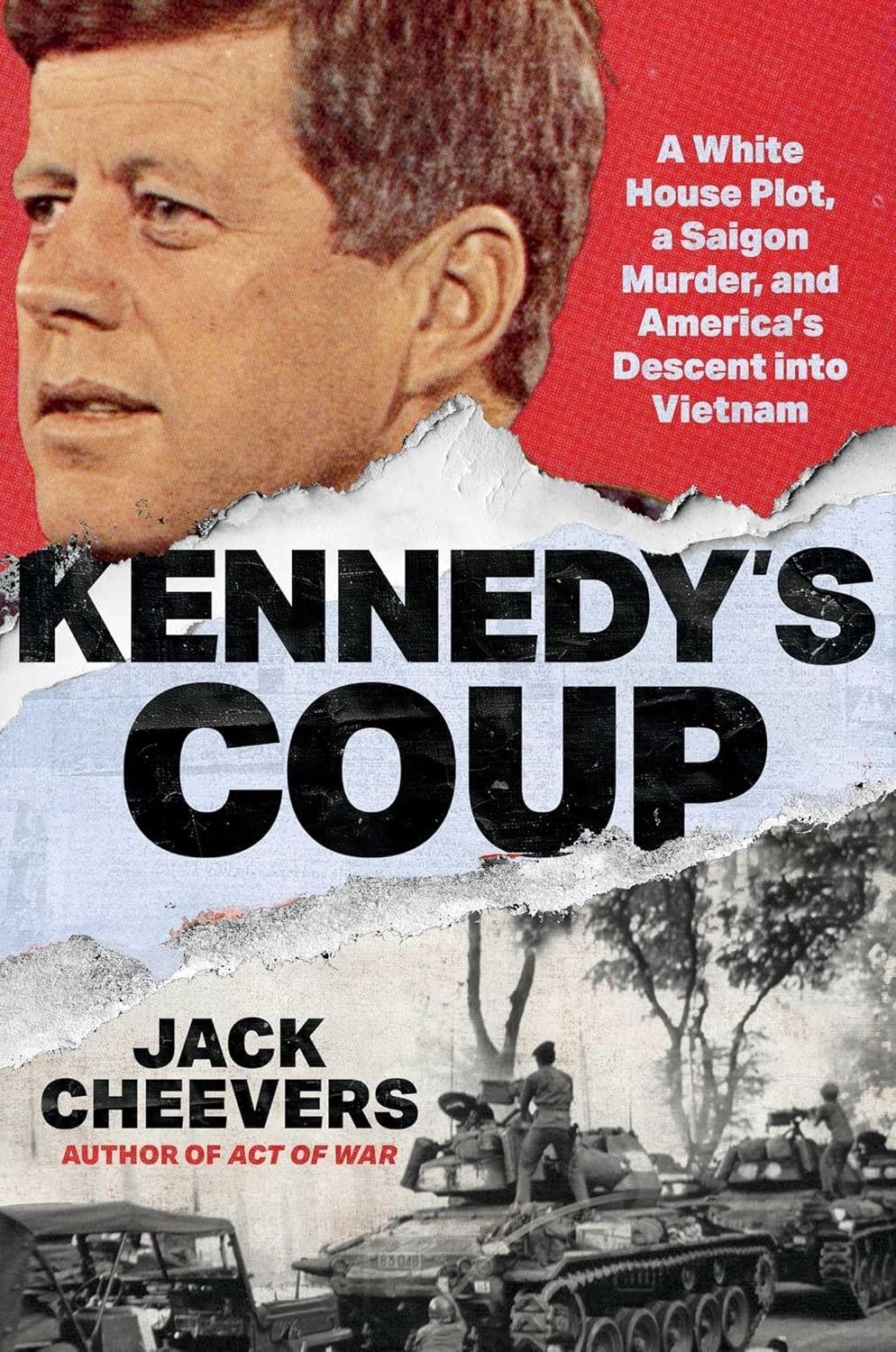
Kennedy's Coup: A White House Plot, a Saigon Murder, and America's Descent into Vietnam earns a prestigious 4 out of 4 trench coats