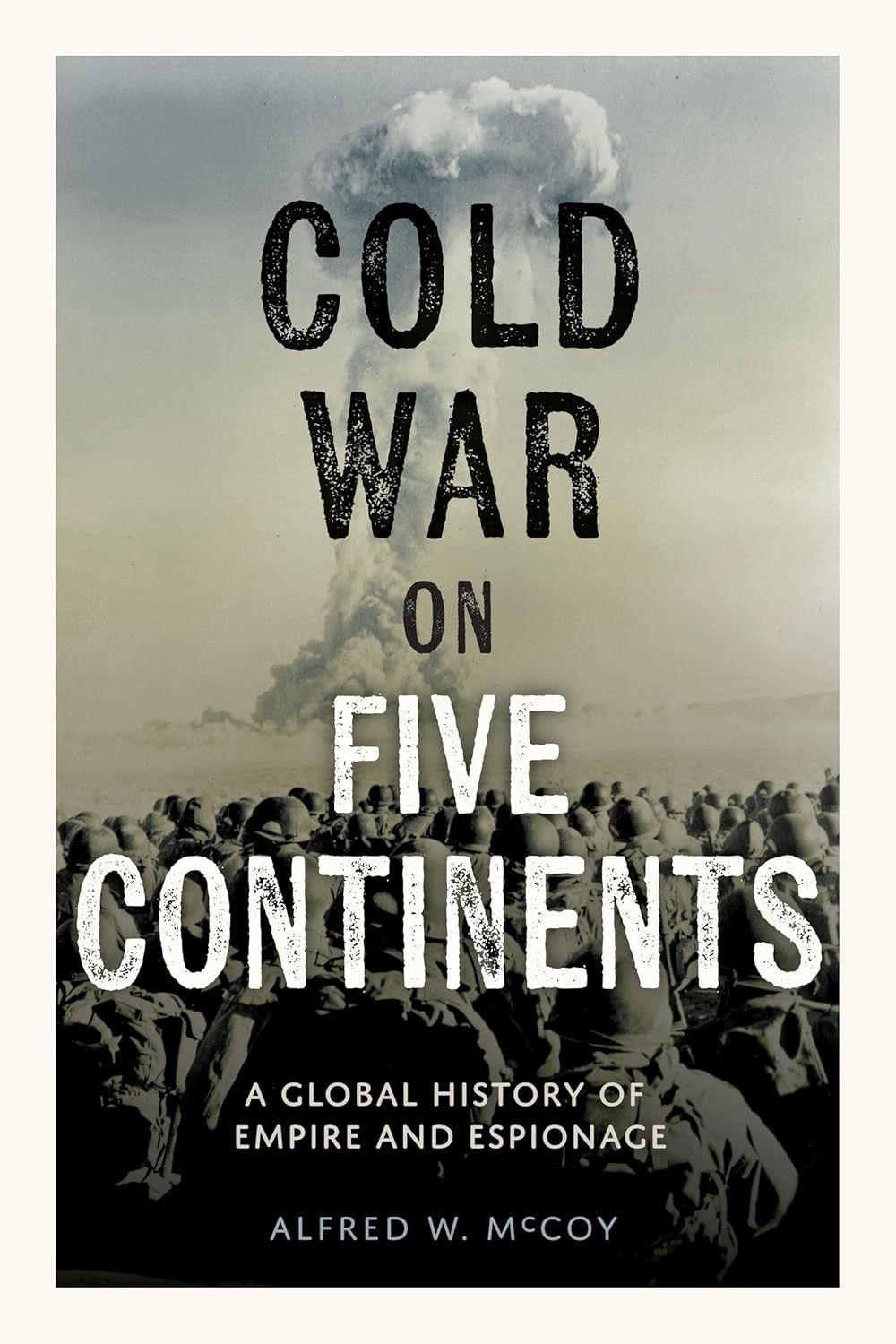

Book Review of Cold War on Five Continents: A Global History of Empire and Espionage
By Alfred W. McCoy/ Haymarket Books
Reviewed by: Jean-Thomas Nicole
The Reviewer — Jean-Thomas Nicole is a Policy Advisor with Public Safety Canada. The opinions expressed are those of the author and do not reflect the official policies or positions of Public Safety Canada or the Canadian government.
Review — Alfred W. McCoy is one of the most distinguished historians of U.S. foreign policy and Southeast Asian history, renowned for his fearless scholarship and penetrating analyses, with political leanings that align closely with progressive or left-leaning perspectives. Over the decades, McCoy has produced a body of work that spans multiple themes: the history of modern empires, the Philippine political order, covert operations, the architecture of surveillance and torture and the imperial dimensions of U.S. global power.
Across these works, McCoy has combined archival rigor with moral clarity, illuminating the covert mechanisms of power—from opium pipelines to torture chambers, from psychological war campaigns to surveillance regimes. His writing is not only a contribution to historical scholarship but also a warning about the fragility of democratic norms under the weight of empire. Today, he holds the Fred Harvey Harrington Professorship of History at the University of Wisconsin–Madison, where he has taught since 1989.
From the foreword of his latest book, Cold War on Five Continents, McCoy announces the vantage point from which he will see the world: the close, human distance at which ambition, fear, and improvisation collide. From there, he invites us to reconsider the Cold War as an imperial continuity—less a war of ideological opposites than a relentless contest for rule over the world’s periphery. The superpowers, he argues, choreographed their struggle through a combination of grand strategy and granular manipulation, never daring a direct clash beneath the nuclear shadow, but unleashing surrogates and sending agents to the most fissile edges of the world system. There, “men on the spot” emerged as protagonists, their actions amplified by the extraordinary autonomy granted in moments of rupture.
Who’s Reading this? More than 500K of the most influential national security experts in the world. Need full access to what the Experts are reading?
McCoy’s scaffolding is deceptively simple: four forces that together shape his account—superpower rivalry, geopolitics in the Mackinder tradition, covert operations as instruments of statecraft, and decolonization as the great accelerant of modern history. He revisits Mackinder’s “World Island,” not as dogma but as a lens through which to understand how Eurasia becomes the stage upon which empires dance and collide.
McCoy’s gift lies in giving us faces, voices, and decisions—Edward Lansdale fine-tuning propaganda and political theatre in Manila and Saigon; Kermit Roosevelt Jr., in a haze of charm and calculation, extracting a dynasty’s return from Tehran; Roger Trinquier, whose chillingly lucid writings etched into military doctrine the apparatus of torture; Norman Reddaway, whose quiet British psychological war in Indonesia abetted cataclysmic purges; Pham Xuan An, a reporter whose public role concealed a clandestine craft that shadowed American efforts in Vietnam. These figures, arrayed across continents and crises, press against the abstract contours of geopolitics and force history to turn.
The narrative begins in Europe’s ruins, where McCoy carefully reconstructs the standoff that solidified into a continent’s partition. Here he is instructive rather than nostalgic, reminding us that the Iron Curtain’s grandeur—its divisions, its armored symmetries—disguised the extent to which covert services mattered. He shows how the CIA’s “stay-behind” networks in Italy, France, and Greece prepared for a future that never came and shaped a present that did. In Greece, he is at pains to remind us that the communist defeat and the Right’s ascendance were purchased through methods that corroded democratic institutions, culminating in the colonels’ dictatorship and a shuddering confrontation over Cyprus.
From Europe, McCoy turns his gaze to Asia, where the Cold War sheds the manners of stasis and becomes kinetic, rupturing societies at crush depth. His telling of the Korean War is not a march of armies but a record of misreading—an anatomy of how confidence curdled into catastrophe. There are moments here that echo the tone of the book’s wider thesis: the inability of commanders to see beyond their own presumptions, the relentless logic by which limited wars metastasize, the grim calculus of airpower and its futile promise. Yet McCoy never loses sight of consequences: dead civilians, cities erased, a peninsula split and ossified, three million lives extinguished in a war curiously absent from Western ceremony.
It is in Southeast Asia that McCoy’s narrative finds its most harrowing clarity. His chapters on the Philippines and Vietnam are a braid of biography and geopolitics, with Edward Lansdale as the central strand. In Manila, Lansdale proves the virtuoso of psychological war and political choreography, partnering with Ramon Magsaysay to drain the Huks’ revolt of its élan and convert insurgency into an electoral triumph.
In Saigon, the virtuoso meets his limits. Lansdale’s midnight access to Ngo Dinh Diem and the pitched street battles with the Binh Xuyen syndicate display the audacity that made him legend. But McCoy is unsparing about the cascade of consequences: an authoritarian order installed beneath the banner of anti-communism; democratic promises deferred or derailed; an American investment in a fragile polity that would, in time, pull Washington into a war it could neither win nor explain.
The human line continues with Pham Xuan An, the reporter-spy whose quiet labor reminds us how intelligence can outlast force and how the contours of defeat are often drawn in invisible ink.
McCoy’s account of Indonesia after 1955 is one of his most disturbing chapters, precisely because its mechanistic coldness is so meticulously revealed. The British psychological war apparatus, working in the half-light with American sympathies, becomes the faintly audible metronome behind a purge of staggering proportions. McCoy does not sensationalize the mass killings of 1965–66; he documents their scale and method, their political convenience, and the aftermath’s silence. He is attentive to how language can be used to exculpate, and how archives can bury as efficiently as they can reveal. In this, he demonstrates the ethical backbone of the book: the insistence that we look without flinching at the costs of covert action when it escapes both law and prudence.
The Middle East chapters are equally compelling, mapping the hinge by which Britain’s imperial posture collapses and America’s ascent. McCoy writes with a careful tension about the months leading to the 1953 Iran coup, allowing the reader to inhabit the ambiguity of sovereignty, contract, and corporate power. The portraits of Norman Darbyshire and the Rashidian brothers read like a noir embedded in diplomatic history; the operation itself is described neither as brilliance nor as inevitability, but as an act with consequences measured across decades—among them SAVAK’s repression and the conditions for 1979’s revolutionary backlash.
The Cipher Brief brings expert-level context to national and global security stories. It’s never been more important to understand what’s happening in the world. Upgrade your access to exclusive content by becoming a subscriber.
Throughout, McCoy keeps returning to the “cultural Cold War,” those invisible currents of influence that run beneath policy and persuasion. His chapters on the CIA’s Mighty Wurlitzer—journal subsidies, unions split, magazines launched, exhibitions curated, film scripts nudged—offer a catalog of interventions that feels both operatic and disquieting.
As his narrative advances toward the Cold War’s close, McCoy widens the aperture to encompass Africa and Central America. Angola’s long war becomes a ledger of foreign entanglement—Cuban troops, South African incursions, CIA cash, Soviet matériel—each column and counter-column reflecting how proxy warfare turns territory into abstraction. Congo appears as a template for chaos, Chile as an object lesson in the violence that can attend economic doctrine. Afghanistan, the imperial graveyard, closes the arc of surrogate wars with familiar shadows: ideologues at the wheel, militias on the ground, and a widening spiral that outlasts the hands that set it spinning.
If the book were only a parade of covert action and intelligence, it would be worthy but incomplete. What elevates Cold War on Five Continents is McCoy’s insistence that the story of clandestine men and shadow governments sits within a longer trajectory of human action. He devotes his later chapters to the “crowd”—those mass movements that, in the 1980s, pushed history past stalemate and made the end of the Cold War thinkable.
At moments, the Soviet perspective feels underlit compared to the American apparatus, a reflection of archive asymmetries as much as authorial emphasis. Yet the balance is not an absence so much as a choice: the book centers the machinery through which the United States, and to a lesser degree its allies, shaped much of the peripheral conflict that defined the age.
What, then, does McCoy want from his reader? Not merely comprehension, but recognition. To read him is to understand that the Cold War, far from a neat formula for deterrence and diplomacy, was a global struggle whose instruments often deformed the societies they sought to save. The “dirty business” of covert action—assassination, torture, psychological warfare—left scars that endured long after files were burned and agents retired.
And the consequence is not solely historical. McCoy’s closing reflections point toward the apparition he calls a “new cold war,” one triangulated among Washington, Moscow, and Beijing, arriving in an age of ecological peril and resource scarcity. The warning is sober but not theatrical: we have rehearsed this tragedy before; its lines are familiar; its ending, if we choose not to alter it, will again be written in blood and squandered time.
The Cipher Brief participates in the Amazon Affiliate program and may make a small commission from purchases made via links.
Sign up for our free Undercover newsletter to make sure you stay on top of all of the new releases and expert reviews.
Read more expert-driven national security insights, perspective and analysis in The Cipher Brief because National Security is Everyone’s Business