

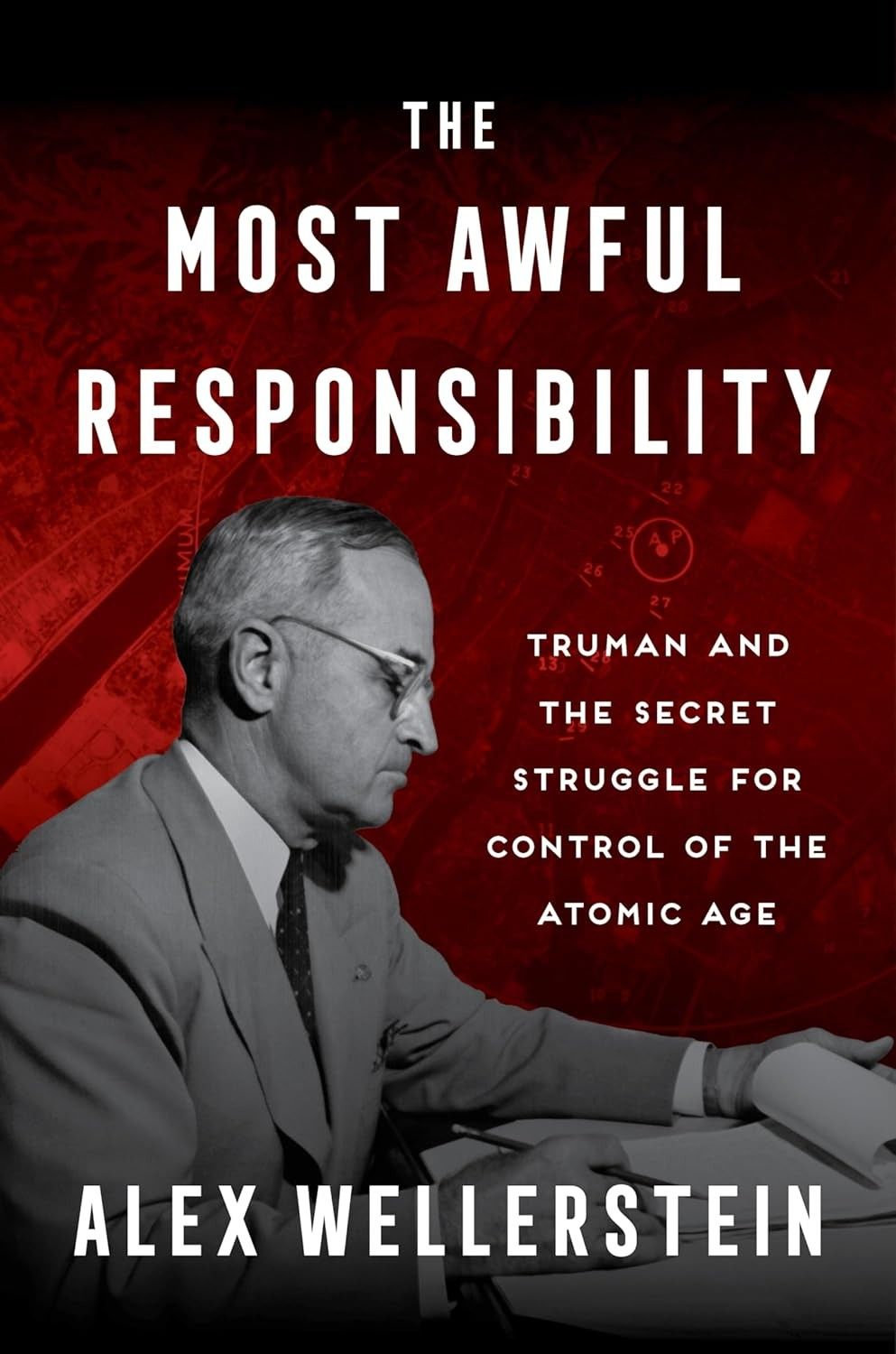
BOOK REVIEW: The Most Awful Responsibility: Truman and the Secret Struggle for Control of the Atomic Age
By Alex Wellerstein / William Morrow
Reviewed by: John A. Lauder
The Reviewer: John A. Lauder is a Senior Fellow at the Wisconsin Project on Nuclear Arms Control and is a founder of the James A. Garfield Center for Public Leadership at Hiram College. He retired from the US government with over 33 years of managerial, analytical, and policy experience in the Central Intelligence Agency*, National Reconnaissance Office, and as an arms control negotiator. He has continued to lead efforts to improve intelligence on weapons of mass destruction and to facilitate verification of international agreements.
REVIEW — The reputation of Harry Truman, and appreciation for the accomplishments of his presidency, have grown in the years since his departure from office. Truman now regularly makes the list of the greatest Presidents in part because of his common man image and the extraordinary challenges that he surmounted in office.
Still, one area of great debate and uncertainty has been Truman’s role in the use of atomic weapons against Japan and his views of nuclear weapons in the early years of the Cold War. Alex Wellerstein, in The Most Awful Responsibility; Truman and the Secret Struggle for Control of the Atomic Age, provides a fresh, insightful, and provocative look at Truman’s perspectives and decision-making related to atomic weapons.
Wellerstein is an associate professor in the science and technology program at the Stevens Institute of Technology. He is known as an historian of nuclear issues, including his book Restricted Data: The History of Nuclear Secrecy in the United States. He may be most familiar to some readers of the Cipher Brief though as the creator of NUKEMAP – the online nuclear weapons effects simulator that scholars use to assess scenarios and that others seek out in the middle of the night to contemplate the terrible consequences of an international crisis spiraling out of control.
In the Most Awful Responsibility, Wellerstein depicts a conflicted Truman. The President did not shy from taking responsibility for the dropping of the atomic bombs on Japan but remained throughout his Presidency opposed to further use of such weapons. Truman oversaw the development of the national security infrastructure and strategy that managed the Cold War in which nuclear weapons became an increasingly greater component of deterrence and national power. Truman set in motion the great expansion in the numbers and destructive power of nuclear weapons – but also helped enshrine the worldview that the nonuse of such weapons should be the norm. Such weapons would be for deterrence and not be a routine instrument of conflict. They would be used only in the most dire of circumstances and only then at the explicit direction of the President.
Wellerstein depicts the complexity and humanity of Truman in establishing the norms and policies that still govern the control and use of nuclear weapons. The author argues that “the idiosyncratic and human aspects of Truman, the man, had large impacts on the decisions made by Truman, the president. . . Truman, the president, is the one who made the modern nuclear age, and rooted the personage of the US President to the very core of it.”
Wellerstein persuasively relies on documents and notes created at the time of key decisions as opposed to later memoirs that sometimes articulated a clear rationale for decisions that were driven more by the crush of events rather than wise policy foresight. The book is exhaustively footnoted and contains a rich bibliography. The author acknowledges the contribution of scholars and former government officials who will be well-known to students of nuclear history, strategy, and arms control. Despite the underlying layer of his impressive research, the author has a highly readable style that makes the book a page turner for general readers and not a ponderous tome only for the most expert in the arcane discipline of nuclear affairs.
The easy writing style does lead the author to be almost too brief in the identification of the many players and events of the beginning of the Cold War. For example, referring to Paul Nitze, the principal drafter of NSC-68 – arguably the seminal document of Cold War strategy -- merely as an analyst at the State Department seems a striking understatement.
Given the extensive volume of sources on the beginnings of the Cold War, it is understandable that Wellerstein misses citing some key works. Wellerstein outlines the factors that led the US to pursue even more powerful nuclear weapons – the hydrogen bomb or the Super as it was called at the time. Yet, the author does not cite an iconic political science article on that decision – Warner Schilling’s “The H-Bomb Decision: How to Decide without Actually Choosing.”
This omission is surprising because the Schilling thesis – that Truman and most other Presidents have sought to make minimal decisions to keep open the greatest number of future alternatives -- supports one of the key themes of the Wellerstein book. Truman often made only incremental decisions at the milestones of the early nuclear age but bureaucratic momentum, political exigencies, and strategic concerns about Soviet behavior led to outcomes that Truman did not initially wish to pursue. The US pursuit of capabilities to produce hydrogen bombs was one such outcome driven in the end by domestic politics and fear that the US could not be in a position where the Soviets acquired such capability first.
The key instance of Truman deciding without actually choosing was his assent to the military target list for the atomic bombings of Japan. Wellerstein makes a strong case that Truman thought he was acting to mitigate the destruction of civilian populations by sparing Kyoto as a target in favor of Hiroshima and Nagasaki, which Truman’s contemporary writings suggested that he believed were primarily miliary targets and not urban centers.
Despite small blemishes, The Most Awful Responsibility should be part of every collection of the history of the Cold War and of the Presidency. The author shines new light on the origin story of US nuclear weapons policy and of the establishment of the President as the sole authority who can authorize the use of nuclear weapons by the United States. Wellerstein makes a compelling case that Truman should not be remembered primarily as the only President who used nuclear weapons in combat but as the President who set in motion the policies and procedures that have so far meant that he was the last President to use such weapons. Wellerstein concludes: “In something like atonement for having used the atomic bombs in the first place, [Truman] centralized more and more responsibility for nuclear weapons in the office, and even the person, of the president, for better or worse. But his motivation for this was not because he wanted the power to use the weapons himself, but because he wanted the power to make sure they were not used again. That is the awful responsibility that he ultimately took upon himself.”
*All statements of fact, opinion, or analysis expressed are those of the author and do not reflect the official positions or views of the US Government. Nothing in the contents should be construed as asserting or implying US Government authentication of information or endorsement of the author's views.
The Cipher Brief participates in the Amazon Affiliate program and may make a small commission from purchases made via links.
Sign up for our free Undercover newsletter to make sure you stay on top of all of the new releases and expert reviews.
Read more expert-driven national security insights, perspective and analysis in The Cipher Brief because National Security is Everyone’s Business
The Most Awful Responsibility: Truman and the Secret Struggle for Control of the Atomic Age earns an impressive 3.5 out of 4 trench coats