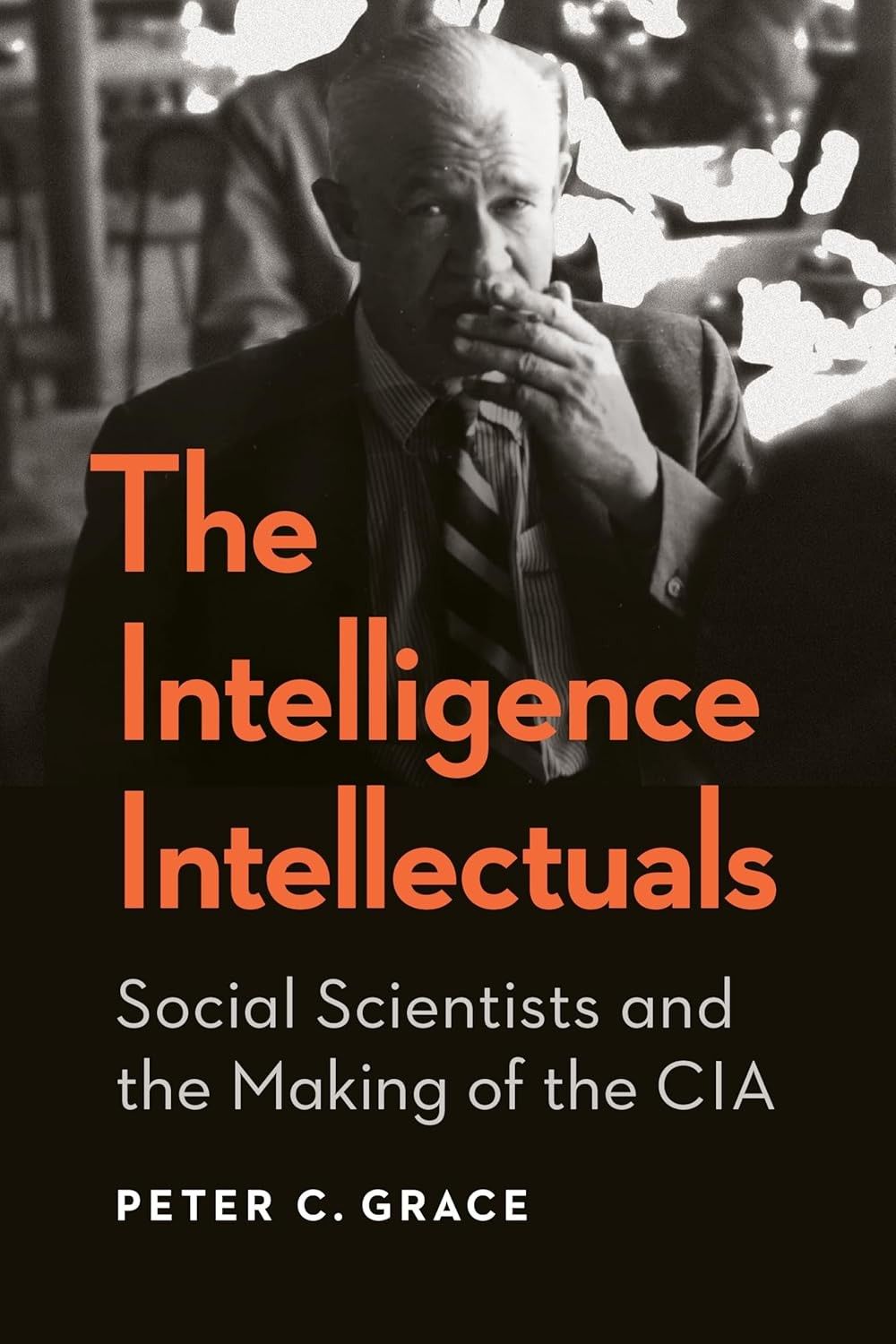

BOOK REVIEW: The Intelligence Intellectuals: Social Scientists and the Making of the CIA
By Peter C. Grace/ Georgetown University Press
Reviewed by: Linda Weissgold
The Reviewer: Cipher Brief Expert Linda Weissgold retired from the Central Intelligence Agency* with more than 37 years’ experience. Her final position was serving as Deputy Director for Analysis, responsible for the quality of all-source intelligence analysis at the CIA. She previously served as head of CIA’s Office of Terrorism Analysis and as a Presidential Intelligence Briefer. She is currently the Director of the Masters in National Security and Intelligence Program at Texas A&M University’s Bush School of Government and Public Service in Washington, DC. She is also a geopolitical consultant and active on multiple advisory boards.
REVIEW —Intelligence professionals and educators, myself included, speak about objective analytic tradecraft and the analytic intelligence discipline not only as inherently important for our national security, but as axiomatic. Peter Grace’s new book, The Intelligence Intellectuals: Social Scientists and the Making of the CIA, however, reminds us that neither was inevitable in the early days of the CIA and that both require constant attention to maintain the respect of demanding consumers. The author makes a convincing case that a few key social scientists and economists who joined the struggling CIA analytic ranks in the period between 1950 and 1953—including Sherman Kent, William Langer, and Max Millikan—are largely responsible for establishing the organization’s analytic legitimacy with policymakers and the military and creating the tradecraft and culture of rigorously testing hypotheses that still exist today. As the author states, they understood that creating an institution and a profession of peacetime strategic intelligence meant that “the organization needed to create a workforce of civilian intelligence analysts, develop expertise and a product that competitors couldn’t offer, and fulfill a need demanded by national security stakeholders.”
Grace’s research, which is mostly drawn from primary sources, paints a vivid picture of the many bureaucratic challenges and turf wars faced by the fledgling CIA, including gaining access to compartmented information, but focuses largely on the uncharted waters of delivering timely, sophisticated, and coordinated strategic estimates. The 1947 National Security Act that established the CIA specifically authorizes it to correlate, evaluate, and disseminate intelligence, or analysis. Indeed, CIA’s creation is grounded in a resolve to prevent another Pearl Harbor by ensuring that available intelligence would be evaluated in one place and provided to those who need it. Policymakers were not looking for CIA analysts to deal with the obvious. Their territory was, and continues to be, the unknown, the uncertain, and the deliberately hidden.
The three-year period covered in Grace’s book is a relatively small slice of CIA’s history, but it marks a remarkable turnaround without which the organization might not have survived. By 1950, President Truman perceived the fledgling CIA as failing to meet his expectations and installed a new CIA Director, Walter Bedell Smith, to enact reforms. CIA faced accusations in 1949 of failing to accurately predict the Soviet Union’s development of the atom bomb and China’s fall to Communism, as well as the outbreak of the Korean War in 1950. Smith, and the Ivy League social scientists that he recruited, realized that answering the policymakers’ needs required new methodological approaches and greater expertise. Within just a few years, these thought leaders built a solid tradecraft foundation and hired a workforce that delivered lasting change.
During my tenure leading CIA’s Directorate of Analysis, I was always conscious that I was standing on the broad shoulders of previous generations, so this book is almost certainly more personal to me than it will be to most readers. As I read many of the citations, I realized how much of my own theories of analytic tradecraft can be traced directly to this period in CIA’s history. I often say that at the heart of CIA’s analytic tradecraft is the ability to explain why you think what you think and to be able to replicate that objective thought process if asked to do so. In addition, intelligence analysts owe customers transparency on their confidence in their judgments and the humility of continuous learning. These are essentially derivatives of principles Sherman Kent, who is largely credited with creating a strategic analysis intelligence discipline, laid out in his writings. Grace highlights a quote from Kent’s autobiography that writing strategic intelligence estimates requires assessing “knowable information which we knew for certain; unknowable information which we could not state for certain but about which we could make reasonable conjecture; and unknowable information which was virtually impossible to prove and when presented had to be couched in varying degrees of probability and improbability.”
Throughout Grace’s book, I repeatedly found myself thinking of the adage that history doesn’t repeat itself but often rhymes. As a result, I could not help wishing that the author had more explicitly drawn lessons for current practitioners and consumers. To do so, however, would have changed the academic nature of the book. So, I will offer a few historic parallels for consideration:
Sherman Kent sought to set reasonable customer expectations for strategic vice tactical analysis — a debate that continues today. (Think of the difference of warning of al-Qa’ida’s intent to attack the United States and predicting the day.)
The job of an analyst is still grounded in thinking critically, weighing information that is often contradictory and always incomplete; assembling and testing arguments; and using words and visuals in ways that are clear, concise, and compelling. Policymakers and analysts still struggle with ensuring shared understandings of probabilistic language. Fueled by the lessons of the past, however, relations with customers have become more of a dialogue. This discussion allows clarification and is, in my opinion, not innately politicization. Pushback and controversy often are a price for relevance and impact in a process where intelligence is only part of a policymaker’s corpus of information.
Grace describes how analysts in the early CIA developed tools and methodologies to cope with unprecedented levels of information and disinformation flowing in from all corners of the world, but he does not draw comparisons to today’s information overload and unreliability. I personally am confident that his “intelligence intellectuals” would, as I do, advocate that we leverage AI to find “the signal within the noise” but also caution against the replacement of analysts. In 1965, Kent warned new collection methods meant the intelligence discipline needed to change with the times, but also stated his conviction that “there is no substitute for intellectually competent human—the person who was born with the makings of a critical sense and who has developed them to their full potential; who through firsthand experience and study has accumulated an orderly store of knowledge, and who has a feeling for going about the search for further enlightenment in a systematic way.” This description fits the dedicated public servants at CIA of yesteryear and today.
The Intelligence Intellectuals: Social Scientists and the Making of the CIA, clearly and succinctly depicts a critical period in the history of American intelligence analysis and deserves a spot on the overflowing bookshelves of Cold War historians and intelligence scholars.
*All statements of fact, opinion, or analysis expressed are those of the author and do not reflect the official positions or views of the US Government. Nothing in the contents should be construed as asserting or implying US Government authentication or endorsement of the author’s views.
The Cipher Brief participates in the Amazon Affiliate program and may make a small commission from purchases made via links.
Sign up for our free Undercover newsletter to make sure you stay on top of all of the new releases and expert reviews.
Read more expert-driven national security insights, perspective and analysis in The Cipher Brief because National Security is Everyone’s Business