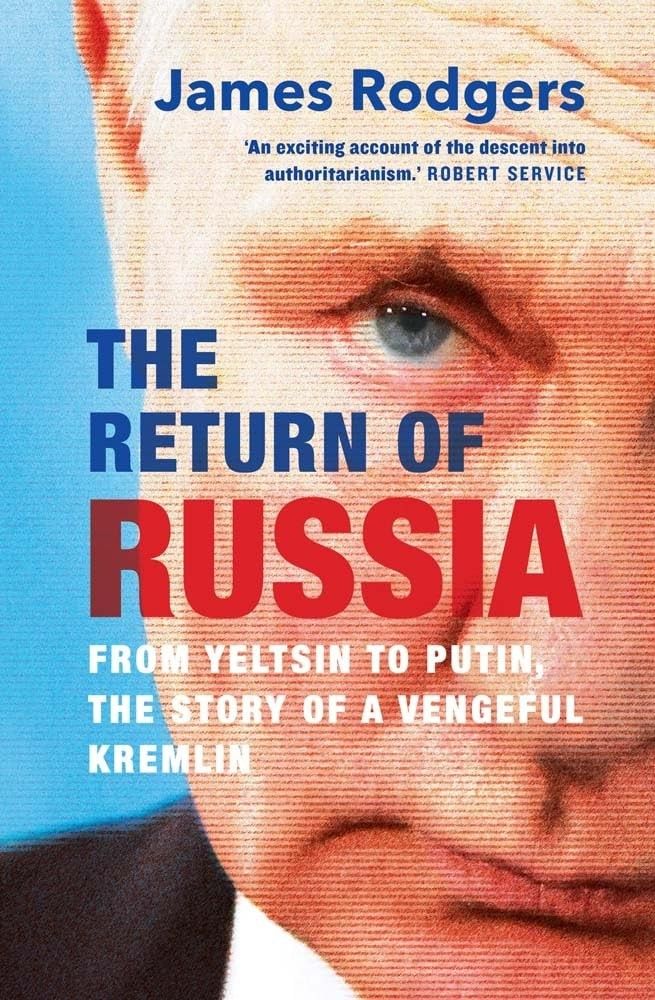

BOOK REVIEW: The Return of Russia: From Yeltsin to Putin, the Story of a Vengeful Kremlin
By James Rodgers / Yale University Press
Reviewed by: Susan Gorgioski
The Reviewer: Susan Gorgioski is a writer who lives in Australia. She informs us that she has never served in special operations or intelligence -- but likes to read those genres among others. She’s researching a novel while enjoying life with her family and three amazing dogs
REVIEW — James Rodgers is an experienced former TV producer, journalist and writer who teaches journalism at the University of London. His new book The Return of Russia: From Yeltsin to Putin, the Story of a Vengeful Kremlin is an ambitious study of the political turmoil that engulfed Russia from the end of the Union of Soviet Socialist Republics under Mikhail Gorbachev to the present day.
Rodgers has shrewdly decided to concentrate on the years 1991 to 2022. While news has travelled evermore swiftly during this period, attention spans have continued to wane. The disintegration of the Union of Soviet Socialist Republics in 1991 was a moment of unimaginable significance. The Soviet Socialist behemoth had finally collapsed. This would have been an unthinkable occurrence even ten years earlier. Rodgers was well placed to observe and report on these dramatic changes. He speaks Russian and was posted to the country during crucial moments in the last 30 years.
He relies heavily on political memoirs, news reports, official government statements and interviews with key figures. There is little personal reflection of his time in Russia or the thoughts and opinions of average Russians. His focus is on the channels of official and, in the case of Bellingcat; open-source intelligence which is a relatively new tool for historians.
The main character in this period is Vladimir Vladimirovich Putin.
The book provides a good introduction and analysis of the wars against Chechnya and the terrorism that accompanied them. In the 1990s Chechnyan insurgents embarked upon a campaign of bombings and killings to further their independence aims. Putin portrayed these atrocities as attacks on Russia which had to be stopped and extraordinary measures had to be employed to ensure this happened. Restrictions on media, freedom, and political expression followed. The 1994 war in Chechnya was an exceptionally bruising experience for Russia. Its men were slaughtered and what in theory should have been a quick victory for Russia, became prolonged carnage.
The late 1990s were an economic disaster in Russia. The transition from Soviet communism to free market liberalism was neither planned nor controlled. Having said that, 10% of the Russian population in 1999 owned the majority of the country’s wealth. The rise of that curious golem: a Russian oligarch was well underway. Rodgers provides valuable statistics and examples of the chaos that was the Russian economy. Bill Browder is mentioned in passing in The Return of Russia: From Yeltsin to Putin, the Story of a Vengeful Kremlin but interested readers should read Browder’s Red Notice for a detailed and terrifying exploration of ‘doing business’ in Putin’s Russia.
NATO was and will always be an organization that is a source of concern and hatred for Russia. The Warsaw Pact dissolved but NATO carried on and, inadvertently and purposely, aggravates Russia to this day. At the 2008 Bucharest Summit, Georgia and Ukraine were promised membership “one day”. Rodgers details how galling this was to Putin and, ultimately, unhelpful to Georgia and Ukraine. NATO’s ephemeral carrots were responded to with tanks, missiles and thousands of men on the ground when Russia invaded Georgia and Ukraine.
Military campaigns by Western governments in Kosovo, Libya and Iraq cumulatively exposed the differences between how Putin saw Russia’s role on the world stage versus how Western governments saw Russia. In essence, Western governments made the mistake of treating Russia like a provincial backwater that had once been great. A country like Russia with such a diverse and complex history — and nuclear weapons stockpile — should never have been underestimated especially when so many issues were left unresolved after the end of the Cold War. Pride is paramount to the Russian people, as it is for most people. Putin took the actions of the West personally and by force of personality and oratory skill took the Russian people with him in opposing the West.
A chapter in the book deals with the invasion of Crimea by Russia in 2014. Putin claimed justification for the invasion and annexation of Crimea by citing Kyivan Rus; “…Putin recalled that Crimea was where ‘Prince Vladimir was baptised. His spiritual feat of adopting Orthodoxy predetermined the overall basis of the culture, civilisation and human values that unite the peoples of Russia, Ukraine and Belarus.” ‘Putin frequently harkens back to Russia’s golden past. A superlative propaganda tool that has served him well. He has been employing the same strategy in the current war against Ukraine.
As said at the beginning, the main character in this story is Vladimir Vladimirovich Putin. He casts a long shadow during and will continue to do so for the foreseeable future. Rodgers has written a solid account of the thirty years since Gorbachev and Yeltsin attempted to usher in extraordinary changes to an extraordinary land. This book is a welcome addition to this area of scholarship.
The Cipher Brief participates in the Amazon Affiliate program and may make a small commission from purchases made via links.
Sign up for our free Undercover newsletter to make sure you stay on top of all of the new releases and expert reviews.
Read more expert-driven national security insights, perspective and analysis in The Cipher Brief because National Security is Everyone’s Business