

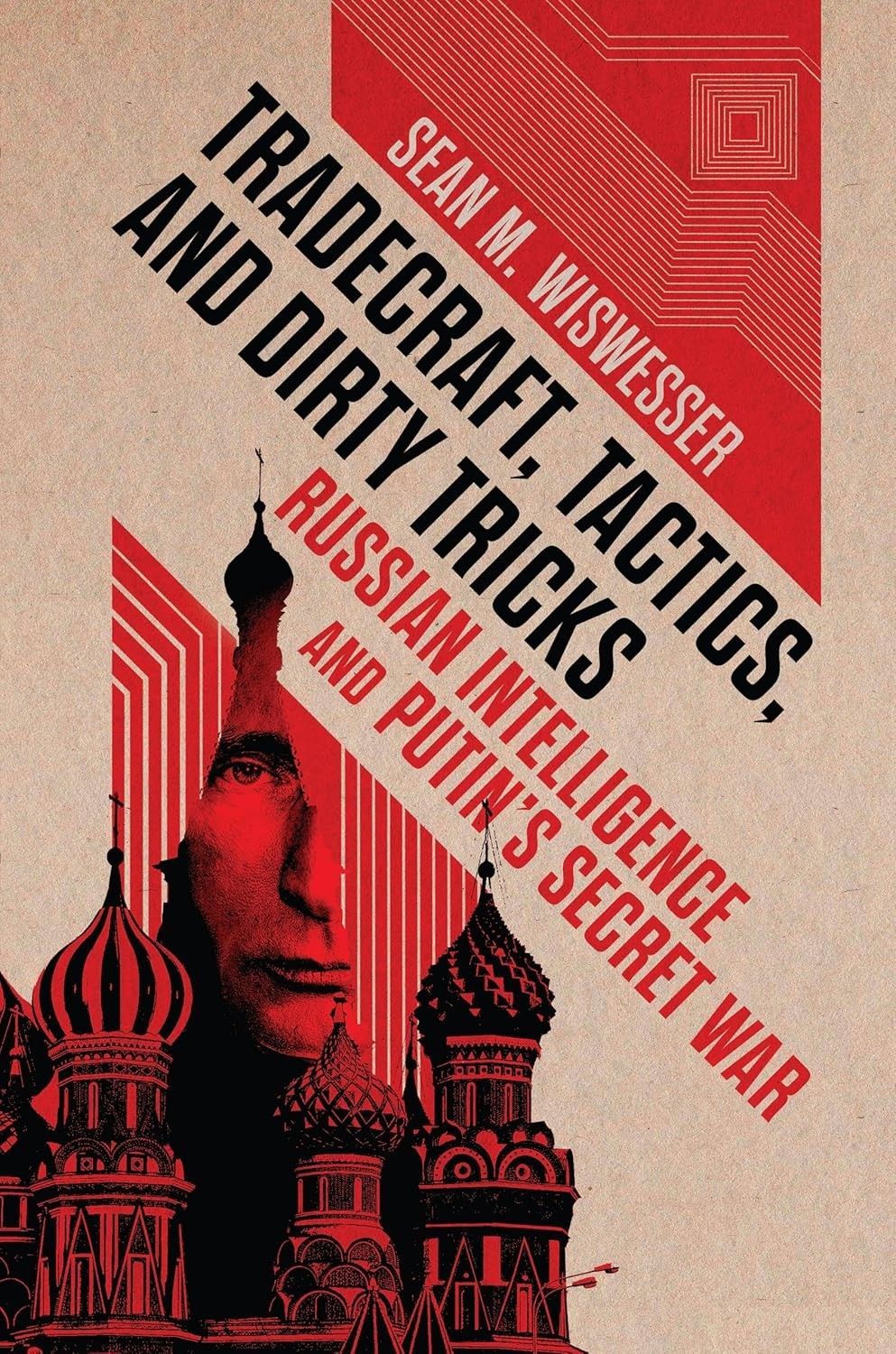
BOOK REVIEW Tradecraft, Tactics, and Dirty Tricks: Russian Intelligence and Putin’s Secret War
By Sean M. Wiswesser / Naval Institute Press,
Reviewed by: Joseph Augustyn
The Reviewer — Joseph Augustyn is a 28 year veteran of the CIA’s Directorate of Operations, and once served as the Director of the National Resettlement Operations Center
REVIEW: With the dissolution of the Soviet Union in December 1991, the world, and especially the United States, breathed a collective sigh of relief. The Cold War was over…capitalism had defeated communism, and the world was perceived to be a safer place. The Soviet intelligence system, long dominated by the KGB, was decimated and dismantled, and what was left of the intelligence apparatus was divided among various smaller and fragmented agencies eager to assert their influence in a troubled country in search of a new identity. For almost ten years, confusion and uncertainty plagued the Russian intelligence system until…Vladimir Putin.
Putin’s rise to power shocked no one who knew him. A relatively obscure KGB officer in East Germany, he was brought back to Moscow in the late 1990’s to head the relatively new FSB (The Federal Security Service), the principal security agency of Russia that would grow under his tenure to nearly 100,000 people strong. Putin’s ascendency to the presidency in 2000 saw the reemergence and growth of the country’s intelligence apparatus to a new level of international prominence and influence not seen since the USSR’s collapse.
In what some would argue is a new Cold War between the US and Russia, this one not about communism versus capitalism, but about national security writ large, there is a pressing need for the US Intelligence Community (IC) to understand, counter when necessary, and defeat when required, Putin’s powerful and growing intelligence juggernaut. With his book, Tradecraft, Tactics, and Dirty Tricks, Sean Wiswesser has given us an important tool and guidebook on just how to do that.
Wiswesser is a 28-year veteran of the CIA, spending much of his time as a senior case officer overseas (including as Chief of Station), but he is more than that. He knows Russia. He is a fluent Russian speaker, a student of Russian history and culture, and he knows what makes Russians tick, having recruited some of recruited some of them himself having spent countless... hours debriefing Russian intelligence officers and defectors.
The title of Wiswesser’s book, Tradecraft, Tactics, and Dirty Tricks, speaks for itself. The book is a compendium of detailed stories and anecdotes about the Russian Intelligence Services (RIS), their histories and their failures and successes. At times, the book reads like a scholarly dissertation when the author documents and details the organizational structures and various departments of Russia’s three main intelligence agencies, i.e., the FSB, SVR (the external service) and the GRU (its military intelligence arm). On the other hand, and at the same time, the book provides an engaging narrative of the author’s personal interactions with Russian intelligence officers, and details those intelligence operations against the Russians in which he was involved and allowed by CIA to discuss.
Wiswesser divides his 200 pages of text into ten chapters, each dealing with a specific facet of what he calls the “malign” services. There are chapters, for example, on “Training and Preparation,” “Surveillance”, “RIS Street Tradecraft” and “Dirty Tricks.” And another on the “Illegals” program, a program which utilizes Russian sleeper agents worldwide under unofficial cover. As the author confirms, despite its historically low rate of effectiveness, Putin still heralds those who serve as “illegals” as the “pride” of the RIS. Wiswesser devotes several pages to the FBI’s now celebrated and well documented “Ghost Stories” operation in which ten Russian illegals living in the US were arrested and eventually traded in June 2010 for four individuals held by Russia on espionage charges (Wiswesser himself played an admittedly small role in the operation).
Wiswesser is at his best when discussing his personal experiences dealing with the RIS over his long career at CIA. He is not kind, nor should he be, in concluding that the entire RIS system is corrupt, dishonest and unscrupulous, its officers frequently admitting to him in private conversation that many in their cadre fabricate and exaggerate intelligence reports in order to further their careers or to garner favoritism among their superiors. The use of coercion and blackmail, he adds, is also a common tradecraft practice in the RIS, as is the use of “honey traps” or “swallow operations,” a tactic in use for decades because of its effectiveness and success… particularly among Westerners. Illustrating his point, Wiswesser details the Clayton Lonetree “sexpionage’ case in which the Moscow-assigned US Marine guard was seduced by a female KGB officer in the late 1980’s and provided damaging US intelligence to Moscow. Amusingly, Wiswesser cites Putin as publicly proclaiming at one point that “Russia has the best prostitutes in the world.”
What we learn throughout the book is that none of the Russian intelligence services are meritocracies, that all hold allegiances to Putin, and that if you “kill” for Putin, he will not forget you. Wiswesser uses the example of the assassination attempt in March 2018 of Russian double agent Sergei Skripal and his daughter Yulia, who were poisoned by a Russian nerve agent in Salisbury, England. While they survived, the two GRU agents, who Wiswesser says were ”lazy” and careless in their tradecraft, were publicly honored by Putin upon their return to Moscow. Furthering his point about the brutality of Putin and his regime, after the successful assassination of Russian helicopter pilot Maxim Kuzminov, who defected to Ukraine and then moved to Spain, former Russian President Dmitry Medvedev boasted on Russian TV that “A dog deserves a dog’s death.”
Wiswesser describes in terms the general reader would understand the use of sabotage, Active Measures (the use of disinformation, front organizations, hacking etc. to advance foreign policy goals) and cyber warfare, all actions intended to undermine and destabilize especially NATO countries, the US, and all of Putin’s perceived enemies. While the reader is left with the feeling that Putin and his regime are engaged in a full-fledged war, Wiswesser is reassuring at the same time in dispelling that notion because on what he says is the incompetence, laziness, dishonesty and rampant corruption that permeates the RIS.
Wiswesser concludes his book with a compelling and thoughtful discussion of the ongoing war in Ukraine. He specifically highlights the role played by the RIS in orchestrating and executing the war plan, a plan, he says, that has failed in large part because of the ineptitude of the RIS. The lack of integrity in their reporting and targeting, and the false assurances to Putin that the war would be concluded in weeks serve, he says, to demonstrate once again that the RIS is incompetent and stands on clay feet.
Tradecraft, Tactics, and Dirty Tricks is an excellent addition to the compendium of works on the RIS. By coupling his personal and professional experiences with the history and evolution of Putin and the rise of the RIS since 1991, Wiswesser’s book is both insightful and entertaining. His bibliographical citings of other relevant studies and books throughout will be beneficial to those interested in a deeper dive into many of his chapter topics. While obviously proud of his prowess in the Russian language, a minor nit is his overuse of adding the Russian language equivalent to many of the phrases and words he uses throughout his book. Tradecraft, Tactics, and Dirty Tricks is a welcome and highly recommended study for those in the intelligence and/or foreign policy business, or the general reader interested in understanding how Putin and the RIS play the game in this most recent reiteration of spy vs spy.
All statements of fact, opinion, or analysis expressed in this review are those of the author and do not reflect the official positions or views of the US Government. Nothing in the contents should be construed as asserting or implying US Government authentication of information or endorsement of the author’s views.
Editor’s Note: Sean Wiswesser, author of Tradecraft, Tactics and Dirty Tricks was interviewed for a Cipher Brief “State Secrets” podcast published this week. Give it a listen here.
The Cipher Brief participates in the Amazon Affiliate program and may make a small commission from purchases made via links.
Sign up for our free Undercover newsletter to make sure you stay on top of all of the new releases and expert reviews.
Read more expert-driven national security insights, perspective and analysis in The Cipher Brief because National Security is Everyone’s Business
Tradecraft, Tactics, and Dirty Tricks earns an impressive 3.5 out of 4 trench coats