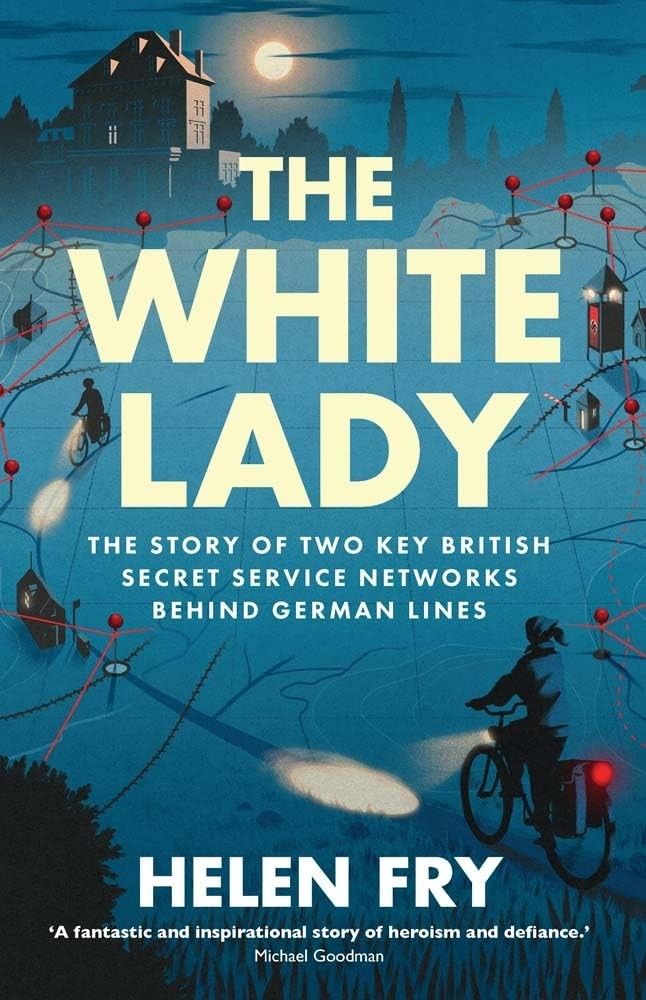

BOOK REVIEW: The White Lady. The Story of Two Key British Secret Service Networks Behind German Lines
By: Helen Fry/ Yale University Press
Reviewed by: Tim Willasey-Wilsey
The Reviewer: Tim Willasey-Wilsey CMG is a Cipher Brief expert. He is a Visiting Professor of War Studies at King’s College, London and a Senior Associate Fellow at RUSI, the defense think tank in London.
REVIEW — This has been a book waiting to be written for 90 years. The secrets of the “La Dame Blanche” intelligence network in Belgium during the First World War were first revealed in 1935 (in contravention of the rules) by the brilliant but egotistical South African MI6 officer, Henry Landau, in his book of the same name. Since then, it has long been known that the network was revived in 1939 as “The Clarence Service” and that it survived intact until the end of the Second World War. However, the MI6 files have remained tightly sealed. Fortunately, most of the papers in the Belgian Archives have recently been declassified. Helen Fry managed to get in early and has been able to write the first joint history of the two networks.
The similarity between the two is quite remarkable. The two world wars were only separated by two decades and for MI6 it seemed obvious to try and replicate a system which had worked so well before. One problem to overcome was Henry Landau’s published indiscretions in the United States which had named too many names and had revealed too many techniques. This is a prime example of why secret services should keep their secrets, although Landau could be partially forgiven because many of the Belgian heroes of La Dame Blanche had been awarded British medals in 1919 with their names revealed in the official government gazette.
La Dame Blanche was a remarkable success, particularly in monitoring railway traffic in German-occupied Belgium thereby providing General Haig’s Headquarters in Montreuil, northern France with crucial insights into the German forces facing them across the front line. The operation also represented a seminal moment in the history of MI6 (SIS). The Directorate of Military Intelligence (DMI) in the War Office was constantly trying to take over the small fledgling service founded in 1909 by an eccentric naval captain (Mansfield Cumming) from Boom Defence. However, thanks to the quality of the intelligence provided from Rotterdam by Landau and the White Lady, Cumming finally won out. Had it not been so, MI6 would probably not exist today.
In many ways La Dame Blanche was quite clunky. In an ideal world, MI6 would have recruited a couple of agents in Berlin to provide intelligence on German troop movements and intentions. Indeed, in one moment of nirvana, an official from the Dusseldorf Post Office “walked in” to Landau in Rotterdam with a full copy of the postal directory for all German deployed units with their locations. This was the intelligence equivalent of winning the lottery.
However, in the absence of ongoing access of this nature, the only option was to build a massive network of observers and couriers. Fry tells us that the operation employed over 3,000 Belgians. Such networks are exceptionally liable to compromise and penetration. During the course of the conflict 1,200 agents were imprisoned and over 100 shot or died in captivity.
The Cipher Brief brings expert-level context to national and global security stories. It’s never been more important to understand what’s happening in the world. Upgrade your access to exclusive content by becoming a subscriber.
The courage and resilience of the members of the network (many of them women, priests and nuns) was extraordinary. Some agents (known as passeurs or smugglers) even had the job of crawling under or through the high voltage fence on the Belgian/Dutch border known as “The Fence of Death” to carry the intelligence to the MI6 station in Rotterdam. Some 850 passeurs were electrocuted in this way (although presumably this is a figure for all smugglers not just those connected with the MI6 operation.)
All too little is known about how the thousands of little snippets of information were processed into actionable intelligence and in what form it reached GHQ via (it seems) the Military Attache in The Hague and the War Office in London. All too few reports seem to have survived. Most related to troop movements but Fry has found a few additional subjects. There is mention of an experimental gun with a 30-metre-long barrel and a purported range of 120 km. Towards the end of the war there was some vital material about the fragile morale of German troops.
Communication was a constant problem. The perils of the Fence of Death and radio transmissions persuaded Landau to think of improved methods. Carrier pigeons were widely employed but aircraft were also used for clandestine missions into enemy territory; a forerunner of the Special Duties aircraft of the Second War.
When the Clarence Service was set up in 1939 it is truly remarkable how many La Dame Blanche veterans (now mostly in middle or even old age) volunteered. Fry rightly focusses on Dieudonné Lembrecht and Walthère Dewé who were both inspirational leaders and paid with their lives. She tells the tragic story of Dewé’s death with the fascinating addendum that the Germans never realized they had shot the leader of the whole Clarence Service. The author also rightly stresses the importance of Belgian women in both wars. Thérèse de Radiquès was perhaps the bravest of all in both wars and cleverly used her advanced age to feign dementia when questioned by the Germans. She paid a heavy price for her patriotism, losing two members of her family. Another female aristocrat was Baroness de Menten (codename Frédérique) who even mounted her own operation to find out the details of the unexpected German Ardennes offensive in late 1944.
One small area which Fry does not explore is the motivation of the members of Clarence. How did it compare to the French Resistance where the aristocrats were outnumbered by communists? Was there a particular reason why Clarence members worked for MI6 rather than the various other networks in Belgium? She does expertly explain the perils of mixing different types of resistance. La Dame Blanche soon realized the dangers of dabbling in escape networks and Clarence knew to avoid involvement in SOE sabotage operations. Any diversion from pure intelligence collection could lead to disaster.
And the intelligence collection was important. Clarence provided vast amounts of tactical information which was useful in the preparations for D-Day. It also reported on V-1 launching sites including a 28-page report on the subject in July 1944. By now Clarence had far more reliable radio comms whereas previously some agents had to travel through France and Spain to pass their reports to MI6.
Fry brings out several common themes from these two operations. She rightly points to the central role played by women and the ground-breaking decision of MI6 (initially without clearance from the War Office) to grant them military ranks long before women in the British armed services served in combat roles.
She demonstrates the supportive, encouraging and appreciative messaging from MI6 in both wars; from Henry Landau in Rotterdam in the first war and Frederick Jempson and Ruth Stowell from London in the second. After both wars great care was taken to ensure that suitable recognition was accorded to the agents. 1,547 agents worked for Clarence of which 52 lost their lives. Field Marshal Sir Bernard Montgomery was co-opted by MI6 to add his tributes to the Clarence Service just as Field Marshal Sir Douglas Haig had for La Dame Blanche.
And thirdly, her book reinforces the dangers of running networks. The stories of arrests, interrogations, torture, imprisonment in Ravensbrück, and death are truly horrific. In the circumstances it is remarkable that both networks (and a third known as Mill) survived. The lesson for any intelligence service is to have agents in any potential enemy’s warfighting machine well in advance of any conflict thereby rendering such networks unnecessary.
Incidentally, one wonders how important the Clarence reporting and the material from Biffy Dunderdale’s French networks (see A Spiffy Tale of MI6 Legend “Biffy” Dunderdale in Cipher Brief book reviews of 20th September 2024) was, compared to the intercept material from ULTRA during the war. To what extent was such HUMINT reporting needed to provide cover for the sheer magnitude of the British SIGINT success against German cyphers? The fact that the Germans witnessed such extensive espionage in Belgium and France must have reassured them that their encrypted traffic was secure. It is a disconcerting thought but one worthy of future historical study.
There is only one blemish in this marvelous book. Yale should have provided a map of Belgium showing all the key railway lines and the position of the front line for most of the first war. Furnished with such a map the text makes so much more sense. Nonetheless Helen Fry has produced a real thriller and a fitting testament to the heroism of the Belgians in both world wars.
The Cipher Brief participates in the Amazon Affiliate program and may make a small commission from purchases made via links.
Sign up for our free Undercover newsletter to make sure you stay on top of all of the new releases and expert reviews.
Read more expert-driven national security insights, perspective and analysis in The Cipher Brief because National Security is Everyone’s Business