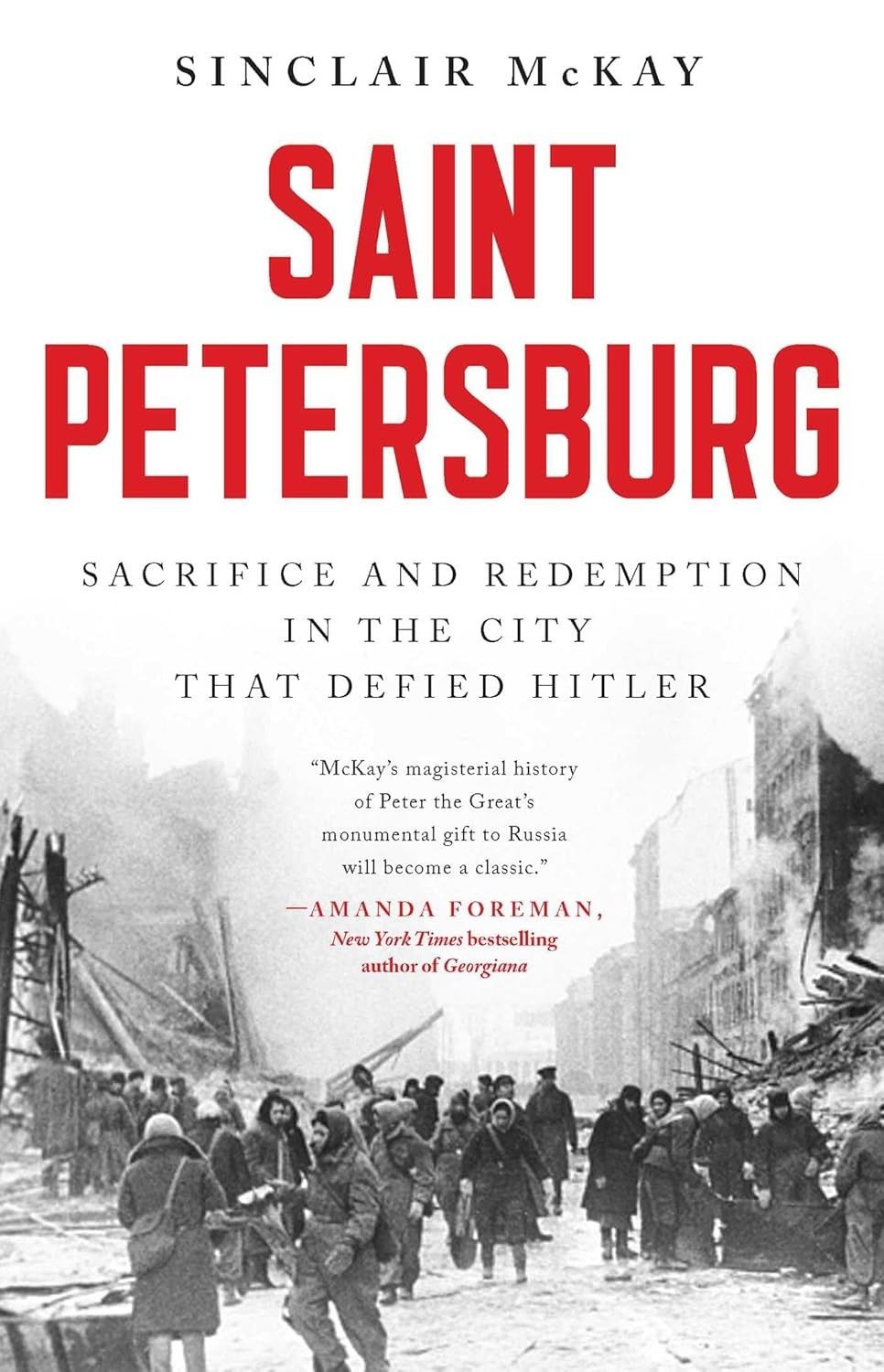

BOOK REVIEW: Saint Petersburg: Sacrifice and Redemption in the City that Defied Hitler
By Sinclair McKay/Pegasus Books
Reviewed by: Susan Gorgioski
The Reviewer: Susan Gorgioski is a writer who lives in Australia. She informs us that she has never served in special operations or intelligence -- but likes to read those genres among others. She’s researching a novel while enjoying life with her family and three amazing dogs
REVIEW — Saint Petersburg, AKA Petrograd, AKA Leningrad, began life as a twinkle in Russian Czar, Peter the Great’s, eye. What better way to announce to the world that one is powerful, glamorous and despotic than by creating a unique city of beauty and solidity on marsh land? Peter the Great’s vision for a metropolis that would rival the established European glamour cities was a dream that often resembled nightmares for its citizens. Sinclair McKay’s Saint Petersburg: Sacrifice and Redemption in the City That Defied Hitler is a robust and compassionate examination of the life of its citizens during the siege of Leningrad in World War II.
Sinclair is a literary critic for The Spectator and the Mail on Sunday and author of books like Dresden: The Fire and the Darkness, and The Secret Life of Bletchley Park. He is a charming and erudite guide through the many layers of politics, art, science, military history and Russian history that make up life in Saint Petersburg.
We’re firmly in the realm of modern history and the Second World War was not that long ago. As McKay points out, Vladimir Putin was born in St Petersburg in 1952, and Putin’s parents lost their first child in the siege. Although relatively recent, World War II was not a 24/7 media spectacle. It was documented by hardy photographers and journalists, and by propaganda departments working overtime. So, McKay’s use of the personal diaries and writings of individuals who lived through the period makes for a very sobering and intriguing peek into the lives of ordinary Soviets.
Leningrad, as it was called from 1924-1991, was a city finding its balance after many years of suffering under Stalin’s dictates. The city of famous sons and daughters: Anna Akhmatova, Shostakovich, Pushkin, Prokofiev, Dostoevsky and so on, was always eager to promote and publicize their works when it benefited the regime. Otherwise, these artists were constantly surveilled, interrogated and often imprisoned. Stalin’s man in Leningrad, Andrei Zhdanov was a firm believer in the goals of Soviet socialism and a ruthless practitioner of its darker practices.
McKay provides a wonderful description of the birth of Dmitri Shostakovich’s Seventh Symphony. Considered subversive, and far too modern, Shostakovich was on Zhdanov’s radar and the great composer had to endure surveillance and interrogation, but he refused to leave Leningrad until he was forced to do so before the siege turned desperately dire. He began writing the Seventh Symphony in Leningrad, and strikingly it was performed for the first time in March 1942 during the siege and broadcast around the surrounding areas. The score was eventually smuggled out of the country and made its way to America and Britain.
Who’s Reading this? More than 500K of the most influential national security experts in the world. Need full access to what the Experts are reading?
In the 1930s and 1940s, Leningrad was a busy and important center of industrial production. Many factories were busy producing ammunition and parts for planes and tanks, materiel for the war. The Germans planned to severely hamper and ultimately halt production by destroying Leningrad.
I am not an expert on military strategy and neither is McKay so I appreciated his layman’s introduction to the tactics of the Red Army and the German Army. The Germans were well versed in causing psychological as well as physical torture. The bombing of Leningrad was done not only to kill members of the populace and destroy the beautiful city but also timed to cause mental distress to the population. McKay touches on the pathology of a military that was determined to eradicate the population by bombing, starvation, disease, and any means at its disposal to ensure the death of all Leningraders. McKay provides enough information about the Germans without dwelling on them as his focus is on Leningrad and its people.
Leningrad has always been a profoundly literate society with a deep love of literature and books in general. Its citizens have always been well served by the theatre, ballet, opera and, of course, poets and writers. The strength of McKay’s book is his clever and judicious use of letters, diaries and many unpublished testimonies from children, factory workers, poets and soldiers. The spectrum of life in Leningrad is represented in these accounts, and they speak as no formal government authored paper could ever hope to do.
One extraordinary account of the siege is from fifteen-year-old Yura Riabinkin who lived with his mother and younger sister in an apartment building. He was a young man who believed in the Soviet ideals and he was filled with plans for his future. As the Germans began their march towards Leningrad, Yura was on his way to the Pioneer Palace to play chess with his friends. McKay intersperses military maneuvers and wider political machinations with diary entries from citizens like Yura. Like thousands of others he did not live to see the end of the siege but his words and thoughts are preserved in this book.
Many Cipher Brief readers will be familiar with the statistics from the Siege of Leningrad; the number of days Leningrad was besieged, the number of dead civilians and soldiers, but McKay personalizes this tragic battle and humanizes the participants. An excellent index and bibliography is provided to further guide the curious reader. Saint Petersburg is undoubtedly unique and beautiful, but any city is only as interesting as its inhabitants. McKay has succeeded in bringing to life the lives of ordinary Soviet citizens enduring unimaginable hardship and depravity.
The Cipher Brief participates in the Amazon Affiliate program and may make a small commission from purchases made via links.
Sign up for our free Undercover newsletter to make sure you stay on top of all of the new releases and expert reviews.
Read more expert-driven national security insights, perspective and analysis in The Cipher Brief because National Security is Everyone’s Business