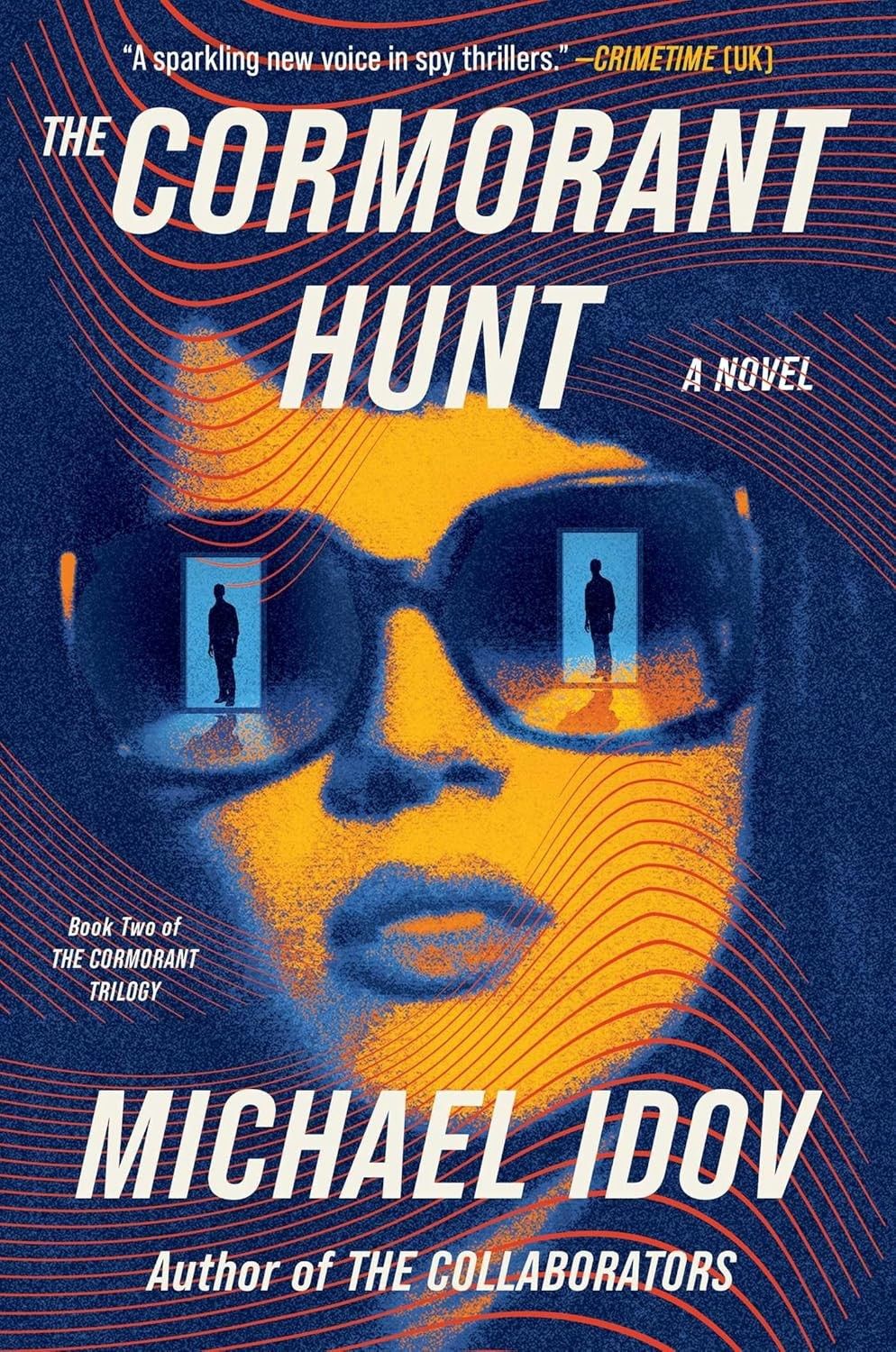


BOOK REVIEW: The Cormorant Hunt
By Michael Idov / Scribner
Reviewed by: Anne and Jay Gruner
The Reviewers: Anne and Jay Gruner are retired CIA senior executives who served in the Directorate of Intelligence and Operations, respectively. Anne was Deputy Director of WINPAC when she retired to become an attorney. Jay served as Chief of Station in multiple countries, was chief of an area division, and founded J.K. Gruner Associates, a business intelligence consultancy. Today, Anne is a writer, poet, and two-time Pushcart nominee whose work has appeared in numerous on-line and print journals. Jay is her muse, beta reader, and proofreader.
REVIEW — Michael Idov’s novel “The Cormorant Hunt,” the second book in what is now known as “The Cormorant Trilogy,” is a challenging work with an intriguing plot, a gallery of mysterious characters, and many plot twists and turns that may modify the reader’s understanding of how today’s covert action, often referred to as “gray zone” operations, are conducted.
The book opens with a prologue in which Katya, a Ukrainian woman working for a Russian investment bank, attempts to flee from Russia on an overland route into Estonia shortly after the Russian invasion of Ukraine. She is assisted by a Russian couple opposed to Moscow’s regime who turn out to be connected to a Western NGO known as the “Free Pen Foundation.” Things do not go as planned.
Forward the narrative nine months as puzzling events, and new characters and organizations appear, setting the stage for an espionage whodunnit connected to the author’s initial novel in the trilogy, “The Collaborators.” Alan Keegan is introduced as the well-meaning and beloved British journalist who runs an “open-source intelligence portal” that publishes alleged intelligence leaks from various sources. Without identifying his whistleblower source, Keegan has published a book detailing CIA’s efforts to rig Russia’s 1996 election that wins an award from a well-known literary organization based in Prague. (Remember Cipher Brief readers, this is FICTION.) The alleged mastermind of the Russian election interference scheme was Rex Harlow, CIA’s former Deputy Director for Covert Action who commits suicide at the end of “The Collaborators.” Ari Falk, a former CIA case officer and the protagonist of “The Collaborators,” was the source of Keegan’s information, and while Harlow gets the blame for the operation, Falk and other CIA officers believe that an unidentified individual informally known as “Cormorant” played a role and possibly was the mastermind. But who is he?
Back at headquarters, Asha Tamaskar has been newly appointed the CIA Deputy Director for Covert Action to replace the deceased Harlow, along with a new Acting Director of the CIA, both of whom are seen as “cleaning house” after CIA’s rogue Russian election operation. Before being elevated to her new senior position, Tamaskar was a career analyst who specialized in identifying channels that are radicalizing young men abroad. CIA professionals reading “The Cormorant Hunt” may find unrealistic the promotion of an analyst to manage “covert action,” but Tamaskar turns out to be extremely skilled with guns and operational quick thinking in the field, making one wonder if there’s more to her background that could be revealed in book three.
As journalist Keegan arrives in Tbilisi to receive his award he is assassinated by an unknown assailant and this sets a complex plot in motion. In the meantime, Tamaskar learns about a character named Felix Burnham, a former professor, who runs the “Alpha Academy,” a European organization collecting and radicalizing ex-intelligence agents, private militia, and anyone else of interest to function as an “urban assault team” opposed to the Western democratic order. The group’s members are brainwashed by Burham’s fascistic and expensive lectures disparaging society and government. The how and why of the Alpha Academy is largely a mystery, but Tamaskar decides that renegade officer Falk, who now lives covertly under an alias in Tbilisi, Georgia, would be great as a covert agent to penetrate the Alpha Academy. In one of her first acts as Deputy Director she tasks Jim Otterbeck, a CIA officer who previously served with Falk in Moscow, to find him and “bring his traitorous ass in, quietly.” Otterbeck comes up with a plan to leak to the press the false story that Falk assassinated Keegan to make him easier to find—though her real plans for Falk remain concealed from both Otterbeck and her boss, the Acting CIA Director, out of concern that Cormorant’s influence may have extended into the Agency itself.
As the main characters move around Europe from the U.K. to Georgia, Prague, Andorra, and Germany, Otterbeck locates Falk, ostensibly wanted for the murder of Keegan, and forces a confrontation in Prague. Tamaskar meets Falk privately and manages to recruit the former officer to become her agent to penetrate the Alpha Academy. Falk’s personal connection to Keegan gives him ample motivation to go after the professor turned fascist.
From this point on, Falk learns to become an agent and seeks to grow close to Burnham, who in turn is seemingly recruiting Falk to join the Alpha Academy, which is primarily organized in Germany with international membership. Meanwhile, Tamaskar undertakes her own missions that end up providing additional clues to the bigger operational picture, including a plot to assassinate the German Defense Minister who wants to deploy missiles in Germany aimed at Russia. As she hunts for Cormorant, there are operations within operations and off book operations that may be for the good as well as the bad in a new world less steeped in professionalism and lacking moral clarity.
Readers are given tantalizing clues about Cormorant: someone with a wealth of money and connections who has been playing chess on a geostrategic scale. While Cormorant’s ultimate purpose is not quite clear, he appears to collaborate with the Russians, buying intelligence from them, and using non-state groups of various political and nihilistic stripes or abhorrent philosophy. The plot is not implausible given today’s realities and the manipulation of misinformation for malignant ends. Cormorant’s character is similarly conceivable given that five or six billionaires today control the global flow of information and increasingly money equates to real power, not just influence. In this regard, “The Cormorant Hunt” is a “new age” novel that illustrates how human interaction through electronic media can change the nature of espionage, covert action, and sources and methods. As old missions fade, new ones arise such as halting the radicalization of young men to undertake anti-government actions. As always, technology has a dual impact—good and bad.
Given the fast-paced, action-packed developments at the operational level in this thriller, it is easy to lose sight of the big picture, and a number of issues remain unanswered at the end. Whether Burnham takes his orders from the Kremlin, from Cormorant, or both remains one of many questions left for the trilogy’s final volume. “The Cormorant Hunt” is not a neat and tidy spy novel, but one that makes you think and offers an appreciation of how the passage of time has changed society, institutions, and humanness itself.
The Cipher Brief participates in the Amazon Affiliate program and may make a small commission from purchases made via links.
Sign up for our free Undercover newsletter to make sure you stay on top of all of the new releases and expert reviews.
Read more expert-driven national security insights, perspective and analysis in The Cipher Brief because National Security is Everyone’s Business