


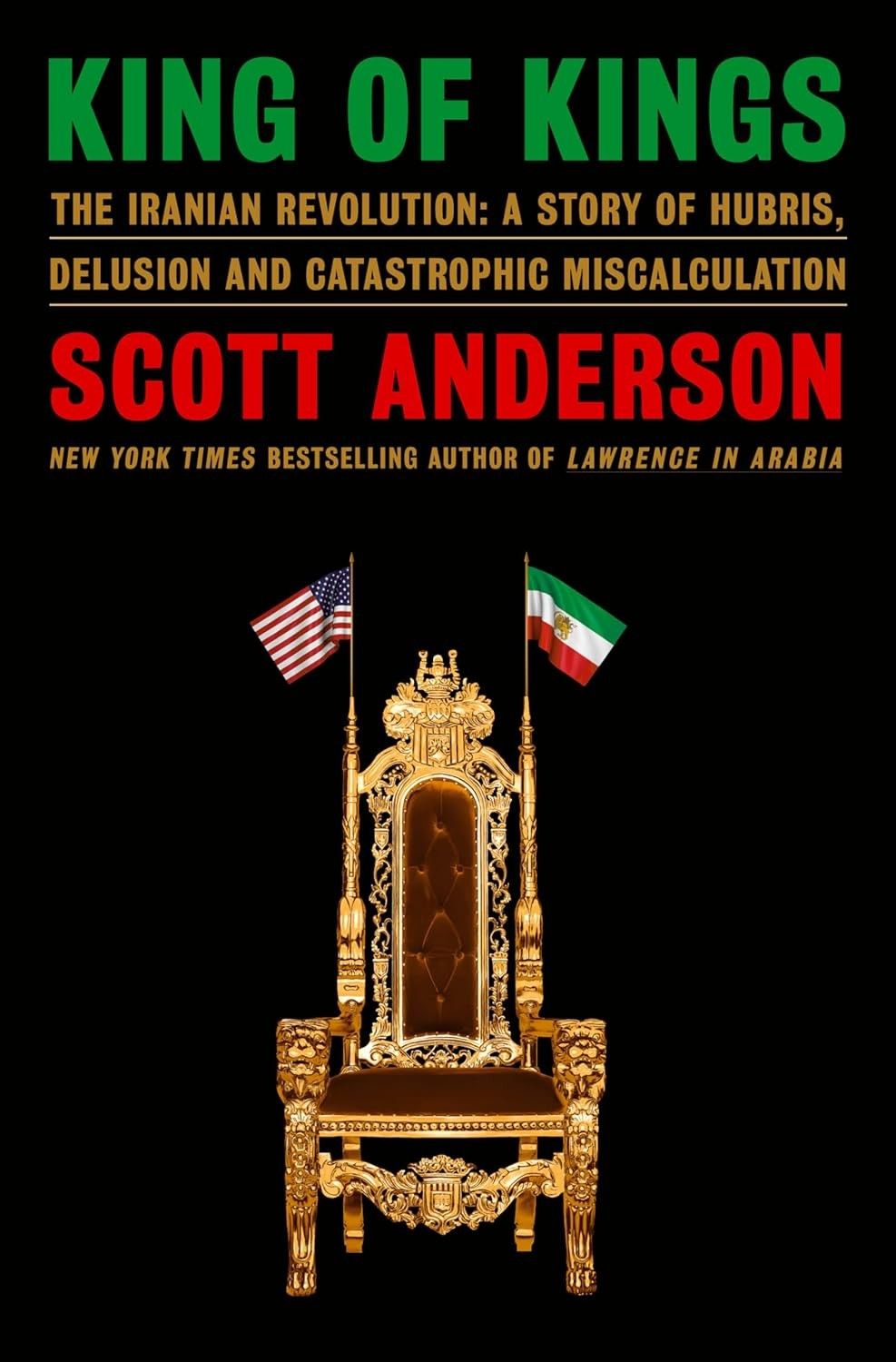
BOOK REVIEW: King of Kings. The Iranian Revolution: A Story of Hubris, Delusion and Catastrophic Miscalculation.
By Scott Anderson / Doubleday
Reviewed by: Andy Dunn, former CIA Deputy Assistant Director
The Reviewer Andy Dunn retired from the CIA in October 2021 after a 29-year career as an analyst and Agency leader. He last served as Deputy Assistant Director of the Near East Mission Center from 2020 to 2021 and as Chief of Analysis in the Iran Mission Center from 2018 to 2020. Iran and the violence perpetrated by its proxies and partners in the region were the major focus of these units. Previous assignments included multiple leadership jobs in the Counterterrorism Mission Center and two war zone tours.
REVIEW: Iran is again in the throes of cascading, nationwide protests, sparked by the economic fallout from Israel’s humbling of Tehran in the 12-day war in June 2025 and decades of sanctions, incompetent government economic decision-making, and regional meddling by the Iranian government. The latest unrest serves as another reminder—if any is needed after 47 years of the Islamic Republic’s abuse of its own people and its neighbors—that no one can credibly argue that the reign of the ayatollahs has improved upon that of the deposed, albeit deeply flawed, Muhammad Reza Shah Pahlavi. Some of today’s protesters are even chanting pro-Pahlavi slogans, which must be particularly galling to the ailing Supreme Leader.
Many of the protesters’ grievances echo the public anger directed at the Shah—fed by economic despair and cultural oppression. Food inflation is running above 64 percent, according to The Wall Street Journal, and the rial has fallen by 40 percent against the U.S. dollar since June. Fearful of mounting public anger, Iran’s government has eased social restrictions to a degree not seen since the Islamic Revolution in 1979. At the same time, the Journal reports that more regime opponents—almost 1,900—were executed in 2025 than at any point in the last four decades, and double 2024’s already ghoulish toll. This is what ultimately distinguishes this regime from that of the Shah: the ayatollahs consistently have demonstrated the will to power to do what they must to stay in power, sometimes by appeasing public anger over the theocratic absurdities that govern private behavior, and always by employing violence to coerce the population into submission.
The current unrest is a fitting backdrop to reading Scott Anderson’s compelling, albeit narrowly focused, recent book on the fall of the Pahlavi dynasty, King of Kings. The Iranian Revolution: A Story of Hubris, Delusion and Catastrophic Miscalculation. He provides a riveting account of how it was that the King of Kings was swept from the Peacock Throne, brought down by his own leadership failings, popular anger over corruption and foreign (read: U.S.) influence, economic disruption during cycles of oil booms and busts, and cultural dislocations sparked by the flood of petrodollars. Anderson argues persuasively that the revolution was not inevitable, but rather the product of cascading miscalculations over decades by the Shah’s government, and its US ally, and chance events.
Anderson’s portrait of the Shah—from his early days as little more than a figurehead enthroned by the Soviets and British to his last days in exile in Egypt—is of a vain, out-of-touch, erratic, insecure, and weak leader. He had ambitions of turning Iran into a first-tier military and industrial power and spent extravagantly on the armed forces. But that same military proved both unwilling and unable to sustain the regime when the final crisis arrived in 1978 and early 1979, in large part because the military leaders selected by the Shah were timorous and divided. The revolution was not the first time the Shah proved not up to the brutish game of holding onto power—he was rescued from his first brush with exile by a U.S.-sponsored countercoup and, more significantly, by the abuses and unpopularity of his would-be deposer, Mohammad Mossadegh. The Shah’s other failings were many and manifest—including his barely disguised disdain for Islam and lack of connection with and understanding of Iran’s masses, his erratic, needy, and paranoid love-hate-love relationship with the United States, and his failure to manage the country’s vast oil wealth to the benefit of most Iranians. But none contributed to his downfall more than his timidity in the face of existential threats to his reign, compounded by indecisiveness and disengagement at times of crisis.
There is little in Anderson’s accounts of U.S. engagement with the Shah and his governments that is groundbreaking. In fact, my biggest criticism is that the book is heavily U.S.-focused in substance and sourcing and is not a comprehensive examination of the Shah’s reign and the revolution. But his retelling of the story of U.S. involvement is painful to read because at almost no point did officials in every administration from Roosevelt to Carter demonstrate strategic forethought, an understanding of the anger most Iranians felt toward the Shah, or how hollow his security institutions were. The book details the arc of U.S. engagement from indifference to greed masquerading as strategic partnership to cluelessness and panic in the final days of the imperial dynasty.
Franklin Roosevelt could barely be bothered to spare 15 minutes for a meeting with the Shah during the 1943 summit in Tehran with Stalin and Churchill because Roosevelt viewed the Shah as a peripheral figure in his own kingdom. Fast forward a decade, and after oil and containing the Soviet Union became the focus of U.S. policy in the region, the Eisenhower administration decided that not only was the Shah an important ally, but one requiring U.S. (and U.K.) support to remove Prime Minister Mossadegh from office because of his support for nationalizing oil production. Deposing Mossadegh allowed the Shah to return from his brief self-imposed exile and begin a 25-year period of increasingly authoritarian rule. President Nixon, completing the Shah’s rise in importance to the United States, paid a state visit to Iran in May 1972 and conferred the status of “strategic partner” on Tehran. This status allowed the Shah virtually unrestricted permission to buy U.S. weapons and build up his armed forces.
Who’s Reading this? More than 500K of the most influential national security experts in the world. Need full access to what the Experts are reading?
Anderson is particularly scathing in his assessment of the U.S. Embassy in Tehran, senior officials in the Carter administration, and the president himself as Iran descended into chaos between the state dinner at the White House in November 1977, when Carter hosted the Shah, and the return of Khomeini to Tehran on 1 February 1979. It is a tale of an embassy staff, led by Ambassador William H. Sullivan, grossly overconfident in the strength of the Shah’s hold on power—and blind to the angry ferment in Iranian society that eventually coalesced around Khomeini’s leadership. What Embassy and CIA reporting missed, largely because no real collection effort was made, was the breadth of mobilization—among clerics, merchants, students, professionals, and workers—without which the revolution could not have succeeded.
Compounding the Pollyanna perspective of the Embassy was Carter’s unexpectedly warm embrace of the Shah in Washington in November 1977 and again the next month during a reciprocal visit to Tehran. Over the course of 1978, as unrest in Iran intensified, the president and his senior advisers failed to ask hard questions, in part, Anderson argues, because they were focused elsewhere, including the Egypt–Israel peace negotiations. By late fall 1978, as it became clear that the Shah was losing his grip on power, the blame game began in Washington, manifested by personal recriminations, infighting, and hiding information among the by-then warring bureaucracies of State, the NSC, and the CIA. All of this further paralyzed the U.S. effort to manage the crisis and a pall of resignation and defeat settled over the White House.
Waiting in the wings to exploit the foment and unrest was the ultimate victor, of course: Ayatollah Khomeini. Anderson argues that it was by no means preordained that Khomeini—exiled since 1963 after a previous round of anti-Pahlavi unrest—would emerge triumphant. But he is the only principal in this book who demonstrated the focus, patience, flexibility, and cunning required to triumph amid the chaos that unfolded in Iran beginning in early 1978. He built a broad-based opposition coalition centered on the active deceit that a post-imperial Iran would be pluralistic and largely governed by principles enshrined in the 1906 Iranian Constitution. As became apparent within weeks of Khomeini’s return to Tehran on February 1, 1979, he never intended to establish anything other than what we now see: a totalitarian theocracy. Many of the secularists and more moderate Islamists who rallied to his leadership during the revolution came to regret their decision; more than a few were subsequently arrested, exiled, executed, or assassinated.
Anderson’s book is a depressing but worthwhile read for many reasons. For people of my generation—teenagers when the humiliation of the hostage crisis dominated our lives for 444 days, and, for me, friends with people who had a parent held hostage—it brings back memories of the swell of patriotism that accompanied the crisis, unimaginable in our own polarized times. But mostly the book makes you feel sorry for the people of Iran. They were governed by one tyrant only to be replaced by something far worse: a brutal government determined to hold onto power at all costs, impoverishing the nation and sowing fear and loathing among many of its neighbors.
The Cipher Brief participates in the Amazon Affiliate program and may make a small commission from purchases made via links.
Sign up for our free Undercover newsletter to make sure you stay on top of all of the new releases and expert reviews.
Read more expert-driven national security insights, perspective and analysis in The Cipher Brief because National Security is Everyone’s Business
King of Kings: The Iranian Revolution: A Story of Hubris, Delusion and Catastrophic Miscalculation earns an impressive 3 out of 4 trench coats