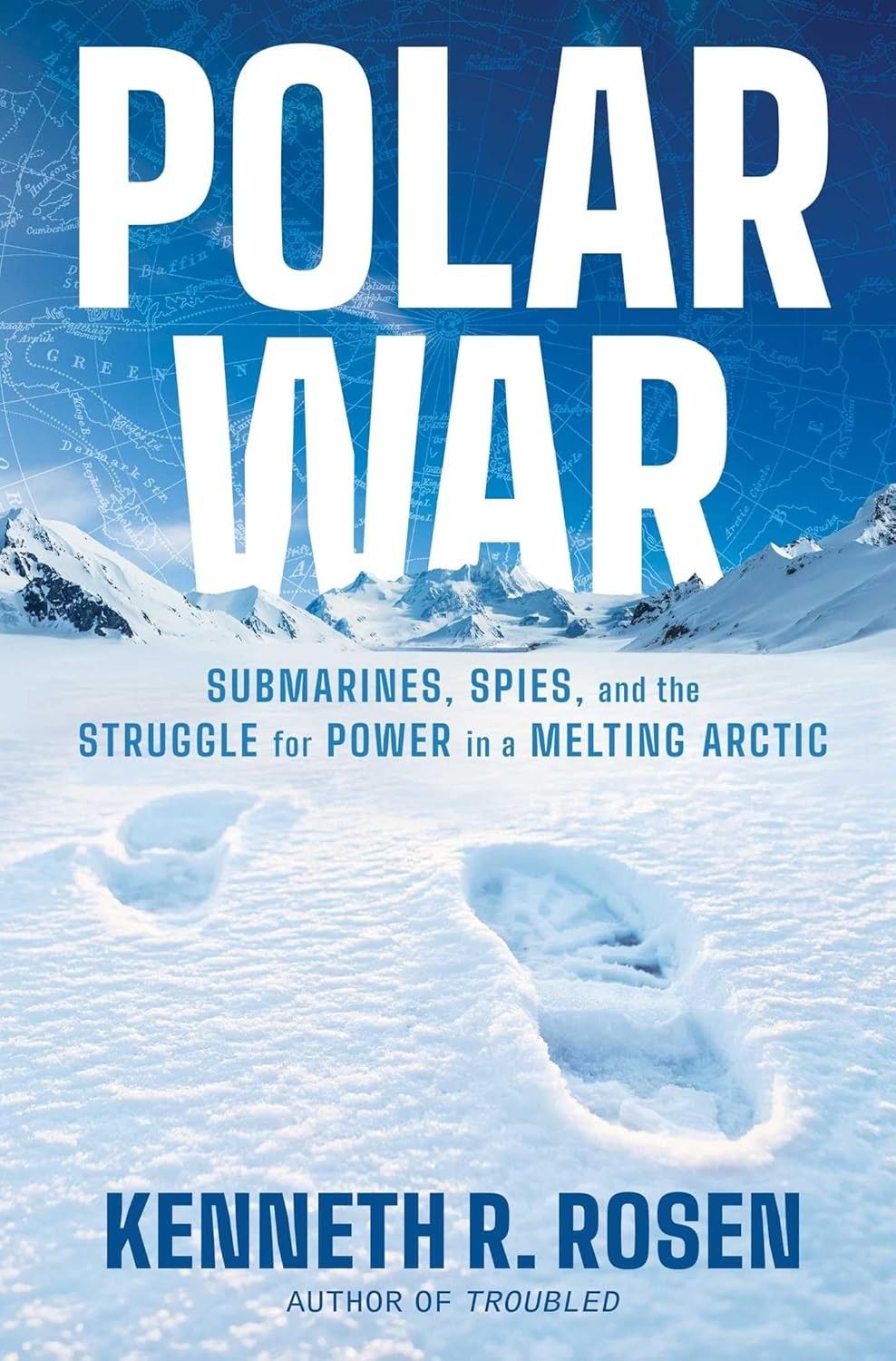

BOOK REVIEW: Polar War: Submarines, Spies, and the Struggle for Power in a Melting Arctic
By Kenneth R. Rosen / Simon & Schuster January 6, 2026
Reviewed by: HEIDI VIEROW
The Reviewer: Heidi Vierow, PhD, a retired CIA Clandestine Service officer, currently is an Intelligence Strategy and Policy Advisor at MITRE.
REVIEW — The Arctic plays a pivotal role in the military and geopolitical realms, and the melting polar cap keeps the gamesmanship in constant flux and tension. Countries worldwide, from those in Scandinavia, Europe, Asia to those in North America and Africa, vie for interests in everything from fishing rights, rare earth elements, and strategic footholds. The Arctic is the apex that Russia, China, and NATO partners seek to dominate. Kenneth R. Rosen in his 2026 book Polar War: Submarines, Spies, and the Struggle for Power in a Melting Arctic explores and explains the tensions among the political, military, scientific, and cultural fronts that overlap and clash at times for dominance in a region under constant and increasingly rapid environmental flux.
The book is the culmination of Rosen’s three years of research and investigative journalism in the Arctic and derived from intensive training with the U.S. and Scandinavian military units; interviews with indigenous peoples, political leaders, scientists; and in-depth reading on the region. The book includes a selected bibliography, which is a handy resource.
Rosen is fearless in his travels and perspicacious in his assessments, and his narrative style varies from analytical to editorial. When he sees what he assesses to be weakness, particularly in military matters, he can be sarcastic. He finds Norwegian and Swedish training and conscripts superior to the American exercises and troops, whom he at times characterizes as cartoonishly naïve or inept. His numbers show how much more seriously the Scandinavians take environmental and military challenges; their forces are better equipped, and they train more rigorously and seriously. The Arctic is their backyard, and the Russians their neighbors, a rising threat since Russia’s invasion of Ukraine. He argues that the American military needs more funding, more specialized naval vessels, and more training in the region. In all of this he is correct, yet this is not an excuse to point out repeatedly the American shortfalls.
The book’s subtitle is eye catching but a bit misleading. Not until 100 pages into the book is there a potential spy, who is more likely a drunken Russian. There are a good number of boats, but few submarines, though every boat can be a submarine once. Nonetheless, Rosen unfurls a multifaceted narrative that broaches a number of topics. He does not pretend to be an omniscient or impartial narrator. For example, when describing the State Department’s National Strategy for the Arctic Region, he concludes with the editorial comment, “To be fair, this is the way government is meant to work, best as I can tell.”
That said, Rosen covers a wide swath of the subject in an engaging narrative. Just as Peter Hessler is an astute observer of China (Oracle Bones: A Journey through Time in China) and of Egypt (Buried: An Archaeology of the Egyptian Revolution), so too Rosen synthesizes a volume of information about the Arctic drawing from his access to a wide range of people, range of travel experiences, and knowledge of cultural nuances. Polar War is a worthy read for an overview of topical and timely issues in the region, and it is a timely wake-up call to the U.S. that it needs to focus its attention more fully on the region.
The Cipher Brief participates in the Amazon Affiliate program and may make a small commission from purchases made via links.
Sign up for our free Undercover newsletter to make sure you stay on top of all of the new releases and expert reviews.
Read more expert-driven national security insights, perspective and analysis in The Cipher Brief because National Security is Everyone’s Business