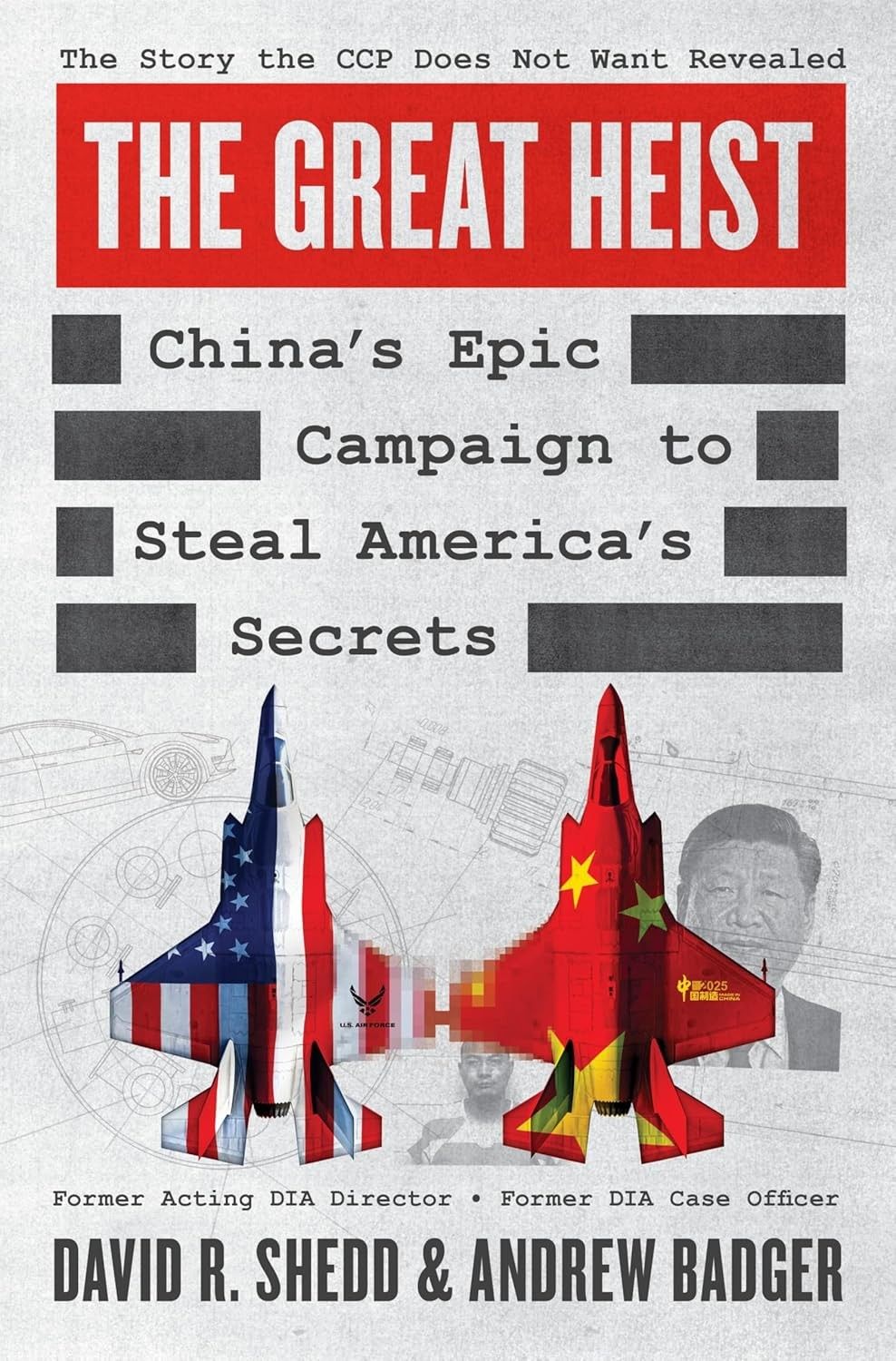

BOOK REVIEW: The Great Heist: China’s Epic Campaign to Steal America’s Secrets
By David R. Shedd and Andrew Badger / Harper
Reviewed by: Nick Fishwick
The Reviewer Nick Fishwick CMG retired after nearly thirty years in the British Foreign Service. His postings included Lagos, Istanbul and Kabul. His responsibilities in London included director of security and, after returning from Afghanistan in 2007, he served as director for counter-terrorism. His final role was as director general for international operations.
REVIEW — All things considered, the campaign seems to be going pretty well.
China has made phenomenal strides forward over the past 50 years since the death of Mao Zedong. I am old enough to remember the TV coverage in the early 70s of Richard Nixon’s visit to meet Mao and the rather less epochal encounter of a former British prime minister no one in the U.S. will remember, Ted Heath. Grainy monochrome TV footage showed thousands of Chinese people careering around Beijing on old bicycles as Nixon, or Heath, was led in to shake hands with China’s venerable mass murderer.
Obviously everywhere looks different from fifty years ago, but surely no transformation has matched China’s. It has an economy approaching the size of the U.S., and western companies – including the bank I used to advise, HSBC – are all over it. Its citizens enjoy a standard of living unimaginable in 1975. Its soft power is formidable. In 2008 it hosted the Olympic Games. Western soccer players head to the Chinese Super League to make a final few million dollars before retirement. Chinese stars compete for the World Snooker Championship. Tik Tok is on the phone of everyone under forty, apparently. China is an economic, cultural, military and technological superpower.
The contention in this book, The Great Heist: China’s Epic Campaign to Steal America’s Secrets, by David Shedd and Andrew Badger (both of whom I know) is that China’s progress has been achieved through espionage, cheating and theft and that this has been at the expense of the US. Corporate America (and corporate Europe) thinks of China as a huge market and opportunity to make money. Shedd and Badger challenge this, at least in the medium term, and argue that people like Elon Musk should be learning the lesson of how western companies are invited into China, then skinned, then discarded as China’s own companies gobble up their knowhow.
Who’s Reading this? More than 500K of the most influential national security experts in the world. Need full access to what the Experts are reading?
The authors document industrial espionage on a massive scale. We are not talking here of a few MSS officers filching a few manuals. We are talking of countless and ingenious cases of insider penetration of American companies with knowledge and technology that China needs. We are talking about massive cyber-attacks. We are talking about the Chinese exploiting commercial and academic ventures and contacts to grab sensitive information, again on a huge scale.
Predictably, some of this information is about tipping the military scales in favor of China. Chinese hypersonic capability is now awesome. But winning a war, or threatening an adversary with one, is not just about military hardware. It is about penetrating the energy infrastructure of the U.S., about potentially being able to leverage food supplies. It is about blowing up American satellites. It is also about stealing and weaponizing data as a tool of espionage on a scale never seen before.
The point of this book is to get the U.S. to wake up to the Chinese threat. The perspective is very much that of the FBI or the National Counterintelligence and Security Center. The evidence that China is gaining strategic advantage over the U.S. through underhand methods is irrefutable. An understanding of China is less apparent. The initials CCP (Chinese Communist Party) are used frequently (“the invisible forces of the CCP”), but what the CCP is is never explained and for me the middle C is an ideological red herring. China is not doing this because it is “Communist” - Russia isn’t communist anymore, but that doesn’t seem to have changed its behavior – but because it is a rising regional power struggling for hegemony. One incidentally that thinks its political and values system licks our own.
Shedd and Badger say the rising threat of China is partly our own fault. Western companies, facing the reality of Chinese espionage on an industrial scale, “don’t give a hoot...until it smacks them in the face”. Indeed, in language Karl Marx would recognize, the authors claim that “America’s pursuit of profits – of capital – has been weaponized against our own interests”. A contradiction of capitalism?
Towards the end of the book, we are taken through fictional scenarios where the U.S. government and businesses are forced to face the reality of the threat. I hope American readers are more open to this literary device (“The president nodded and cleared his throat,” etc.) than some cynical Europeans will be. But the point is to show America awaking to the threat. The book ends with some crisp recommendations about how to make this considerably less easy for the Chinese, forcing the U.S. to protect its most sensitive economic and technological information and getting China out of supply chains. What the costs and unintended consequences of this would be remains a big question.
This is a thought-provoking, worrying, and entertaining book. My reservations are, first, intellectual: if you don’t really understand China, do you really understand its threat and how best to counter it? Secondly, political. I do not know who the president in Shedd/Badger’s fictional chapter was based on, but certainly not on the guy in the White House at the moment. And we Europeans also have political systems that are dysfunctional and getting worse. It’s not so much that the Chinese are stealing it as that we are giving it to them.
The Cipher Brief participates in the Amazon Affiliate program and may make a small commission from purchases made via links.
Sign up for our free Undercover newsletter to make sure you stay on top of all of the new releases and expert reviews.
Read more expert-driven national security insights, perspective and analysis in The Cipher Brief because National Security is Everyone’s Business