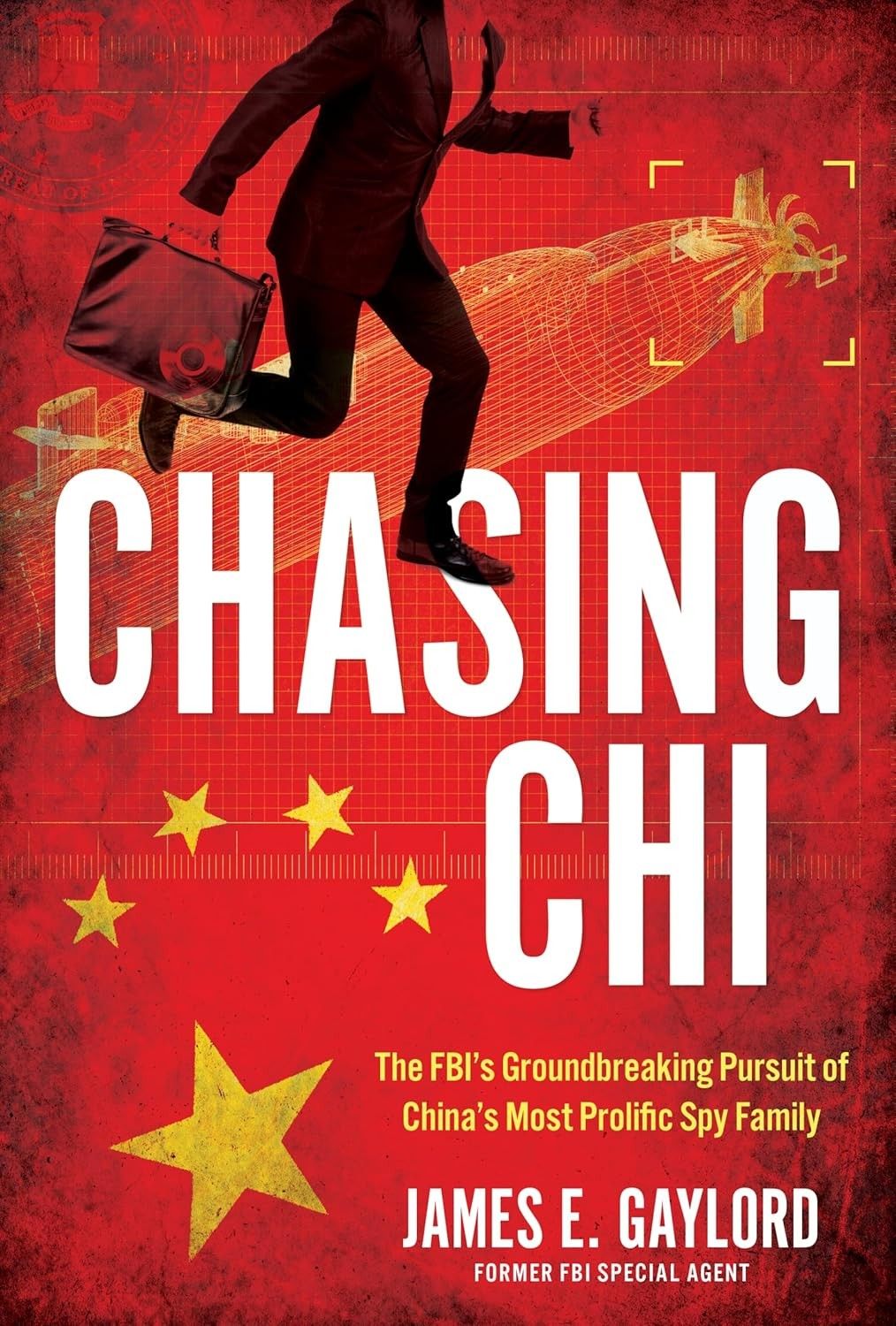

BOOK REVIEW: Chasing Chi: The FBI’s Groundbreaking Pursuit of China’s Most Prolific Spy Family
By James E. Gaylord
Reviewed by: Jean-Thomas Nicole
The Reviewer —Jean-Thomas Nicole is a Policy Advisor with Public Safety Canada. The opinions expressed are those of the author and do not reflect the official policies or positions of Public Safety Canada or the Canadian government
REVIEW — In Chasing Chi, James E. Gaylord—former FBI Special Agent and lead investigator, who served for over 30 years, specializing in counterintelligence investigations until his retirement in March 2017—offers a granular account of the Chi Mak case, one of the Bureau’s most consequential counterintelligence operations. The book is a saga that unfolded not in the shadows of Cold War Berlin or the corridors of Langley, but in the quiet suburbs of Southern California.
This is not merely a story of espionage; it is a study in institutional inertia, operational perseverance, and the evolving face of Chinese intelligence collection.
Gaylord’s narrative is both memoir and indictment, a firsthand chronicle of the years-long pursuit of Chi Mak, a Chinese-born engineer embedded in the U.S. defense industrial base, who—alongside his family—allegedly funneled sensitive naval technologies to Beijing. The book’s strength lies in its duality: it is at once a procedural recounting of investigative tradecraft and a broader meditation on the vulnerabilities of open societies in the age of strategic competition.
For readers of The Cipher Brief, Chasing Chi resonates on multiple levels. It is a case study in the anatomy of a successful counterintelligence operation—complete with wiretaps, surveillance, and the painstaking unraveling of encrypted communications. But it is also a cautionary tale: Gaylord does not shy away from exposing the internal frictions within the Bureau, the bureaucratic hesitations that nearly derailed the case, and the legal ambiguities that complicated prosecution.
The issue lies not in the story itself, which is full of intriguing twists and turns, but rather in Gaylord’s style—both in writing and in tone. His prose is consistently conversational, often veering into the colloquial, vulgar, or even prejudiced. While this approach may create a sense of immediacy and proximity to the investigation, it ultimately disrupts the narrative flow and raises questions about its suitability for recounting a historical espionage case.
Furthermore, Gaylord’s frequent complaints and disparaging remarks about colleagues, management, and interagency practices paint him as less than diplomatic or empathetic. Admittedly, success in complex federal investigations demands persistence, assertiveness, and resilience—but that need not come at the expense of professionalism or respect for others.
Having said that, fortunately, what elevates the book beyond the genre of true crime or spy thriller is Gaylord’s ability to contextualize the Chi Mak operation within the broader strategic ambitions of the Chinese Communist Party. He draws a clear line between tactical espionage and strategic intent, illustrating how the theft of seemingly arcane naval schematics fits into Beijing’s long-term maritime modernization goals. In doing so, he invites the reader to consider espionage not as isolated acts of betrayal, but as instruments of national power projection.
What national security news are you missing today? Get full access to your own national security daily brief by upgrading to Subscriber+Member status.
Stylistically, Gaylord thus writes as a seasoned investigator and the urgency of someone who has seen the stakes firsthand. His prose is lean but evocative, his pacing deliberate, and his tone imbued with a not so quiet frustration and understood cynicism that will be familiar to anyone who has worked within the constraints of a large bureaucracy while trying to protect national security.
In the annals of American espionage, certain names echo with the weight of betrayal—Larry Chin, Katrina Leung, Jonathan Pollard, Ana Montes. Each case, distinct in its motivations and mechanics, has left an indelible mark on the architecture of U.S. counterintelligence.
James E. Gaylord’s Chasing Chi enters this lineage not as a mere addition, but as a reframing—an invitation to reconsider what espionage looks like in the age of strategic patience and technological theft.
Where Larry Wu-Tai Chin operated as a solitary ideologue, translating CIA secrets for Maoist China across three decades, Chi Mak emerges as a quieter, more methodical figure. His loyalty was not to a revolutionary cause, but to a state apparatus that prizes incremental advantage over dramatic disruption. Chin’s betrayal was rooted in conviction; Mak’s, as Gaylord suggests, was embedded in a broader campaign of systemic acquisition—a slow siphoning of naval innovation, calibrated to feed Beijing’s maritime ambitions.
Katrina Leung’s story, by contrast, is one of institutional failure. A double agent nestled within the FBI’s own ranks, Leung compromised investigations and manipulated handlers with alarming ease. Her case exposed the fragility of trust and the dangers of charisma in source operations. Gaylord’s pursuit of Mak, though fraught with bureaucratic resistance, stands as a counterpoint—a testament to procedural discipline and the quiet heroism of agents who persist despite internal sabotage.
Jonathan Pollard’s espionage for Israel, driven by ideology and personal grievance, ignited diplomatic firestorms but lacked the strategic subtlety of Mak’s operation. Pollard acted alone, his thefts dramatic and indiscriminate. Mak, by contrast, operated within a familial network, his wife, brother, and sister-in-law all allegedly complicit. This configuration, rare and potent, rendered the operation both resilient and opaque. It was not a rogue act, but a coordinated campaign, cloaked in domestic normalcy.
Ana Montes, the DIA analyst who spied for Cuba, offers perhaps the closest parallel. Like Mak, she was embedded, disciplined, and ideologically committed. Her tradecraft was elegant, her concealment masterful. Yet Gaylord’s account adds a layer Montes lacked: the familial dimension. In Chasing Chi, espionage is not just a solitary betrayal—it is a shared vocation, a generational compact. That intimacy complicates detection, prosecution, and even comprehension.
Taken together, these comparisons illuminate the uniqueness of the Mak case. It is not the most dramatic, nor the most ideologically charged. But it may be the most emblematic of the future—where espionage is quiet, networked, and strategically aligned with long-term national objectives. Gaylord’s narrative, rich in operational detail and strategic reflection, reminds us that the most dangerous adversaries are not always the loudest. Sometimes, they are the ones who wait.
In sum, Chasing Chi is more than a compelling read—it is a contribution to the literature on modern espionage and counterintelligence. It should be a reading not only for intelligence professionals and policymakers, but for anyone seeking to understand the quiet war being waged beneath the surface of U.S.-China relations. Gaylord’s account reminds us that the front lines of strategic competition are not always visible, but they are always active.
The Cipher Brief participates in the Amazon Affiliate program and may make a small commission from purchases made via links.
Sign up for our free Undercover newsletter to make sure you stay on top of all of the new releases and expert reviews.
Read more expert-driven national security insights, perspective and analysis in The Cipher Brief because National Security is Everyone’s Business