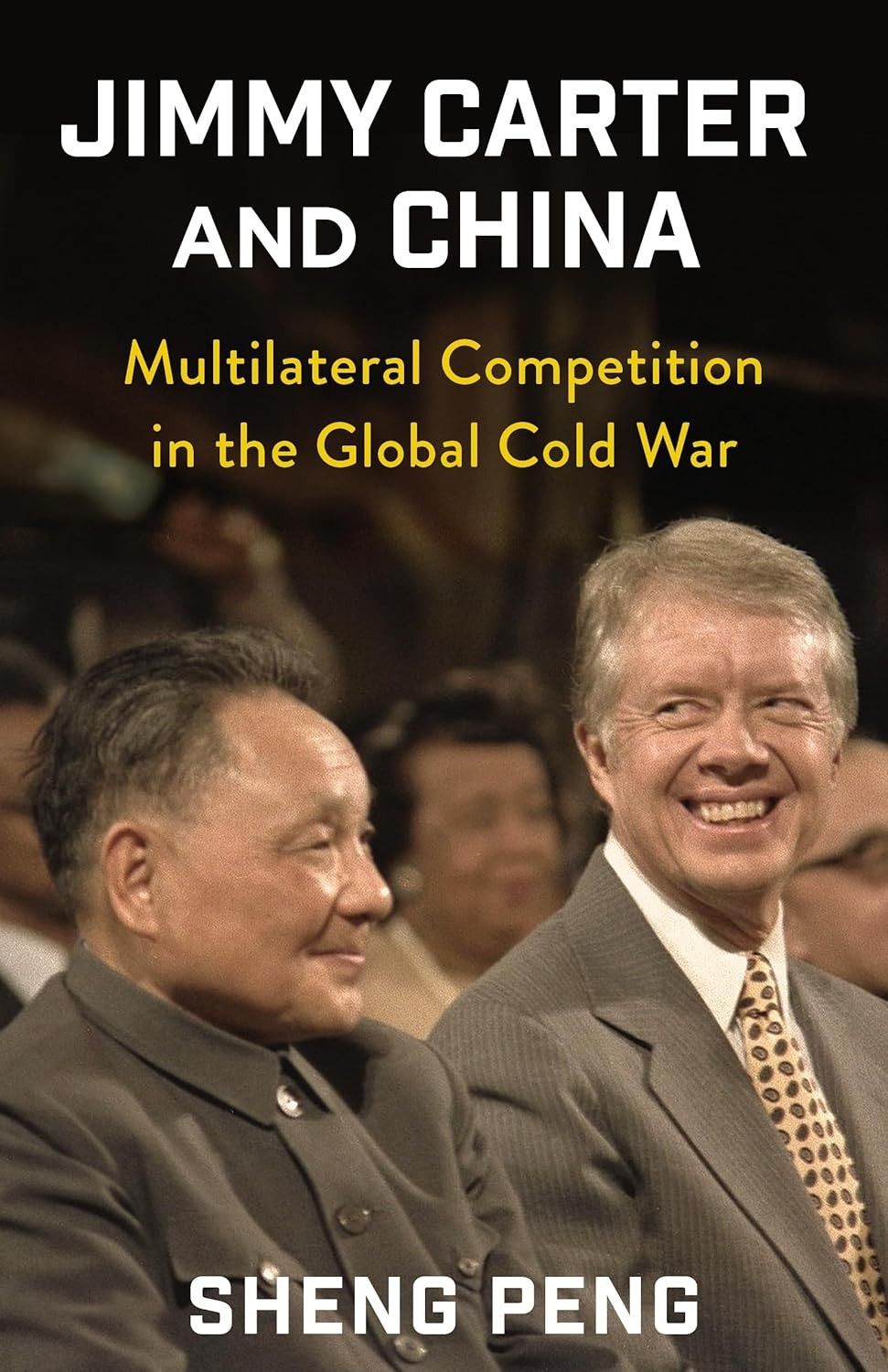


BOOK REVIEW: Jimmy Carter and China: Multilateral Competition in the Global Cold War.
By Sheng Peng / Columbia University Press
Reviewed by: Jean-Thomas Nicole
The Reviewer — Jean-Thomas Nicole is a Policy Advisor with Public Safety Canada. The opinions expressed are those of the author and do not reflect the official policies or positions of Public Safety Canada or the Canadian government.
REVIEW: Sheng Peng is a historian of the global Cold War whose research focuses on technology transfer and the entanglement of U.S., European, and Chinese/Taiwanese policy in the late 1970s. He is an Ernest May Fellow in History & Policy at Harvard Kennedy School’s Belfer Center and a postdoctoral researcher at the University of Vienna’s Research Center for the History of Transformations (RECET).
As a writer, Peng combines archival depth with policy acuity. His doctoral thesis at Oxford—Deng Xiaoping and Jimmy Carter: Technology Transfer and the Origin of U.S.–China Anti‑Soviet Cooperation During the Cold War, 1977–1981—mapped the techno‑strategic bargains that underwrote the U.S.–PRC opening and anticipated several arguments he would later develop. That dissertation forms the spine of his present book, Jimmy Carter and China: Multilateral Competition in the Global Cold War, as part of the Nancy Bernkopf Tucker and Warren I. Cohen series on American–East Asian relations.
The concept for his first major publication is simple and persuasive: the late 1970s were not a two‑hander between Washington and Moscow, nor even a neat strategic triangle once China is added, but a crowded stage on which Paris, London, Bonn and—crucially—Taipei pursued their own designs, often at cross‑purposes with American aims. The result, Peng contends, was to hasten the unravelling of détente and to lock in the ambiguities over Taiwan that still shape policy today.
It replaces the well‑worn morality play of a courageous American opening to a grateful Beijing with a briskly argued international history in which no actor is merely supporting cast. Peng covers Carter’s full term (1977–1981), with spillover into the early 1980s, and organizes the book into three parts—Strategic Competition, Technological Competition, and Ideology—each pairing new archival finds with close reading of policy debates across capitals.
Peng’s narrative is source‑driven and international. He mines U.S., U.K., French, West German, and Russian records (alongside Chinese and Taiwanese materials) to reconstruct back‑channels, cabinet minutes, and export‑control files that seldom surface in standard U.S.–China histories. Many of those sources, such as former West German foreign ministry records on West German–PRC nuclear cooperation, Russian Academy of Sciences papers on Soviet policy toward the PRC, and British Ministry of Defence papers on UK-China anti-Soviet cooperation, have rarely been used or are used here for the first time in the study of US-China relations. The Horn of Africa chapters integrate intelligence sharing, SALT bargaining, and PRC messaging; the CTBT section pairs arms‑control transcripts with China–France exchanges; and the European transfers chapter uses ministerial notes to show allies edging from case‑by‑case exceptions toward a de facto “China differential.”
Going through historical records in multiple languages, as well as speaking to witnesses who personally shaped those historical events, allowed Peng to paint a very different picture of the United States’ engagement with mainland China and Taiwan during those fateful years of the late 1970s, a time of uncertainty, radical changes, and emerging new crises. The book’s multinational document base is a major strength, yet the lack of systematic access to PRC archival decision‑making leaves some judgments—especially about Beijing’s intentions—necessarily inferential.
At the book’s heart lies a reconstruction of how Carter’s desire to rescue arms control from domestic hawks and Soviet opportunism collided with Deng Xiaoping’s hard‑edged view of the world.
As Soviet proxies advanced from the Red Sea to the Horn of Africa and SALT II snagged on Backfires, cruise missiles and the familiar verification thickets, Brzezinski hurried through a fast‑track normalization that accepted Beijing’s three conditions—ending the defense treaty with Taipei, withdrawing U.S. forces, and shuttering official representation—before Congress had caught its breath.
It was a gamble to believe that a posture of strategic goodwill towards China might stabilize an already faltering détente. In the event, Deng Xiaoping seized the upper hand: he declined to endorse arms‑control measures he fundamentally opposed and tied any Sino‑American cooperation against the Soviet Union to sweeping concessions from Washington on the question of Taiwan.
The most original chapters follow the money and the machine‑tool. With American export controls tip‑toeing after geopolitics, Western Europe became China’s back door.
When Afghanistan ended restraint in Washington, the United States fashioned a “China differential” of its own, and the export regime it had built began to fray in earnest. It is a devastating account of how alliance politics and commercial hunger can undo a non‑proliferation architecture more efficiently than any ideological speech.
Peng’s treatment of arms control is equally unsentimental. The Comprehensive Test Ban story is told not as a morality tale of visionary doves and recalcitrant bears, but as a study in asymmetry and self‑interest. If Carter hoped the CTBT might buttress SALT II at home and temper superpower competition abroad, the politics of second‑tier nuclear powers—and the technological gulf that made their calculations rational—helped to sink it.
Taiwan, so often relegated to the footnotes of Kissingerian drama, emerges here as an actor with agency and pathos. The portrait of Chiang Ching‑kuo is unsparing—resolute, improvisatory, often boxed in—and adds ballast to Peng’s central claim: that Taiwan’s ambitions, and Washington’s disciplining of them, were not incidental to the era’s grand strategy but constitutive of it.
The book’s lesson for our present is not coy. Export controls live and die by allied solidarity; sequencing matters when one pursues arms control with one hand and loosens the technological faucet with the other; and so‑called peripheral actors rarely behave as variables in someone else’s model for long.
That these are familiar truths does not diminish their force. Peng has simply shown, with admirable precision, how they played out when a Georgian ex‑submariner in the Oval Office tried to do the right thing all at once—and how a wily Chinese veteran of many purges made sure that it happened on Beijing’s timetable.
Overall, Jimmy Carter and China refreshes a pivotal period with new archives and a genuinely multilateral lens. It complicates feel‑good narratives about normalization, stresses the primacy of technology policy in geopolitics, and reminds us that “small” choices on export licenses, verification clauses, and side deals can move history’s big levers.
In closing, let us remember that today, as Peng rightly underlines, mainland China, ever more oppressive and autocratic, leans toward Putin’s Russia, while Taiwan, now a thriving democracy, has become firmly integrated into US-led liberal political and economic systems. Today, they are in a deadly struggle against one another, representing two opposing international orders.
Sign up for our free Undercover newsletter to make sure you stay on top of all of the new releases and expert reviews.
Read more expert-driven national security insights, perspective and analysis in The Cipher Brief because National Security is Everyone’s Business