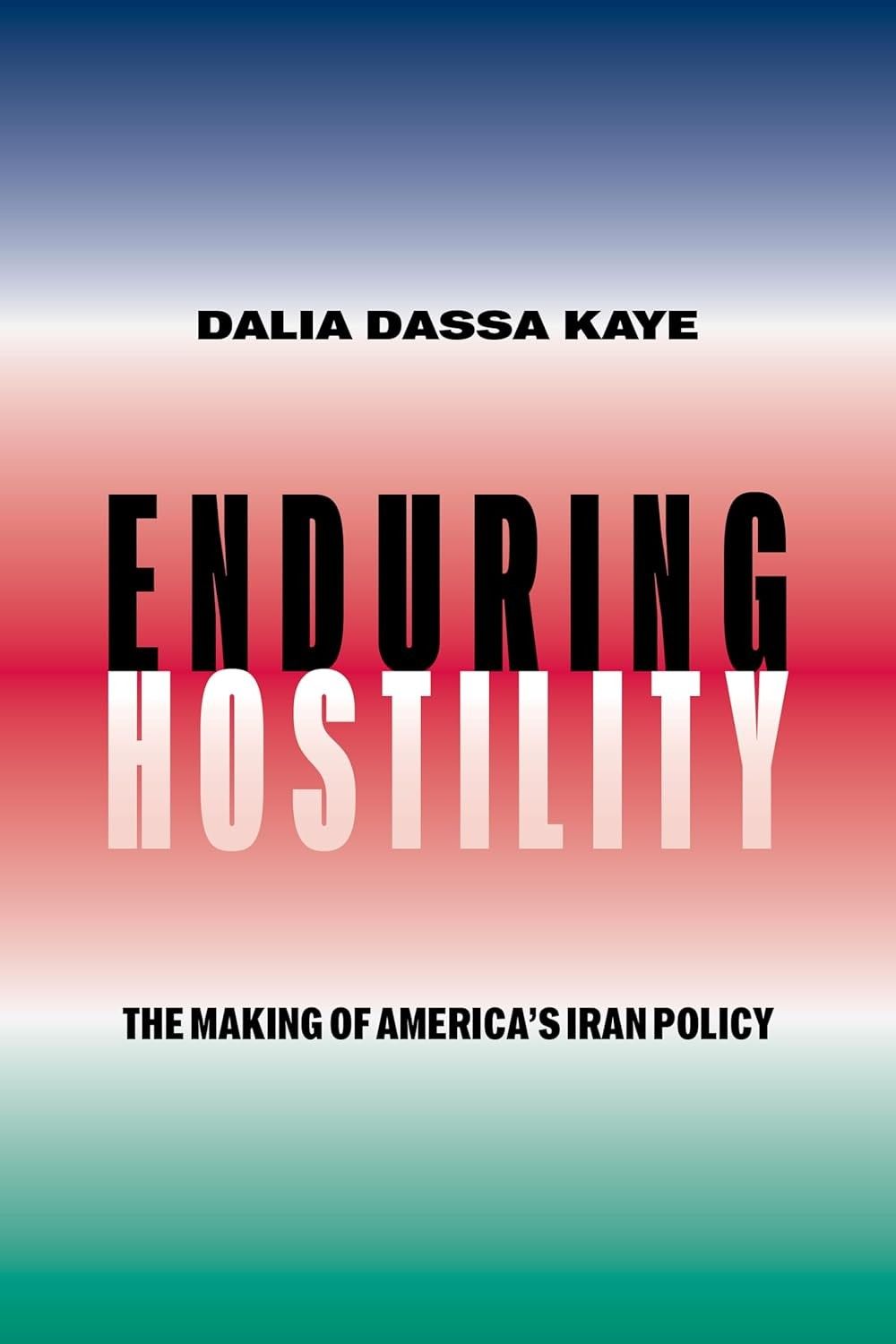


BOOK REVIEW: ENDURING HOSTILITY: THE MAKING OF AMERICA’S IRAN POLICY
By Dalia Dassa Kaye / Stanford University Press
Reviewed by: Joe Zacks
The Reviewer: Joe Zacks is the Co-founder and Managing Partner of Aardwolf Global Solutions. He previously served for 42 years in the national security arena both in the U.S. Army and the Central Intelligence Agency. His final assignment was as the Deputy Assistant Director of the CIA for Counterterrorism
REVIEW — In the close to 47 years since the 1979 Iranian revolution, there have been two Iranian supreme leaders and nine U.S. presidential administrations. In the immediate aftermath of the revolution, the regime took 66 Americans hostage and kept 52 in captivity for 444 days. This national embarrassment resulted in a catastrophic U.S. rescue operation and in many ways led to Jimmy Carter’s overwhelming defeat for a second term as president. In the Iranian regime’s nearly five decades of existence, it has been responsible for the murder of well over 1,000 U.S. citizens by Iranian-sponsored terrorist attacks. This is a simplified description of the toll of the Iranian regime’s animus toward the U.S. Furthermore, Iran has been a leading agent of death and destruction and instability throughout the Middle East. The regime also has a long and atrocious record of abusing its citizenry, especially women and democratic activists, and a vile human rights record. Beyond the Middle East, Iran has been an ardent supporter of Russia’s war against Ukraine, supplying Russia with thousands of Shahed drones used in attacking Ukrainian civilians and critical infrastructure. This track record is largely why U.S. presidents and many American foreign policy experts routinely characterize Iran as what Dalia Dassa Kaye, in her book Enduring Hostility: The Making of America’s Iran Policy as “a fanatical, irrational, implacable enemy.”
As its title suggests, Kaye’s book is singularly focused on U.S. foreign policy vis-à-vis Iran. It provides an abbreviated review of the Iran policies of each presidential administration since the Iranian revolution. The book chronicles how each administration has either contemplated or attempted to reach out to the Iranian regime to alter the adversarial nature of relationship. The Reagan administration was burned by its clumsy and ill-devised outreach to the Iranians. George W. Bush’s administration initially held hope for some form of rapprochement with Iran following Iran’s initial support of the U.S. efforts in Afghanistan post-9/11. However, when President George W. Bush named Iran as a member of the “axis of evil” this nascent effort at improved bilateral relations faltered. The Obama administration framed its negotiations with Iran on the latter’s nuclear program in the context of bringing stability to the Middle East and enabling the U.S.’s pivot to Asia and countering China. The resultant Joint Comprehensive Plan of Action (JCPOA) agreement curtailing elements of Iran’s nuclear weapons program was short-lived as President Trump terminated what he characterized as “one of the worst deals ever.”
Ultimately, Kaye explains, every president has determined that a significant and meaningful improvement in U.S. relations with Iran was either not viable or not worth the domestic political capital. Kaye also explains that after nearly five decades of enduring hostility between the U.S. and Iran, the U.S. foreign policy community is loath to accept those with views discordant with a hawkish framing of U.S. policy toward Iran.
As she makes clear in her final chapter, Kaye is a proponent of breaking the endless hostility between the U.S. and Iran. She argues for a détente in U.S.-Iran relations in which “Iran could become a normal adversary, allowing for both continued competition and the possibility of cooperation in limited areas where interests may overlap.” What Kaye fails to do is explain whether the Iranian regime would be open to such a détente. In fairness, Kaye notes at the outset of her book that she is only focusing on U.S. policies toward Iran and not Iran’s policies toward the U.S. Nevertheless, without delving into the likelihood of Iran being open to détente, this comes across as a somewhat trite conclusion.
From my optic, given that animus toward the U.S. borders on a raison d’etre for the Iranian regime under its two supreme leaders and given that this fanatical hatred of the U.S. has resulted in the murder of so many U.S. citizens, it is fascinating that only President Trump has gone beyond sanctions and naval blockades to make Iran pay for its actions. In his first administration, President Trump ordered the elimination of Iran’s primary instrument of terror, General Qasem Soleimani, the IRGC-Quds Force Commander. In his second term, President Trump upped the ante against Iran by kinetically attacking its nuclear weapons facilities and significantly degrading its nuclear weapons capabilities. It is quite possible that President Trump’s tough approach will ultimately push the Iranian regime closer to accepting Kaye’s vision of a détente than the more tepid policies of past Presidents.
All statements of fact, opinion, or analysis expressed are those of the reviewer and do not reflect the official positions or view of the U.S. government. Nothing in the contents should be construed as asserting or implying U.S. government authentication of information or endorsement of the reviewer's views.
The Cipher Brief participates in the Amazon Affiliate program and may make a small commission from purchases made via links.
Sign up for our free Undercover newsletter to make sure you stay on top of all of the new releases and expert reviews.
Read more expert-driven national security insights, perspective and analysis in The Cipher Brief because National Security is Everyone’s Business.