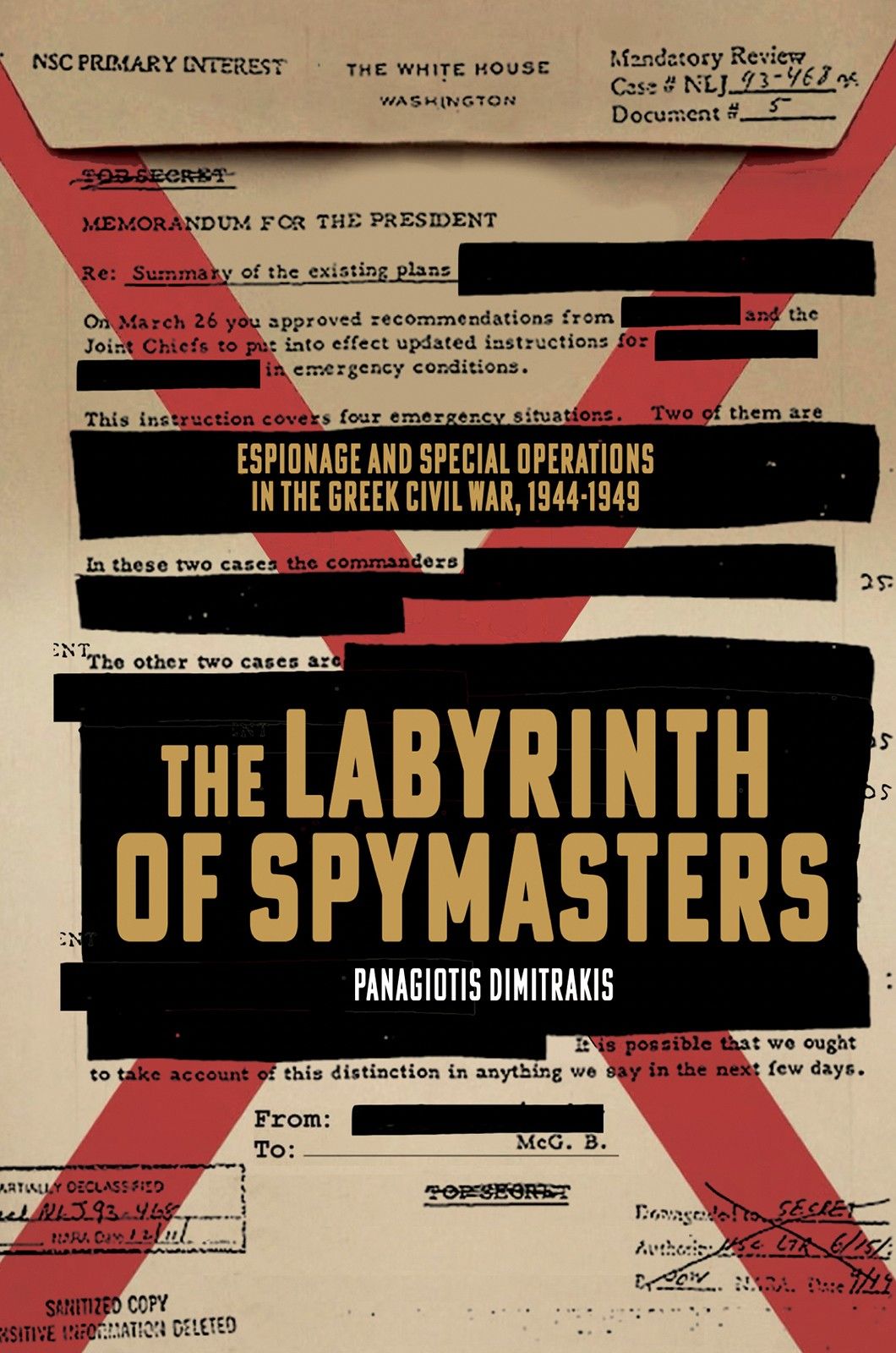

BOOK REVIEW: THE LABYRINTH OF SPYMASTERS: ESPIONAGE AND SPECIAL OPERATIONS IN THE GREEK CIVIL WAR, 1944–1949
By Panagiotis Dimitrakis / New Haven Publishing
Reviewed by: Jean-Thomas Nicole
The Reviewer — Jean-Thomas Nicole is a Policy Advisor with Public Safety Canada. The opinions expressed are those of the author and do not reflect the official policies or positions of Public Safety Canada or the Canadian government.
REVIEW: The Greek Civil War has generated an extensive literature on political polarization, foreign intervention, military operations, and communal violence. In The Labyrinth of Spymasters, Panagiotis Dimitrakis approaches the conflict from a less familiar but highly revealing angle: the clandestine struggle waged by intelligence services, secret agents, informants, and special forces. Drawing on British, American, Greek, and Balkan sources, he presents the war as a multilayered contest over information, influence, and adversaries’ intentions, waged alongside the fight between the Greek state and communist insurgents.
Dimitrakis holds a doctorate from the Department of War Studies at King’s College London and specializes in the history of intelligence, diplomacy, and covert operations. He has published extensively on twentieth-century conflicts, including British and American intelligence activities in Argentina, China, Vietnam, Afghanistan, Cyprus, and Greece.
The book’s central argument is that intelligence played a vital but deeply ambiguous role in the conflict. British and American services often possessed detailed information about Greek politics, communist organization, military capabilities, and foreign assistance. Yet accurate collection did not necessarily produce sound strategic judgment. Policymakers in Athens, London, and Washington frequently interpreted events through preexisting fears of Soviet expansion, sometimes overriding evidence gathered by officers and agents closer to the field. The result was a persistent gap between what intelligence services knew and what governments believed.
The early chapters trace the intelligence legacy of the Axis occupation. German services attempted to penetrate resistance organizations, recruit saboteurs, and deepen divisions among Greek factions. At the same time, Britain’s Special Operations Executive and Secret Intelligence Service, along with the American Office of Strategic Services, built agent networks that survived liberation. The slide from resistance warfare into civil conflict brought those wartime contacts back into play, many of them driven as much by fear, revenge, and personal loss as by ideology.
One of the book’s strongest narrative sequences concerns the December 1944 fighting in Athens. Through the experiences of British intelligence officer Nigel Clive, Dimitrakis conveys the confusion surrounding communist intentions, British intervention, and the precarious position of the Greek government. Clive’s passage across Omonia Square under a temporary ceasefire, escorting a communist representative to negotiations with Lt. Gen. Ronald Scobie, captures the book’s governing metaphor: the intelligence officer navigating a labyrinth in which loyalties, front lines, and motives constantly shifted.
Dimitrakis is equally strong on the discussion of ordinary Athenians who reported weapons positions, barricades, and guerrilla movements. Intelligence depended as much on citizens, journalists, smugglers, and local observers as on formal institutions, and their information varied widely in reliability. This emphasis on the human foundations of intelligence is among the book’s most valuable contributions.
The reconstruction of the British agent network known by codenames such as Caligula, Caracalla, and Heliogabalus is particularly significant. These sources reportedly reached into the Greek Communist Party, rival political camps, the military, and banking circles. Their reporting shows that intelligence requirements went well beyond insurgent deployments to include election strategy, political financing, and rumors of military coups.
The American story is similarly well developed. Dimitrakis follows the institutional transition from the Office of Strategic Services to the Strategic Services Unit, the Central Intelligence Group, and finally the Central Intelligence Agency. This organizational instability helps explain the uneven quality of early American intelligence in Greece, which leaned on diplomatic reporting, military attaché contacts, borrowed British material, and locally recruited agents. The profiles of American sources are especially useful because they challenge the assumption that Western intelligence relied exclusively on royalists or the Right. Several agents were liberals, socialists, or anti-communist leftists who distrusted extremists on both sides.
The book’s most consequential strategic finding concerns Joseph Stalin. Dimitrakis argues persuasively that Stalin never intended to provide the sustained support a communist victory in Greece would have required. Soviet assistance existed, but Stalin repeatedly doubted the insurgents’ prospects and feared that escalation would provoke stronger British or American intervention. Yugoslavia, Albania, and Bulgaria, by contrast, provided sanctuary, training, and arms, with Josip Broz Tito’s Yugoslavia taking the leading role.
This distinction between Soviet caution and Balkan activism is essential. British and American assessments often treated the Kremlin as the controlling center of the rebellion, even when the evidence pointed to a more fragmented system shaped by Greek agency and the separate ambitions of neighboring communist governments. The 1948 rupture between Stalin and Tito severely weakened the Democratic Army of Greece, showing that the insurgency’s external support was never unified under a single chain of command.
The chapters on special operations also make a substantial contribution. The book reconstructs the covert role of the Special Air Service in reconnaissance, training, and the development of Greek mountain-raiding forces. British advisers advocated small, mobile, intelligence-led patrols, while many Greek commanders still preferred conventional encirclement operations. The guerrillas initially exploited superior local knowledge and weak government communications security. The gradual development of special forces and closer air-ground cooperation helped erode that advantage.
Not every part of the book is equally convincing. The sheer volume of archival material sometimes overwhelms the analysis. Long sequences of names, arms figures, operational incidents, and political intrigues could be condensed, with more frequent chapter conclusions identifying what the evidence establishes and what remains uncertain.
The chapter on the murder of American journalist George Polk presents the most serious methodological difficulty. Its review of competing theories and investigative failures is valuable, but its later reconstruction of Adam Mouzenidis’ possible motives and escape becomes highly speculative. The suggestion that he might have disappeared through Syria into the French Foreign Legion is imaginative but unsupported by direct evidence. A clearer separation between documented fact and authorial hypothesis would strengthen this section considerably.
The author’s terminology could also be more consistent. Labels such as “bandits,” “rebels,” and “terror” sometimes migrate from quoted government language into the analytical narrative. Greater care in distinguishing historical terminology from the author’s own vocabulary would reinforce the book’s otherwise sincere effort to document violence and coercion on all sides.
Despite these limitations, The Labyrinth of Spymasters is an ambitious and valuable addition to the historiography of the Greek Civil War. Its archival depth and intelligence-centered approach reveal how secret reporting, covert action, and analytical misjudgment shaped the conflict. Most importantly, it shows that intelligence can fail even when information is abundant, once the evidence is forced into an inadequate strategic framework.
For historians of intelligence, the Cold War, and modern Greece, this is a rewarding study. With tighter organization and a clearer line between evidence and inference, it could become the authoritative account of the hidden war beneath one of Europe’s formative early Cold War conflicts.
The Cipher Brief participates in the Amazon Affiliate program and may make a small commission from purchases made via links.