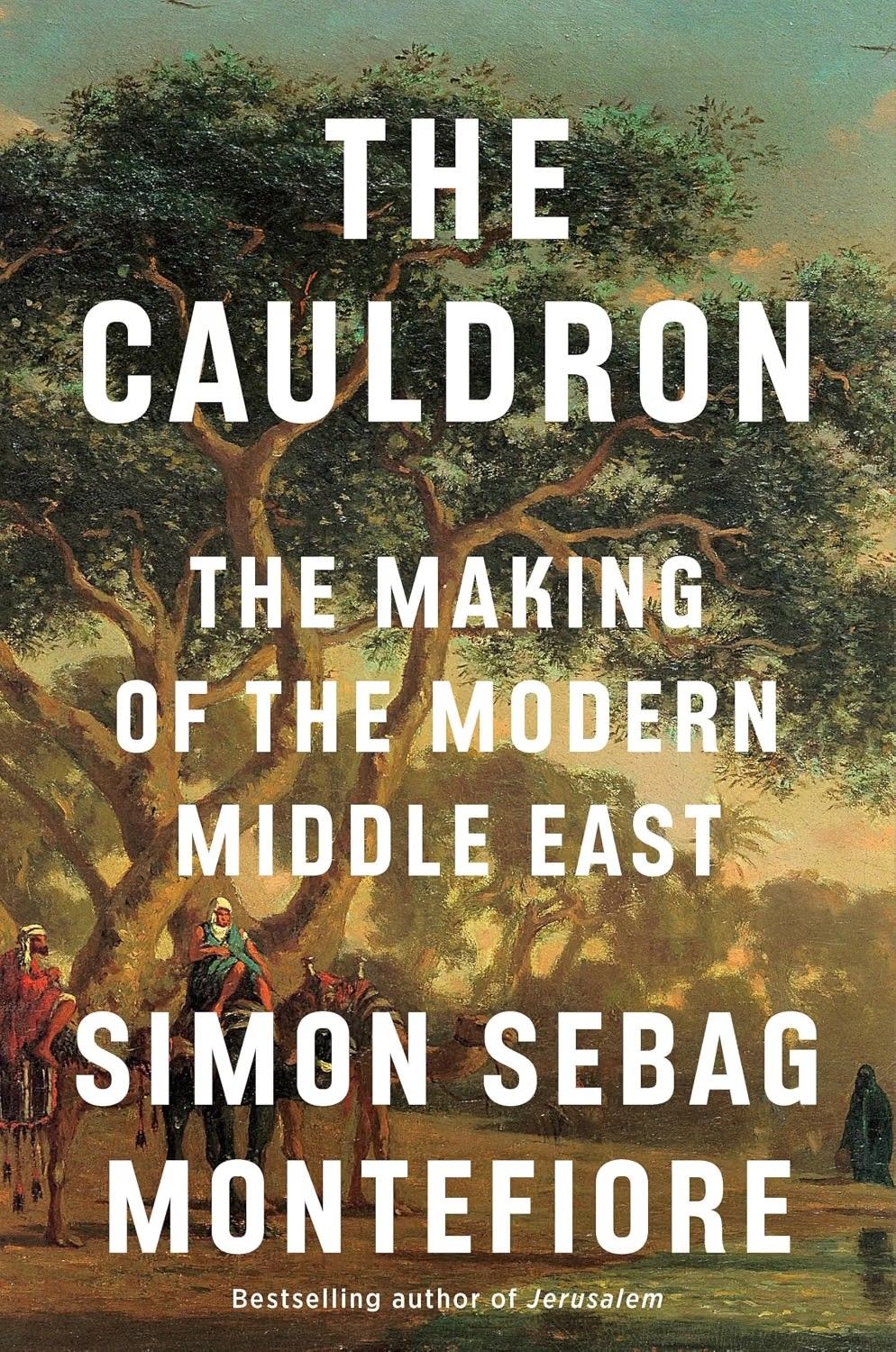

BOOK REVIEW: THE CAULDRON: THE MAKING OF THE MODERN MIDDLE EAST
By Simon Sebag Montefiore / Knopf
Reviewed by: Jean-Thomas Nicole
The Reviewer — Jean-Thomas Nicole is a Policy Advisor with Public Safety Canada. The opinions expressed are those of the author and do not reflect the official policies or positions of Public Safety Canada or the Canadian government.
REVIEW: The title of my review draws inspiration from the Andalusian Sufi philosopher and mystic Ibn Arabi (1165–1240), who famously marveled at the image of the human heart as “a garden amidst the flames,” a paradoxical symbol of beauty and spiritual resilience flourishing amid turmoil.
This metaphor provides a fitting lens through which to read Simon Sebag Montefiore’s The Cauldron: The Making of the Modern Middle East, whose conclusion bears the same evocative title. Montefiore depicts the Middle East as a region of immense cultural and religious richness, repeatedly engulfed by war, revolution, and sectarian strife.
Like Ibn Arabi’s garden, the Middle East that emerges in these pages is a civilization whose creativity and capacity for renewal have endured despite the flames that have so often threatened to consume it.
Simon Sebag Montefiore is a British historian and novelist, born in London in 1965 and educated at Gonville and Caius College, Cambridge. Before becoming a full-time author, he worked in banking and then as a foreign-affairs journalist during the collapse of the Soviet Union. He made his name with Catherine the Great and Potemkin and the award-winning Stalin: The Court of the Red Tsar, followed by Jerusalem: The Biography, The Romanovs: 1613–1918, and The World: A Family History of Humanity.
These works established his characteristic approach: explaining great political change through dynasties, families, and the ambitions of powerful individuals. He now brings that method to the modern Middle East.
The Cauldron is a remarkably ambitious attempt to narrate the region’s modern history in a single volume. Covering the period from Abdulaziz Al Saud’s seizure of Riyadh in 1902 to the upheavals of 2026, it ranges from Morocco to Iran and from imperial collapse to oil, political Islam, and the Israeli-Palestinian conflict. Its fourteen chronological parts run from the late Ottoman world through the Iranian Revolution and the Arab Spring to the “October 7 Wars.”
Montefiore’s governing proposition is that the Middle East cannot be explained by one master cause. Colonialism matters, but so do local empires, dynastic ambition, religion, oil, tribal networks, and individual decisions. He gives Western intervention its due weight and places it within a larger, interconnected arena where local rulers hold real agency and outside powers keep discovering the unintended consequences of their meddling.
The “cauldron” metaphor captures this interplay effectively. Geography supplies the vessel: the Bosporus, Suez Canal, Bab el-Mandeb, and Strait of Hormuz connect continents and concentrate strategic risk. Religion, imperial memory, nationalism, and oil provide the combustible ingredients. Political leaders then raise or lower the temperature. This framework is one of the book’s strongest features. It leaves room for contingency while keeping the story coherent.
The conclusion distills the chronology into four eras: Ottoman and European imperial rivalry, the Mandates, the Cold War age of independent states and pan-Arabism, and the post-1979 age of revolutionary Islamism and American predominance. Montefiore considers the Iranian Revolution an epochal break comparable to 1789 or 1917. In an important formulation, he argues that its ideology was revolutionism “Islamized.”
The book’s foremost strength is narrative propulsion. Montefiore writes political history through vivid episodes and sharply drawn personalities. The opening reconstruction of the Riyadh raid establishes the method: a dramatic scene introduces Abdulaziz and immediately reveals the Ottoman, British, and tribal forces from which Saudi Arabia emerged. The result is a history that remains readable despite its enormous span.
This approach works best when Montefiore sets personal ambition against structural change. Nasser’s rise illuminates the shift from aristocratic monarchies to military republics. The web linking Iran, Hezbollah, and Hamas shows how armed movements come to perform functions once monopolized by governments.
Montefiore also avoids treating the Middle East as synonymous with Israel and Palestine. Sudan, Yemen, Libya, Algeria, and Morocco receive sustained attention, as do minorities from Armenians and Assyrians to Druze and Yazidis. This breadth supports one of his most persuasive themes: modern nationalism has often compressed a historically intricate human mosaic into homogeneous states.
The literary dimension is another virtue. Poetry from across the region serves as an alternative archive of memory, loss, and belonging. The conclusion’s return to Ibn Arabi’s “garden amidst the flames” gives the narrative a humane counterpoint to its long catalog of violence and reinforces the author’s final contention that recognizing competing historical narratives is a prerequisite for coexistence.
The biographical method is also the book’s chief limitation. Its crowd of kings, spies, and revolutionaries makes history vivid but sometimes pushes institutions and economics into the background. Readers learn a great deal about rulers’ maneuvers and comparatively little about labor, education, and everyday social change. The emphasis can imply that states rise and fall mainly on the character of the people who run them.
The tone occasionally compounds this problem. Epigrams, sexual anecdotes, and barbed nicknames make for memorable prose, but they can make catastrophe feel theatrical. The frequent movement from massacre to colorful personal detail sometimes risks aestheticizing violence.
Montefiore declares a commitment to detached balance, and his bibliography draws on sharply conflicting interpretations of Zionism, Iran, and empire. Nevertheless, the narrative voice is often highly assertive. Contested interpretations are sometimes presented as settled judgments, particularly on the 1953 Iranian coup and the missed opportunities in Israeli-Palestinian negotiations.
The treatment of very recent events creates an additional difficulty. The final sections narrate 2025 and 2026 with the same confidence used for events backed by decades of archival scholarship. Casualty estimates, covert operations, and the durability of new alignments are inherently harder to assess, and the prose does not always signal where evidence is provisional. These chapters read as an informed first draft of history.
The density of names, shifting alliances, and overlapping conflicts can overwhelm even informed readers, which makes the maps and dynastic genealogies essential companions. There is also an imbalance between the broad opening and the more concentrated later narrative. As the chronology approaches the present, Iran, Israel, Syria, and the Gulf dominate while the Maghreb fades. That partly reflects contemporary geopolitics, but it weakens the promise of a region-wide synthesis.
The Cauldron succeeds as narrative synthesis. It restores agency to Middle Eastern actors, resists single-cause explanations, and gives neglected countries and communities their place. Its storytelling makes a vast subject unusually accessible, and the scholarship underneath holds up.
It is less definitive as analytical history. Its appetite for dramatic anecdote, its categorical tone, and its confident handling of unfolding events call for a critical reader. It is best read as a powerful interpretive panorama that opens its many controversies to debate.
Still, The Cauldron is an absorbing, learned, and provocative history. Its greatest achievement is to portray the Middle East as a dynamic political world with its own actors, memories, and possibilities. Its biases show, and they are outweighed by its ambition, its narrative brilliance, and its humane insistence that knowledge of competing histories is the best antidote to ideological certainty.
The Cipher Brief participates in the Amazon Affiliate program and may make a small commission from purchases made via links.
EDITOR’S NOTE: Want to know more about Simon Sebag Montefiore and The Cauldron? Check out The Cipher Brief’s State Secrets podcast where Suzanne Kelly interviews the author.