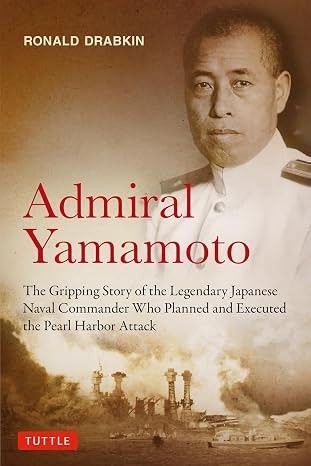

BOOK REVIEW: ADMIRAL YAMAMOTO: THE GRIPPING STORY OF THE LEGENDARY JAPANESE NAVAL COMMANDER WHO PLANNED AND EXECUTED THE PEARL HARBOR ATTACK
By Ronald Drabkin / Tuttle Publishing
Reviewed by: Jean-Thomas Nicole
The Reviewer — Jean-Thomas Nicole is a Policy Advisor with Public Safety Canada. The opinions expressed are those of the author and do not reflect the official policies or positions of Public Safety Canada or the Canadian government.
REVIEW: Few figures of the Second World War have been as thoroughly mythologized as Admiral Isoroku Yamamoto (1884–1943). Ronald Drabkin's Admiral Yamamoto: The Gripping Story of the Legendary Japanese Naval Commander Who Planned and Executed the Pearl Harbor Attack enters this crowded historiographical terrain with both confidence and originality. Drabkin is an American author, entrepreneur, and angel investor based in Tokyo who developed an interest in World War II intelligence and naval history after discovering that both his father and grandfather had been involved in counterintelligence work. He first gained recognition as a historian with Beverly Hills Spy: The Double-Agent War Hero Who Helped Japan Attack Pearl Harbor (2024), a well-received study of British aviator-turned-Japanese spy Frederick Rutland. (Editors note: that book was very favorably reviewed in The Cipher Brief.
Admiral Yamamoto thus appears to be another biography of an endlessly studied military figure. In reality, it is something more ambitious: an attempt to reexamine the foundations of Yamamoto's historical reputation itself. Drawing upon newly available Japanese sources, private correspondence, family records, contemporary scholarship, and a meticulous reassessment of long-accepted assumptions, Drabkin seeks not merely to recount Yamamoto's life but to understand how the legend of Yamamoto was created, sustained, and ultimately canonized.
The result is one of the most compelling and intellectually stimulating biographies of a Japanese wartime leader that I have read in recent years.
What makes the book particularly significant is that it exists in direct conversation with Hiroyuki Agawa's magnificent The Reluctant Admiral: Yamamoto and the Imperial Navy, long regarded as the definitive biography of the admiral. Agawa's work, first published in Japan in the 1960s and based extensively on interviews with contemporaries, personal correspondence, and official documents, profoundly shaped Western and Japanese understandings of Yamamoto. Agawa presented a deeply sympathetic figure: thoughtful, humane, internationally minded, and painfully aware that Japan could not prevail in a prolonged war against the United States. His Yamamoto was less an architect of catastrophe than a tragic participant trapped within larger historical forces.
Drabkin does not dismiss Agawa's achievement. Indeed, throughout the book one senses enormous respect for the earlier work. Yet he argues, implicitly and sometimes explicitly, that the "reluctant admiral" interpretation has become so influential that it has obscured aspects of Yamamoto's personality and agency that deserve renewed examination. The book's central accomplishment is not that it overturns Agawa's portrait, but that it complicates it. The Yamamoto who emerges is neither reluctant hero nor cartoon villain. He is far more interesting—and far more unsettling—than either stereotype allows.
One of Drabkin's greatest strengths lies in his treatment of Yamamoto's formative years. Rather than hurrying toward Pearl Harbor, he patiently reconstructs the social, cultural, and emotional world that shaped the future admiral. Beginning with his samurai ancestry and family history, the author situates Yamamoto within the extraordinary upheavals of Meiji Japan. The old order was collapsing; new opportunities and anxieties were emerging. In these chapters, Yamamoto appears not as a future strategist already destined for greatness but as a young man struggling to find his place in a rapidly transforming society.
This approach reveals an aspect of Drabkin's methodology that deserves particular praise. Unlike many biographies that proceed from event to event, Drabkin is constantly attentive to the interplay between personal history and larger structural forces. He asks not merely what Yamamoto did, but how his experiences shaped his perceptions of hierarchy, achievement, national identity, and power. The result is a richer and more psychologically convincing portrait than many military biographies provide.
The author's methodology represents one of the book's most important contributions. His research draws upon Yamamoto's private letters, family materials, memoirs, Japanese scholarly literature, and sources that have become more accessible since Agawa wrote his landmark study. Crucially, Drabkin does not simply aggregate evidence, he interrogates it. He compares recollections against documentary records, examines inconsistencies, and asks how postwar memory may have reshaped perceptions of wartime events. In many respects, this is as much a book about historical memory as it is about naval history.
This methodological difference is especially striking when compared to Agawa's approach. Agawa enjoyed access to numerous individuals who had personally known Yamamoto and therefore captured an emotional immediacy that later historians could never replicate. Yet proximity carries limitations as well as advantages. Contemporary recollections often reflect loyalty, nostalgia, and the understandable desire to remember admired figures in a favorable light. Drabkin benefits from historical distance. Equipped with new evidence and several decades of subsequent scholarship, he is able to revisit inherited narratives and ask questions that earlier generations either could not or would not pursue.
Particularly illuminating is his treatment of Yamamoto's private correspondence. These letters reveal a man whose public image concealed considerable complexity. Readers encounter someone capable of self-doubt, insecurity, sentimentality, ambition, and occasional melancholy. The letters also illuminate recurring themes that shaped his worldview: his admiration for certain Western figures and institutions, his sensitivity to status and recognition, and his persistent awareness of Japan's precarious position in the international system. Yet what impressed me most was Drabkin's restraint. He refuses to claim certainty where evidence is incomplete. Wherever ambiguities exist, he candidly acknowledges them. This intellectual honesty enhances the book's credibility and distinguishes it from more speculative works of historical psychology.
The reassessment of Yamamoto's relationship with the United States is equally persuasive. Traditional accounts often emphasize his time abroad as evidence of his admiration for America and his understanding of its industrial might. Agawa's portrayal reinforced this interpretation, presenting Yamamoto as one of the few Japanese leaders who genuinely grasped the overwhelming economic and military advantages enjoyed by the United States.
Drabkin does not deny these observations, but he contextualizes them differently. He demonstrates that Yamamoto's experiences in America exposed him not only to technological prowess but also to racial prejudice and cultural exclusion. These encounters seem to have produced a more complex mixture of respect, realism, and resentment than previous accounts acknowledged. As a result, Drabkin argues that familiarity with America did not necessarily translate into moderation or affection. Instead, it may have reinforced Yamamoto's conviction that Japan operated within an international order fundamentally stacked against it.
It is when the narrative reaches the years preceding Pearl Harbor that Drabkin's revisionist argument achieves its greatest force. The cornerstone of the traditional Yamamoto legend has always been the notion that he opposed war with the United States and merely fulfilled his duty once the political leadership chose conflict. Agawa's biography largely embraced this interpretation, portraying a commander who foresaw disaster but could not redirect the course of national policy.
Drabkin asks a different question. Did Yamamoto oppose war itself, or did he simply oppose fighting it under unfavorable circumstances? The distinction is crucial. Through careful examination of planning records, bureaucratic rivalries, strategic debates, and naval decision-making, Drabkin argues that Yamamoto was far more than a reluctant participant. He became one of the foremost advocates of a bold preemptive strike strategy. Once war appeared increasingly likely, he actively promoted the operational concepts that culminated at Pearl Harbor. Foreknowledge of risk, Drabkin suggests, should not be confused with opposition.
This reinterpretation is the book's boldest contribution. Yet it succeeds precisely because it emerges from evidence rather than polemic. Drabkin never seeks to transform Yamamoto into a one-dimensional warmonger. The portrait remains sympathetic even as it becomes more critical. Yamamoto emerges as a strategist of extraordinary brilliance whose greatest strength—his willingness to think creatively and embrace risk—also became his greatest weakness. He understood American power better than most of his contemporaries, yet he convinced himself that a dramatic operational victory could alter strategic realities. Pearl Harbor, in this telling, was not simply a gamble; it was the culmination of a worldview.
The military history itself is superb. Drabkin explains carrier warfare, naval aviation, strategic doctrine, and operational planning with clarity and precision, avoiding both excessive technical detail and oversimplification. His discussion of Midway is particularly effective because it reveals the tragic contradiction at the heart of Yamamoto's career. The same intellectual audacity that revolutionized naval warfare also contributed to catastrophic strategic misjudgments.
The most thought-provoking sections concern the aftermath of Yamamoto's death and the gradual construction of what might be termed the "Yamamoto myth." Here Drabkin's work transcends biography and enters the realm of historiography. He demonstrates how memory, politics, nationalism, and selective recollection combined to create the postwar image of Yamamoto as a tragic moderate. In doing so, he offers not merely a reinterpretation of one man but a meditation on how societies construct usable versions of their past.
What impressed me most throughout the book was Drabkin's refusal to replace one mythology with another. Many revisionist works become trapped by the temptation to invert established narratives. Drabkin avoids this entirely. He neither sanctifies nor condemns. Instead, he restores ambiguity and complexity to a historical figure who has too often been flattened into symbol. His achievement is methodological as much as interpretive. By combining fresh sources with rigorous skepticism and historical empathy, he provides a portrait that feels simultaneously more nuanced, more convincing, and more human.
In the end, I believe Admiral Yamamoto should be read alongside—not instead of—Agawa's The Reluctant Admiral. Agawa remains indispensable for understanding how Yamamoto was remembered by those who knew him and why he inspired such loyalty among contemporaries. Drabkin, however, is indispensable for understanding how that memory was constructed, how historical reputations evolve, and why familiar narratives deserve periodic reconsideration. Together, the two biographies provide a remarkable lesson in the evolution of historical scholarship itself.
I finished Drabkin's book with a deep sense of admiration—not only for the author's research, but for his willingness to confront complexity without sacrificing readability. This is military history at its best: deeply researched, intellectually ambitious, narratively engaging, and unafraid to challenge orthodoxies. More than a biography of Yamamoto, it is an exploration of leadership, responsibility, memory, and historical mythmaking. For readers interested in the Pacific War, Japanese history, strategic studies, or the craft of biography itself, it is an exceptional and important work.
The Cipher Brief participates in the Amazon Affiliate program and may make a small commission from purchases made via links.