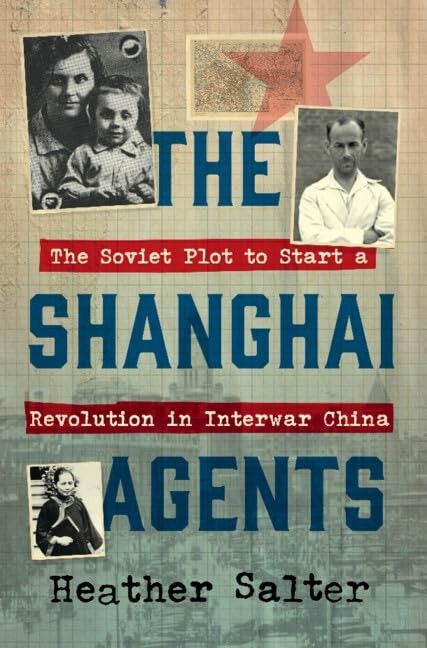

BOOK REVIEW: THE SHANGHAI AGENTS: THE SOVIET PLOT TO START A REVOLUTION IN INTERWAR CHINA
By Heather Salter/ Cambridge University Press
Reviewed by: Martin Petersen
The Reviewer — Martin Petersen is a CIA veteran, Asia expert, and a Cipher Brief Expert. He is the author of City of Lost Souls, A Jack Ford Shanghai Mystery, which was named Earnshaw Books Best Seller of 2024. A second Jack Ford Shanghai Mystery, City on the Edge, will be published late this year.
REVIEW: The Noulens Case was a global cause célèbre in 1930s and is masterfully documents in “The Shanghai Agents” by Heather Salter. Noulens was an alias, one of many and for the sake of simplicity I have chosen to refer to the principals by that name in this review. Like the Rosenbergs, the Noulens attracted world attention and leftists agitated for the release of this husband and wife team accused of being communists and running a spy ring.
The true identity of the Noulens was not revealed until 1991. At the time of their arrest, they claimed Belgian citizenship and said they were Marie Motte and Fernand Vanderheruyssen. Before it was all over, they said their name was Noulens and when that story collapsed, they claimed to be Paul and Gertrud Ruegg, supposed German nationals. They were in fact Tatyana Moiseenko and Yakob Rudnik, Russians and the key Comintern agents in Shanghai. (The Comintern, short for Communist International, or the Third International, was founded by Lenin to work for the overthrow of capitalist governments around the world.)
Earlier books and articles leave the impression that they were fairly minor
players. But Salter’s research shows that as the Comintern’s Far Eastern Bureau leads in China, they had a central and critical role in Moscow’s efforts to advance communism across all of Asia. They were the critical communications and money channel between the fledgling Chinese Communist Party and Moscow and between Moscow and communists in Malaya, India, and French Indochina. Salter describes in some detail how the Noulens operated and the tradecraft they employed.
Their arrest was a huge blow for Moscow, which is why the Comintern launched a huge propaganda campaign that claimed the Noulens were innocent of the Communist charge and were victims of the repressive Chinese Nationalist Government. A major part of this effort was the creation of Committees to save the Noulens and drafting petitions calling for their release. Albert Einstein, Henri Barbusse, and Otto Dix were among the Noulens’ supporters. Salter’s research reveals that Soong Ching-ling (Madame Sun Yat-sen) played a much larger role than previously known in aiding this public relations onslaught. She was not duped. She was well aware of their guilt.
Extraterritoriality—a provision of Western treaties with China dating to the end of the Opium War that said Westerns could only be tried in their own national courts using their national law—was also a factor in the many aliases used by Noulens. Russia renounced its extraterritoriality after the Communist revolution. So Russian citizens then would be tried in Chinese courts and under Chinese laws. The crimes the Noulens were charged with—and guilty of—carried the death penalty. Thus, the repeated efforts to establish identities protected by extraterritoriality first as Belgians and then as German nationals.
China was trying to negotiate an end to extraterritoriality at this time and knew for that to have a chance, the Chinese legal system had to be seen in the West as fair, honest, and modern. The Noulens, however, were badly treated while awaiting trial, which frightened ex-pats in China, and the death penalty hung over their heads. They were found guilty in the end but the death sentence was commuted to life in prison. Their trial antics—hunger strikes, refusal to answer questions or cooperate in any way, and continually disrupting the proceedings—rivals the behavior of the Chicago Seven circus in 1969.
A fascinating collection of historical figures march though and around this story: Madame Sun Yat-sen, Zhou Enlai, Richard Sorge, Agnes Smedley, Valentine Vivian, and Ho Chi Minh. Added to these are the Comintern officials in Moscow and their agents in Germany. Ironic perhaps, but their arrest, the long maneuvering before trial, and imprisonment almost certainly saved the Noulens’ lives. They were in a Chinese prison when the Great Terror started in Russia and officials with ties to the Comintern were prime targets.
The Noulens were released under a general amnesty after the Japanese attack on China in 1937. They made their way home to Russia in September 1939 where they were reunited with a son they had not seen in 13 years. Both died in 1964.
The case has been touched on—generally in passing—in other works, most notably Frederic Wakeman’s Policing Shanghai 1927-1937, and a 1994 article in The China Quarterly by Frederick Litten dealt with the case in more detail. Drawing on press accounts from the period, trial transcripts, and Russian archives, Salter has written what has to be the definitive account of this episode. She has also written a book that readers who are interested in modern Chinese history, Russian machinations in China, intelligence tradecraft, the Comintern, or a good spy stories will enjoy.
The Cipher Brief participates in the Amazon Affiliate program and may make a small commission from purchases made via links.