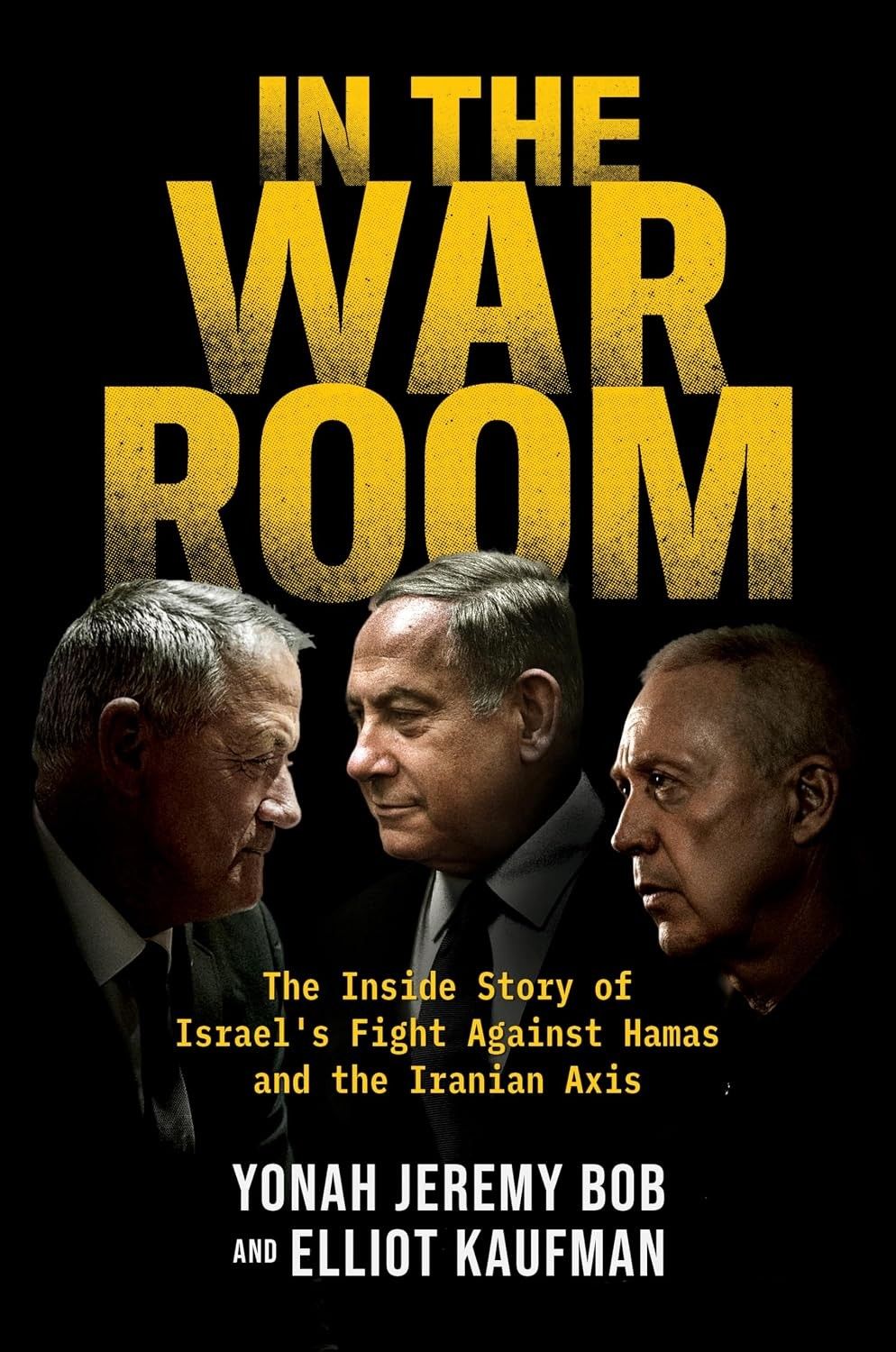

BOOK REVIEW: IN THE WAR ROOM: THE INSIDE STORY OF ISRAEL'S FIGHT AGAINST HAMAS AND THE IRANIAN AXIS
By Yonah Jeremy Bob and Elliot Kaufman / Wicked Son
Reviewed by: Jean-Thomas Nicole
The Reviewer — Jean-Thomas Nicole is a Policy Advisor with Public Safety Canada. The opinions expressed are those of the author and do not reflect the official policies or positions of Public Safety Canada or the Canadian government.
REVIEW: In the War Room is a gripping and consequential work of contemporary strategic history, offering an insider's account of Israel's response to the October 7 attacks and the multifront conflict that followed. Drawing on extensive interviews with senior political leaders, military commanders, intelligence officials, and international partners, the book seeks not merely to recount events but to illuminate the machinery of decision-making under conditions of extraordinary uncertainty and national trauma.
In the War Room is the result of the collaboration between two seasoned experts. Together, the two bring a combination of investigative reporting, strategic analysis, and high-level access to policymakers and intelligence sources that inform their new book. Yonah Jeremy Bob is an award-winning Israeli journalist and senior military analyst for The Jerusalem Post, known for his extensive access to Israeli defense, intelligence, and security officials. He is the author of three previous books, most notably Target Tehran (2023), a widely praised account of the Mossad's covert campaign against Iran's nuclear program.
His co-author, Elliot Kaufman, is an editorial writer and member of The Wall Street Journal's editorial board, specializing in Israel, Iran, and Middle Eastern affairs. Since October 7, 2023, Kaufman has extensively covered the regional conflict, conducting interviews with senior Israeli political and military leaders.
At its core, the book is less a military history than a study of leadership under pressure. The authors reconstruct the tense deliberations that occurred within Israel's highest political and security circles as the country grappled with a catastrophic intelligence failure, mounting hostage crises, escalating regional threats, and unprecedented international scrutiny. What emerges is a portrait of a state struggling to regain its footing after strategic surprise, while simultaneously waging campaigns against Hamas, Hezbollah, and the broader Iranian axis.
One of the work's greatest strengths is its treatment of the intelligence and policy failures preceding October 7. Rather than attributing the disaster solely to operational mistakes, the authors describe a deeper failure of assumptions—a prevailing belief that Hamas had been deterred and that existing strategic frameworks remained valid. The book illustrates how warning signs were discounted, dissenting voices overlooked, and institutional confidence transformed into complacency. In doing so, it offers lessons that extend far beyond the Middle East, speaking to universal challenges in intelligence assessment, risk management, and strategic foresight.
Equally compelling is the book's depiction of the "war room" itself. Contrary to simplistic portrayals of unified wartime leadership, the narrative reveals a decision-making process characterized by disagreement, rivalry, and constant reassessment. Political leaders, military commanders, and intelligence chiefs frequently diverged on questions of operational timing, escalation risks, hostage negotiations, and relations with the United States. This emphasis on debate and friction lends the account both credibility and analytical depth. The authors demonstrate that successful crisis management often depends not on consensus but on the capacity of institutions to accommodate competing perspectives while remaining capable of decisive action.
The operational sections are equally illuminating. The book traces Israel's transition from shock and disarray to increasingly sophisticated military and intelligence operations. Detailed accounts of urban warfare in Gaza, targeted strikes against senior militant leaders, covert intelligence activities, and efforts to counter Hezbollah and Iran illustrate a remarkable degree of adaptation. Particularly striking is the portrayal of how military innovation, intelligence integration, and strategic flexibility enabled Israel to recover from an initial strategic setback. The narrative repeatedly underscores a central lesson of modern conflict: resilience often matters more than preparedness alone.
Beyond the battlefield, the book is at its most insightful when examining the relationship between military operations and international politics. The authors devote significant attention to Israel's interactions with successive U.S. administrations, highlighting moments of close cooperation as well as serious disagreement. These episodes reveal the constraints imposed by alliance politics and demonstrate how military decisions are inseparable from diplomatic legitimacy, humanitarian concerns, and domestic political pressures. The result is a nuanced exploration of statecraft in which battlefield success does not necessarily translate into strategic or political advantage.
The authors also deserve credit for their methodological transparency. They acknowledge the constraints imposed by security considerations, censorship requirements, and the sensitivities of high-level sources. While much of the narrative is built upon extensive interviews and privileged access, they candidly recognize the limitations inherent in reconstructing events that remain politically and strategically contested. This openness strengthens the work's credibility, even where some claims cannot be independently verified.
Yet the book is not without shortcomings. Its most significant limitation stems from its perspective. The narrative is overwhelmingly driven by Israeli political, military, and intelligence viewpoints. Palestinian, Lebanese, and Iranian perspectives appear primarily through the lens of Israeli assessments rather than as independent voices. Consequently, while the work excels as a study of Israeli decision-making, it is less effective as a comprehensive history of the conflict itself. Readers seeking a fuller understanding of the broader regional experience will need to supplement it with alternative perspectives.
Similarly, while the humanitarian dimensions of the conflict are acknowledged, they do not receive the same analytical depth as military and strategic considerations. The immense civilian suffering associated with the war forms part of the background context rather than the central focus of the narrative. Likewise, the book offers relatively little insight into the long-term political questions surrounding Gaza, Palestinian governance, or prospects for regional reconciliation. It explains how leaders navigated the crisis but is less persuasive when considering what sustainable peace might ultimately require.
Despite these limitations, In the War Room stands as an important contribution to the literature on modern conflict, intelligence, and national security decision-making. Its enduring value lies in its exploration of how governments respond when assumptions collapse and events outpace existing plans. Far from a triumphalist narrative, it is a study of adaptation: how institutions recover from failure, how leaders make decisions amid uncertainty, and how strategy evolves under the pressure of events.
Ultimately, the book succeeds because it illuminates not only what happened, but how and why crucial decisions were made. For policymakers, military professionals, intelligence practitioners, and students of contemporary statecraft, it offers a rare and often sobering glimpse into the realities of leadership during war. Even readers who question its perspective will find its insights difficult to ignore. As a work of strategic analysis and crisis leadership, In the War Room is both highly informative and deeply thought-provoking.
The Cipher Brief participates in the Amazon Affiliate program and may make a small commission from purchases made via links.