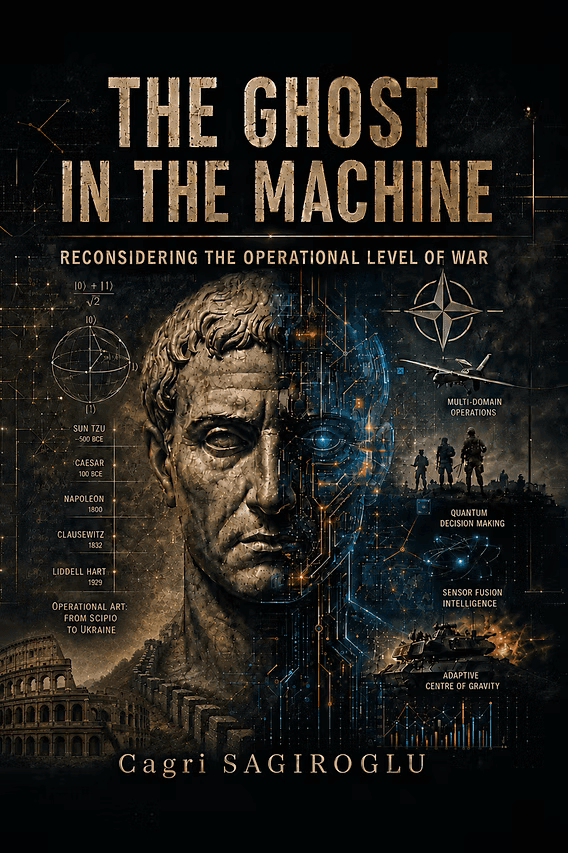

BOOK REVIEW: THE GHOST IN THE MACHINE: Reconsidering the Operational Level of War
By Cagri Sagiroglu / Howgate Publishing Limited
Reviewed by: Gregory B. Elder
The Reviewer — Gregory Elder is a lecturer at the Johns Hopkins University Krieger School of Arts and Sciences. He was the chief historian of the Defense Intelligence Agency for a decade and has held several senior-level positions in the Department of War and the Intelligence Community, including as a President's Daily Brief briefer, a deputy defense intelligence officer, senior intelligence officer, and a course director and master instructor.
REVIEW: I love military theory. Indeed, my email address starts with "Clausewitz"! And at a time when quality analytical theory on war seems increasingly scarce, Dr. Cagri Sagiroglu's work is, in one sense, a breath of fresh air. By revisiting important elements of Jomini, Clausewitz, and von Moltke; engaging the debate over operational art versus the operational level of warfare; tackling the challenges between new technology and classical theory; and drawing on historical vignettes to argue for a new way of organizing for combat, he offers a fresh and fascinating perspective on war. Many of the individual discussions in the book make it worth the read.
However, Sagiroglu may also have bitten off more than he could chew. The Ghost in the Machine is a book filled with numerous themes and arguments, many of which warrant a treatise of their own. Yet the book attempts to package too many of these ideas into a single 400-page volume while simultaneously trying to weave them into a coherent whole, with the end-state being an argument of a new, dynamic brigade structure for military operations. The result is ambitious and thought-provoking, but the sheer breadth of the argument comes at the expense of depth and clarity.
One of the early arguments in Sagiroglu's The Ghost in the Machine is the distinction between the fox and the hedgehog or, more precisely, between an approach to war based on dynamic, adaptive thinking and one that seeks to reduce warfare to "discoverable, teachable, universally applicable principles." Sagiroglu is not arguing that military professionals should disregard the lessons of history or the insights of great military thinkers. Rather, he cautions against treating those lessons as timeless formulas. As he explains, "War's nature endures; its character changes; and the military institution that mistakes the enduring nature for a licence to apply yesterday's solutions to today's problems will repeat, at whatever cost, the history of fighting the last war. This study is, in its deepest aspiration, a fox's study of a hedgehog problem."
This is one of the book's strongest ideas, although the examples used to illustrate it, including Napoleon's campaigns and the ongoing war in Ukraine, are somewhat too brief to fully develop the argument. Nevertheless, Sagiroglu's broader point is compelling: military institutions must distinguish enduring principles from the specific methods, structures, and assumptions that emerge from a particular historical context. The ability to adapt is more important than the ability to preserve hard-won institutional knowledge.
Sagiroglu then turns to Jomini, Clausewitz, and von Moltke to examine the intellectual foundations of modern Western approaches to warfare, particularly how "the operational level of war became embedded in Western military culture, and to identify the intellectual traditions from which it drew and from which, in most cases, it selectively deviated." Here, Sagiroglu makes an important distinction between operational art and the operational level of war. Operational art concerns how military leaders employ intellect, forces, and resources to achieve strategic objectives through campaigns and operations. The operational level, by contrast, is a formal organizational construct positioned between the tactical and strategic levels of war.
That distinction is central to Sagiroglu's argument. The great military theorists recognized the importance of what we would now call operational art, but, he argues, they did not advocate for the formal operational level that later became embedded in Western military institutions. In Sagiroglu's view, that distinction matters because the operational level has evolved into an unnecessary bureaucratic intermediary that can impede the speed and effectiveness of military decision-making. As he observes, "What Moltke's campaigns demonstrate—planned and executed through a staff system of exceptional professional quality—is that operational art at its most effective operates precisely without the bureaucratic intermediation that the formal operational level implies." Rather, he argues for the use of grand strategy to bridge the gap between battle and war. Whereas the operational level of war is indicative of larger scale operations, such as corps level operations, grand strategy can be applied to the full range of conflicts.
This argument, that modern militaries should reconsider or even eliminate the formal operational level to improve the speed with which tactical actions contribute to strategic outcomes is woven throughout the book. Whether readers ultimately agree with Sagiroglu's premise is another matter; this reviewer does not. Nevertheless, the argument is sufficiently well-developed and consequential to warrant consideration. Sagiroglu challenges a deeply embedded assumption within modern Western military thought, and even readers who reject his conclusion will benefit from examining why that assumption exists and whether it continues to serve its intended purpose.
Sagiroglu then examines the military traditions of Napoleon, the Ottomans, the Prussians/Germans, the Russians/Soviets, the British, Americans, and Chinese, using each to illuminate both the possibilities and limitations of operational art. His comparative analysis ultimately identifies a common weakness across these traditions: the persistent difficulty of integrating operational art with political intelligence. As he observes, "What no tradition has consistently achieved is the full integration of operational art with political intelligence – the capacity to connect military means to political ends across the full spectrum of conflict, from the high-intensity conventional battle to the protracted irregular campaign, without losing coherence at either pole." The broader implication is that operational art cannot be understood solely as the effective orchestration of military forces; its enduring challenge is to translate political objectives into coherent military action across radically different forms and intensities of conflict.
As with other topics, Sagiroglu seeks to reconsider rather than discard the concept of the Center of Gravity (CoG). In traditional conflict theory, the CoG is exemplified by Clausewitz, who famously defined it as the "hub of all power and movement, on which everything depends." In operational planning, which can span years depending on the objective, identifying and successfully attacking the CoG is viewed as the primary method for dismantling an adversary's warfighting system to achieve victory. Depending on the nature of the conflict, historical CoGs have included capturing an enemy's capital, undermining their will to fight, or defeating their principal army in the field. However, Sagiroglu aptly points out that war is dynamic, and targeting a CoG invariably requires achieving interim objectives. Consequently, fixating on a single, unalterable CoG needlessly restricts operational art and flexibility. For Sagiroglu, the pivotal inquiry should shift: "[T]he question is not what is the enemy CoG? but what is the CoG now?"
Although Sagiroglu addresses other topics, such as the impact of emerging technologies on conflict, his primary concluding argument is that operational flexibility in modern warfare is best achieved through brigades rather than alternative combat structures. To quote Sagiroglu, "A well-structured brigade, possessing organic multi-domain capabilities and commanded by an officer trained to practise operational art as an intellectual discipline rather than a procedural checklist, is uniquely suited to navigate the cross-domain challenge: it is large enough to generate combined-arms effects across multiple domains, small enough to operate at the tempo demanded by modern contested environments, and agile enough to reorient its effort as the centre of gravity shifts through successive campaign phases." However, I found this to be one of the book's weaker arguments. While Sagiroglu stresses that this modular approach is a response to contemporary complexities, he relies on historical examples dating back to Roman antiquity to prove his point. Furthermore, numerous historical precedents demonstrate why divisions and corps remain optimal. Ultimately, Sagiroglu fails to provide compelling evidence that a globally engaged military, such as the United States, would truly benefit from such a drastic reorganization.
Ultimately, The Ghost in the Machine is most valuable not because every one of Sagiroglu's conclusions is necessarily persuasive, but because it challenges readers to reconsider assumptions that have become deeply institutionalized in modern military thought. Its central warning: to avoid confusing enduring truths about war with solutions that belong to a particular era, is particularly relevant to military professionals attempting to prepare for conflicts whose character may differ significantly from those of the past.
The Cipher Brief participates in the Amazon Affiliate program and may make a small commission from purchases made via links.
All statements of fact, opinion, or analysis expressed are those of the author and do not reflect the official positions or views of the US Government. Nothing in the contents should be construed as asserting or implying US Government authentication of information or endorsement of the author's views.