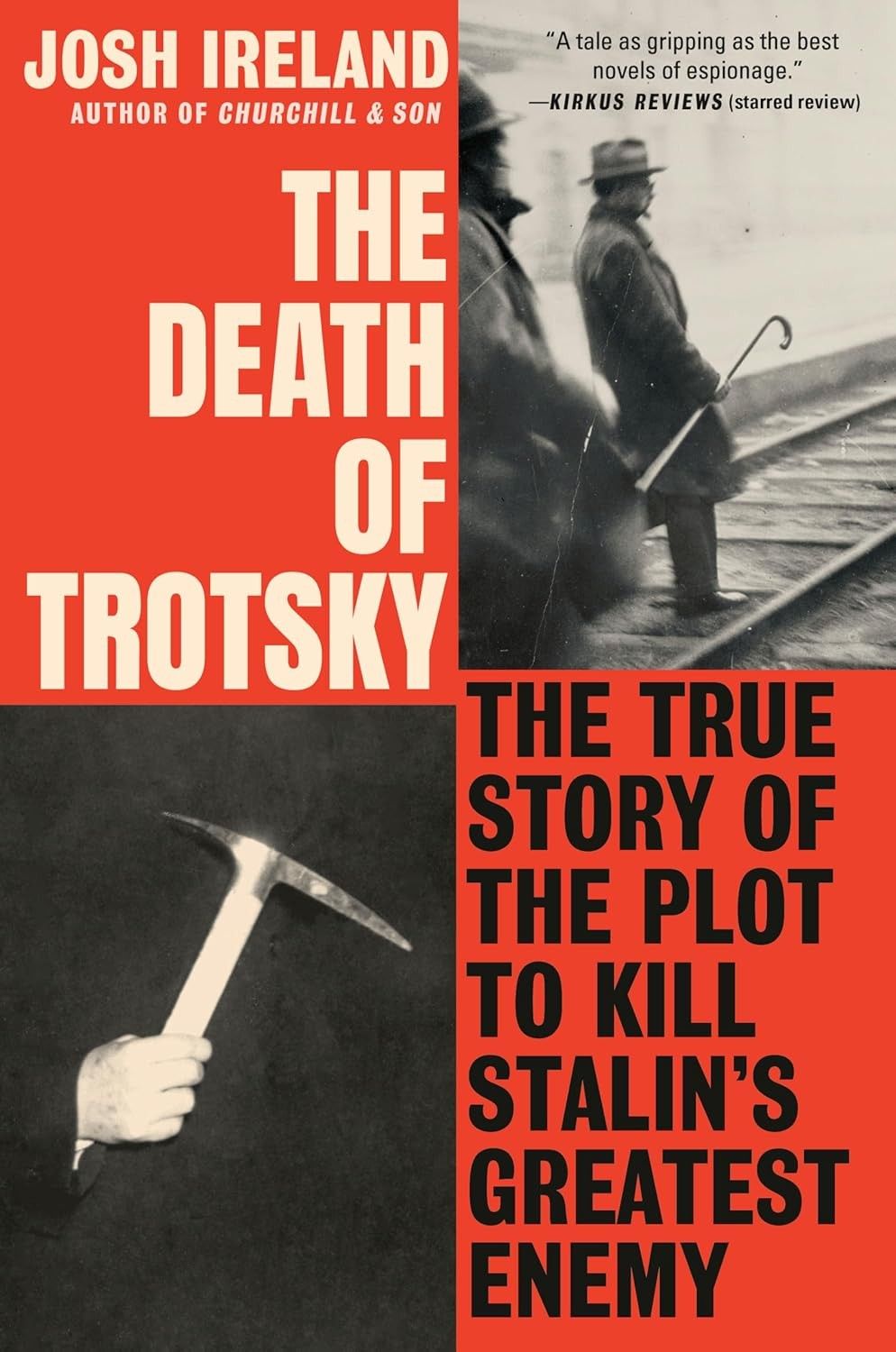


BOOK REVIEW: THE DEATH OF TROTSKY: THE TRUE STORY OF THE PLOT TO KILL STALIN’S GREATEST ENEMY
By Josh Ireland/ Dutton
Reviewed by Michael J. Ard
The Reviewer: Michael J. Ard is a former CIA analyst and Deputy National Intelligence Officer for the Western Hemisphere. Ard is program director for the Master of Science in Intelligence Analysis program at Johns Hopkins University.
Leon Trotsky lived in fear. It was only a matter of time before Stalin’s henchmen, agents of the NKVD, tracked him down to his Mexican hideout. Then, in 1940, it happened; a mysterious man who had access to his house approached him from behind and smashed a mountaineer’s ice ax into his head. Thus, Trotsky, a key leader of the Bolshevik revolution, head of the Red Army, and Stalin’s hated rival to succeed Lenin, was eliminated. This murder culminated the NKVD’s long campaign to purge Stalin’s real and perceived enemies all over the world.
Trotsky, despite his ruthlessness during the Russian Civil War, lacked Stalin’s political skills and, in 1927, was easily expelled from the ruling Politburo and dispatched into exile. After fitful stays in France and Norway, Trotsky and his wife Natalie and some loyalists found refuge in socialist-friendly Mexico, sponsored by the sympathetic painter Diego Rivera.
It took a while before Stalin’s men could get to Trotsky. Since Stalin initiated the “Great Terror” after the 1934 assassination of Sergei Kirov, the NKVD sought to eliminate Trotsky’s scattered and paranoid “Fourth International,” which they saw as a rival to Moscow’s Comintern. But Stalin reasoned that the movement would soon die without its bombastic but aloof leader.
Josh Ireland’s “The Death of Trotsky” narrates the events that led up to this famous assassination in painstaking detail. The book is engrossing in describing the NKVD’s tradecraft in embarking on its deadly missions and the strange, idealistic personalities attracted to the charismatic but doomed Trotsky.
For a hunted exile, Trotsky had been living a bucolic life in Mexico. After being expelled from Norway, he and his wife Natalia found a home in Rivera’s Blue House with his artist wife Frida Kahlo. Trotsky spent his time gardening, raising rabbits, and writing anti-Stalin articles and books. Ireland relates he even had a dalliance with the lame but exotic Frida. But soon tempers flared between the Russian revolutionary and the Mexican muralist—Rivera’s large mansion could not contain two giant egos—so Trotsky and his entourage moved to another property outside Mexico City. The house was guarded by several of Trotsky’s American followers, chosen for loyalty over competence.
Ireland covers in detail the family history of Trotsky’s eventual murderer, the Catalan Ramón Mercader, and his mother, the unstable and ironically named Caridad (“Charity”), who had become fanatical Stalinists, fought in the Spanish Civil War, and then became recruited NKVD agents. Caridad herself claimed to have hunted and eliminated Trotskyists. They were recruited by Leonid Eitingon, the NKVD director in Spain, and reported to Pavel Sudoplatov, who as deputy director of the Foreign Department undertook the “special task” of Trotsky’s assassination.
The operation was a high priority. The previous failure to kill Trotsky led to Pavel Sudaplatov’s predecessor’s elimination. The NKVD’s internal review process was harsh. So, Sudoplatov decided the new mission must proceed on two tracks: one would be an armed assault on Trotsky’s house, led by the Mexican painter and Stalin fanatic David Alfaro Siqueiros and several armed gunmen. Siqueiros’ main qualification for the role seemed to be his founding of the pro-Stalin Mexican Communist Party. The other plan would be for Mercader to infiltrate an assassin to Trotsky’s house, kill him quietly, and then escape before detection. Neither Siqueiros nor Mercader knew of the other’s operation.
Mercader seemed like the perfect agent to get to Trotsky. Skilled in languages and an amateur actor, the secretly committed Stalinist moved easily among several aliases. Posing as a socially aware businessman and playboy in Paris, he romanced a young Trotskyite who, fortuitously, became the Mexican exile’s private secretary. Operating under the alias of Frank Jacson with Canadian passport acquired by Soviet spies in Spain, Mercader traveled to the United States and then entered Mexico through the southern border. Trotsky’s security personnel soon became used to the handsome but enigmatic “Jacson” coming to the house to visit his lover.
Siqueiros and his gang struck first and shot up the house, but failed to kill Trotsky, who hid under a bed. The job then fell to Mercader, aka “Jacson.” Meanwhile, Trotsky’s fatalism grew. It is a mystery why he did not change residences after this attack.
On the fateful day in 1940, Mercader arrived at the house wearing an overcoat concealing an ice ax, a knife, a pistol, and enough cash to assist his getaway. He was never searched. He planned to ask Trotsky to review an article he had written. While alone with the aging revolutionary in his study, Mercader drew the ice ax and struck Trotsky from behind. But he missed the kill shot. Instead of dying instantly, Trotsky screamed and grappled with his attacker, drawing the bodyguards into the room. Mercader was captured, and Trotsky collapsed, bleeding from his soon-fatal head wound.
As Stalin predicted, the “Fourth International” lost steam once Trotsky died. Yet the dictator reacted indifferently to Trotsky’s death; he had greater concerns. The coming war with Nazi Germany ended the Great Terror.
The Mexican authorities arrested Mercader (still known to them as “Jacson”) and, after extensive interrogations, sentenced him to 20 years in prison. Still a Soviet agent, Caridad moved to the U.S.S.R, and through her indiscretion revealed Ramón’s identity as Trotsky’s murderer. Released in 1960, Ramón Mercader traveled to the Soviet Union and was made a Hero of the Soviet Union.
Ireland’s “The Death of Trotsky” is a solid but occasionally tedious story. Ireland’s passion for exactitude is admirable; he made exhaustive use of the abundant memoirs and records from the period. But this reviewer, schooled in the old DI style guide, prefers less distracting and insignificant detail, which made the book read long. Had Ireland learned what Mercader ate for breakfast the day of the murder and the color of his pocket handkerchief, he would have told us. Still, the book is valuable for chronicling one of the most dramatic political murders of the twentieth century.
Note: All statements of fact, opinion, or analysis expressed are those of the author of this review and do not reflect the official positions or views of the US Government. Nothing in the contents should be construed as asserting or implying US Government authentication of information or endorsement of the author’s views.
Sign up for our free Undercover newsletter to make sure you stay on top of all of the new releases and expert reviews.
Read more expert-driven national security insights, perspective and analysis in The Cipher Brief because National Security is Everyone’s Business