

BOOK REVIEW: Mindful Soldier: Building Resilience to Overcome Life’s Challenges
By Ash Alexander-Cooper with Dr. Jessica K. Miller / Hachette Mobius
Reviewed by: Tim Wllasey-Wilsey
The Reviewer Tim Willasey-Wilsey is a Cipher Brief Expert and Visting Professor of War Studies at King’s College, London. He is also a Senior Associate Research fellow at RUSI, the London-based military think tank.
REVIEW — I first met Ash Alexander-Cooper, the author of “Mindful Soldier.” in Afghanistan where he was serving with the British Army in an operational role which brought him into close contact with Afghan, American and other coalition forces at the sharpest end of the campaign against Al Qa’ida terrorists and Taliban militants. Lots of Cipher Brief experts and subscribers will know him too and probably, like me, would have identified him as an Alpha Male with high levels of competence and self-confidence. Indeed, it came as little surprise to read that he has excelled in so many areas; even as a child at a cathedral choir school he was flown to New York to perform at the premier of Andrew Lloyd-Webber’s Requiem. He played rugby at national and rowed at international level. He runs marathons, flies helicopters, climbs mountains; you name it and he has done it.
But this book, his first, has an added sense of importance because it is not about his many achievements but about the struggles and challenges he has faced since childhood during which he suffered terribly at the hands of a disturbed and abusive father.
The book begins with a detailed and graphic description of a night operation which goes horribly wrong. It has all the shocking immediacy of the initial minutes of the film “Saving Private Ryan”. Ash is wounded in at least three places and loses one of his team killed in action. In the aftermath he worries about why his brain was so slow to function at the moment of greatest peril and later still he is distressed by having to leave his team for medical treatment in the UK and in attending his team member’s funeral.
Later in Chapters 9 and 11 Ash returns to combat and endures similarly chaotic and disturbing situations. In one, he was walking only a few feet behind a soldier who trod on a mine. In another a coalition aircraft drops a bomb on his position by mistake.
I do remember observing at the time that a small number of coalition troops were doing the bulk of the fighting in Afghanistan; often flying out almost nightly in an attempt to detain terrorists or insurgents. Even more missions were undertaken in Iraq where there would sometimes be multiple operations each night. For many soldiers posted to one of the huge airbases dotted around these coalition theatres the chances of death or injury were negligible. But for those who ventured outside the wire of these sanctuaries or who occupied Forward Operating Bases (FOBs) in the most hotly contested locations the risks were considerable.
I wondered at the time whether politicians and military commanders had given any thought to the likely long-term consequences of having such a small number bear such a large proportion of the so-called kinetic war. So, it is extraordinary that there seems to have been so little provision for mental wellbeing. This may account for the large number of suicides since those days.
As an exceptionally practical person Ash has tried to work out solutions for much of his trauma himself by identifying methods which work for him. Getting out into nature and long-distance running have clearly helped but he has also developed a theory that resilience is like a currency; and that you can build up a credit balance to be spent when next needed. He has been helped in this quest by his co-author Dr Jessica Miller, a leading neuropsychologist and trauma specialist, who has provided a Practical Tip at the end of each chapter and has also added several paragraphs supporting Ash’s “lived experience” with the current state of academic theory. It is this conjunction of the deep thinking of a sufferer of trauma and the simultaneous input of an expert which makes this book such compelling reading.
There are many sections which require thorough study rather than just a single reading. There are thoughts about humor, self-harm, attention-seeking, blame, shame, becoming accustomed to uncertainty, kindness, self-doubt (often positive), never giving up (essential), post traumatic growth, returning home, comfort zones (not always good), objectivity, gratitude and compassion. There are also some specific techniques, such as STOP (Stop,Take a breath, Observe, Proceed).
I suspect that this book will be helpful to everyone faced with extreme anxiety, not only war veterans. It was only in my late teens that I realized that my father had some hidden demons. He was a professional soldier who had fought throughout World War Two and in many of UK’s wars of decolonization, Malaya, Egypt, Cyprus and Indonesia. He rarely talked about such things, but I do recall mention of a fatal incident in which several men decided to sleep in heavy rain under their vehicle in Holland in 1945 only for it to sink up to its axles during the night.
In those days the accepted way to deal with trauma was to suppress it but many also relied on their religious faith. Christian belief and church attendance were more prevalent in the UK then than now, leaving a gaping chasm to be filled by alternative remedies.
Like Ash my father also developed resilience. Once in the early 1960s when we were driving behind a motorcycle and sidecar it pulled out intending to overtake but collided with an oncoming lorry. My father left my mother and me (aged about 7 or 8) in our car and ran back to help several others lift the lorry off the wreckage but the rider and the three occupants of the sidecar (his wife and two children) died at the scene. Directly after this horrific experience my father got back into our car and drove on. The incident was never mentioned again.
In writing my recent book “The Spy and the Devil” I mentioned Sir Stewart Menzies (the third Chief of MI6) whose regiment suffered catastrophic casualties in the first two battles of Ypres in 1914 and 1915. Only after the book was published did I read that his wife could never invite guests to stay overnight at their large country house in southwest England because Sir Stewart would regularly wake up screaming. One can only imagine what horrors the families of the veterans of the two world wars had to endure in the decades which followed.
The author admits that many of the events he describes have been “at the extreme end of what people experience in their daily lives” (p.198) He has lost more than 60 friends or colleagues killed in action. However, such trauma is not just suffered by soldiers. Some 20 per cent of police officers have endured trauma as have many first responders. Imagine those who have to deal with the aftermath of road accidents or my former colleague who was one of the first on the scene at Lockerbie in 1988. But there are also the everyday traumas caused by the loss of loved ones or the damage caused by failure, crime, relationship breakdowns or abuse. This is why so many people will find insight and solace in this remarkable book.
The Cipher Brief participates in the Amazon Affiliate program and may make a small commission from purchases made via links.
Sign up for our free Undercover newsletter to make sure you stay on top of all of the new releases and expert reviews.
Read more expert-driven national security insights, perspective and analysis in The Cipher Brief because National Security is Everyone’s Business
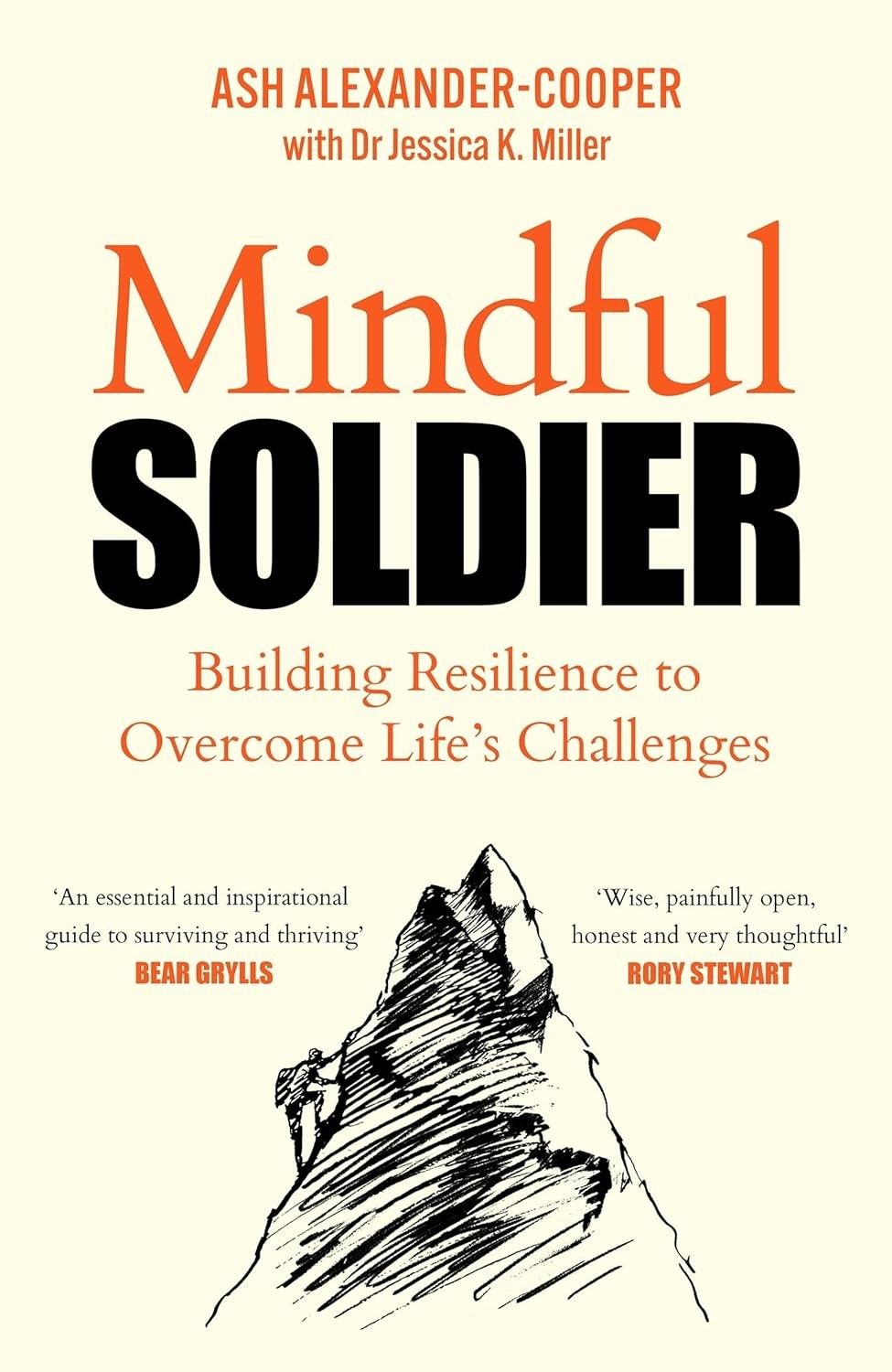
Mindful Soldier: Building Resilience to Overcome Life's Challenges earns a prestigious 4 out of 4 trench coats