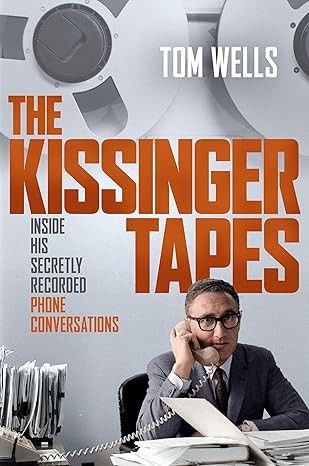

BOOK REVIEW: The Kissinger Tapes: Inside His Secretly Recorded Phone Conversations
Tom Wells/ Oxford University Press
Reviewed by: Jean-Thomas Nicole
Jean-Thomas Nicole — Jean-Thomas Nicole is a Policy Advisor with Public Safety Canada. The opinions expressed are those of the author and do not reflect the official policies or positions of Public Safety Canada or the Canadian government.
REVIEW —The Kissinger Tapes consists of phone conversations that Henry Kissinger had secretly monitored or recorded when he was National Security Advisor (1969–1974) and Secretary of State (1973–1977). Selected from over 15,000 phone records—some 20,000 pages for the Nixon years alone—these calls offer a sweeping portrait of the man and his era. Unlike narrative biographies, this volume grounds its arguments in near-verbatim telcons (telephone transcripts), interweaving concise scene-setting from the editor with the calls themselves. That structure makes it unusually dependable as a research tool and unusually gripping as a read: you get the adrenaline of real-time decision-making and the unguarded candor rarely found in memos or memoirs.
Author/editor Tom Wells holds a PhD in sociology from the University of California-Berkeley. He is the author of three previous books— The War Within, Wild Man, and The Wrong Guys (with Richard A. Leo) and is currently completing a new book on the innocence revolution in the U.S. justice system.
The conversations in the Kissinger tapes capture blunt words, invective, and scheming the participants would never have put on paper, while at other times evincing guardedness about speaking on tape. They show Kissinger barking orders during pressure-packed crises—sometimes remarkably unruffled and witty, other times enraged and snapping derisively at aides. Histories tell us what was decided; these tapes show how—the impatience, the performative threats, the tactical feints, and the ever-present calculation about how a move would “read” in the press. The tapes also cover a broader period than the more famous Nixon tapes: Kissinger began recording calls in January 1969—two years before Nixon’s system was installed—and continued for over three years after Nixon’s system was dismantled.
The scope of issues covered is vast: the Vietnam War in all its dimensions—bombing campaigns in Cambodia and Laos, the Son Tay raid, the 1972 enemy offensive, and the tortured Paris negotiations; the 1971 slaughter in East Pakistan; the administration’s undermining of Allende in Chile; the rapprochement with China; SALT negotiations and Soviet summits; the 1973 Yom Kippur War; the Cyprus crisis; and the Watergate scandal. Leaks and the paranoia they bred are a recurring thread, including Kissinger’s role in the FBI wiretaps of officials and journalists.
Kissinger himself emerges as a study in contradictions: brilliant, witty, possessed of boundless stamina and sharp bureaucratic instincts—yet also arrogant, controlling, a habitual and easy liar, and stunningly callous toward the deaths wrought by his Vietnam policies. His fraught relationship with Nixon—with whom he logged more phone hours than anyone else—is rendered in unsettling detail; they never fully trusted each other.
For all its scale, the book faces an inevitable curation problem: selection shapes meaning, and while the editor’s skeptical stance is carefully argued and amply evidenced, some readers will want more room for countervailing context—bureaucratic constraints, real-time intelligence ambiguities, and the like. The telcon-by-telcon construction, however faithful to events, can read as staccato; a touch more synthesis between transcripts would smooth the narrative for general readers without blunting its documentary force.
With The Kissinger Tapes, Wells has assembled a command-center view of U.S. foreign policy at the dawn of the 1970s. Admirers of Kissinger’s diplomacy will have to confront the unabashed candor of the record; critics will find their arguments reinforced with hard evidence. Ultimately, the book reshapes the factual foundation for any future debate about Kissinger and his era.
The Cipher Brief participates in the Amazon Affiliate program and may make a small commission from purchases made via links.
Sign up for our free Undercover newsletter to make sure you stay on top of all of the new releases and expert reviews.
Read more expert-driven national security insights, perspective and analysis in The Cipher Brief because National Security is Everyone’s Business