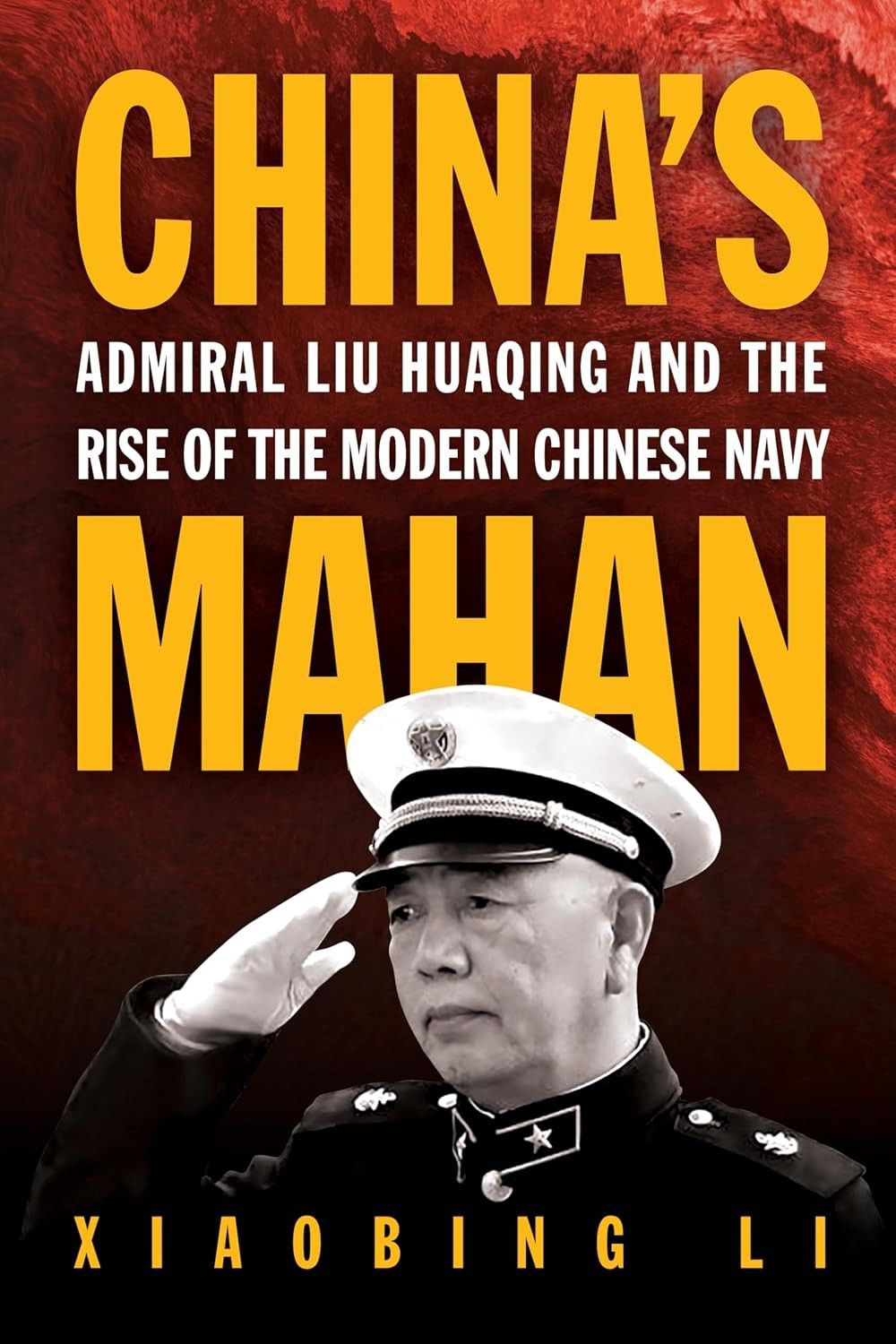


Book Review: China’s Mahan: Admiral Liu Huaqing and the Rise of the Modern Chinese Navy by Xiaobing Li (Naval Institute Press, 2026).
The Reviewer Jean-Thomas Nicole is a Policy Advisor with Public Safety Canada. The opinions expressed are those of the author and do not reflect the official policies or positions of Public Safety Canada or the Canadian government.
REVIEW — Xiaobing Li’s China’s Mahan is not a hagiography but a rigorously sourced strategic biography that explains how one individual reshaped the institutional, doctrinal, and political foundations of the People’s Liberation Army Navy (PLAN). Li’s central argument is that Admiral Liu Huaqing (1916–2011) is best understood not as a Chinese Alfred Thayer Mahan, but as China’s analogue to Soviet admiral Sergey Gorshkov: a party‑loyal naval modernizer who fused missile‑age technology, submarine deterrence, centralized research and development, and maritime strategy firmly under Chinese Communist Party (CCP) control.
Li, a historian and former PLA officer, brings deep familiarity with Chinese military institutions and sources to the subject. Drawing on Liu’s writings, internal PLAN publications, archival compilations, and interviews with retired Chinese and Taiwanese admirals, he reconstructs not only Liu’s career, but the system Liu helped build. The result is less a personal narrative than an institutional history that explains why the PLAN looks—and behaves—the way it does today.
The book begins by dismantling the label “China’s Mahan,” noting that Liu rejected the comparison and that it obscures the political core of his thought. While Liu was exposed to Mahan’s ideas, often through former Kuomintang professionals—his decisive intellectual influence came from Soviet naval theory. During his education at the Voroshilov Naval Command Academy in Leningrad between 1954 and 1958, Liu absorbed the Gorshkovian synthesis: a modern navy requires an industrial base, balanced forces emphasizing submarines and missiles, and firm political control.
Li shows convincingly how this experience shaped Liu’s lifelong approach of “adopt, adapt, and indigenize,” selectively borrowing foreign doctrine and technology while embedding them in Chinese geography, industry, and party authority.
The narrative traces Liu’s early career as a Red Army political commissar, where he internalized the Leninist principle that “the Party controls the gun.” Transferred into the nascent navy in 1952, Liu encountered an institution that depended on Soviet advisors and former Nationalist sailors even for basic operations. As an instructor and later leader at the Dalian Naval Academy, Liu began to grasp that technological competence, professional education, and party supervision had to develop together if the PLAN were to escape its coastal‑auxiliary status.
Li emphasizes that Liu’s most lasting contributions were institutional rather than tactical. As commander of Lüshun Naval Base after returning from the USSR, Liu first stabilized Soviet‑style operational systems and later localized them following the Sino‑Soviet split. He concentrated scarce resources into what Li describes as “pockets of excellence,” creating quick‑reaction forces in the Yellow Sea and extending naval protection to fishing fleets—an early illustration of Liu’s belief that maritime power linked defense, commerce, and sovereignty.
The heart of the book is Liu’s tenure as founding president of the Ministry of Defense’s Seventh Research Institute (1961–66). Here, Li shows Liu centralizing and militarizing naval R&D by consolidating disparate civilian and service laboratories into a single “dragon‑head” organization for ship research. Liu brought scientists into uniform, protected them politically through the Anti‑Rightist Campaign and the Cultural Revolution, and pursued a strategy of rapid imitation followed by incremental improvement. This institutional engineering laid the groundwork for later advances in anti‑ship missiles, submarines, and eventually modern surface combatants. Li persuasively argues that without this bureaucratic foundation, later PLAN modernization would have been impossible.
Operational episodes are used sparingly and function as proof of concept. Li recounts the 1965 Taiwan Strait clashes, in which Chinese torpedo boats and patrol craft sank larger ROC Navy vessels, and the 1974 Paracels engagement against South Vietnamese forces. These actions validated Liu’s emphasis on speed, concentrated firepower, and missile‑centric warfare, even as he increasingly argued that China would require larger ships and greater endurance as its maritime interests expanded. The accounts rely heavily on Chinese sources, but they support Li’s broader institutional argument rather than standing as detailed battle histories.
A pivotal moment comes with Liu’s 1975 memorandum to Deng Xiaoping. Frustrated by planning guidance that would have frozen the PLAN as a small‑vessel coastal force, Liu submitted a lengthy brief calling for a technology‑driven transformation: aircraft carriers, large destroyers and frigates, a sea‑based nuclear deterrent, and a shift toward defending China’s sea lines of communication. Deng’s positive marginal comments—and Mao’s assent—did not immediately overturn policy, but they opened strategic space for debate and reform.
As PLAN Commander from 1982 to 1988, Liu translated these ideas into doctrine. Li reconstructs the development of “near seas defense”, which replaced static coastal defense with an active defensive strategy extending across the Yellow Sea, East China Sea, and South China Sea to the first island chain. In Liu’s formulation, these “near seas” constituted a vast operational box bounded by Okinawa, Taiwan, waters west of the Philippines, and the South China Sea’s disputed archipelagos. The doctrine explicitly linked naval operations to sovereignty claims and allowed offensive action at sea to achieve defensive political aims.
Li is most persuasive in showing doctrine, shipbuilding, and law moving together. Under Liu’s influence—both as PLAN commander and later as vice chairman of the Central Military Commission—the navy accelerated production of guided‑missile destroyers and frigates, expanded both conventional and nuclear submarine forces, and maintained a long‑term commitment to aircraft carriers that would only materialize decades later. Li also highlights Liu’s role in advancing maritime legislation in the early 1990s that framed “the sea as territory,” reinforcing the strategic and legal basis for China’s maritime posture.
The book concludes by tracing Liu’s posthumous elevation within the CCP’s official narrative. Leaders from Hu Jintao to Xi Jinping have explicitly praised Liu’s legacy, with Xi urging study of his “red tradition” and institutional approach. Li draws a clear line from Liu’s near‑seas defense concept to the PLAN’s contemporary blend of layered coastal defenses, submarine bastions, and regular operations near key sea lanes.
There are limitations. The reliance on Chinese sources means some operational details and casualty figures should be treated cautiously, and Liu’s role as commander of the Capital Martial Law Forces in 1989 is addressed only briefly. Readers should triangulate contentious episodes with non‑PRC accounts. Nonetheless, China’s Mahan succeeds as an explanation of the logic governing China’s naval behavior.
For scholars of maritime strategy and practitioners concerned with Indo‑Pacific security, Li’s study demonstrates that China’s naval rise is not a reactive or ad hoc phenomenon. It is the product of decades of deliberate institutional design linking party control, industry, technology, and strategy—an architecture authored by Liu Huaqing. Understanding his legacy helps explain not only the PLAN’s past, but its present trajectory toward becoming a “world‑class navy.”
The Cipher Brief participates in the Amazon Affiliate program and may make a small commission from purchases made via links.
Sign up for our free Undercover newsletter to make sure you stay on top of all of the new releases and expert reviews.
Read more expert-driven national security insights, perspective and analysis in The Cipher Brief because National Security is Everyone’s Business