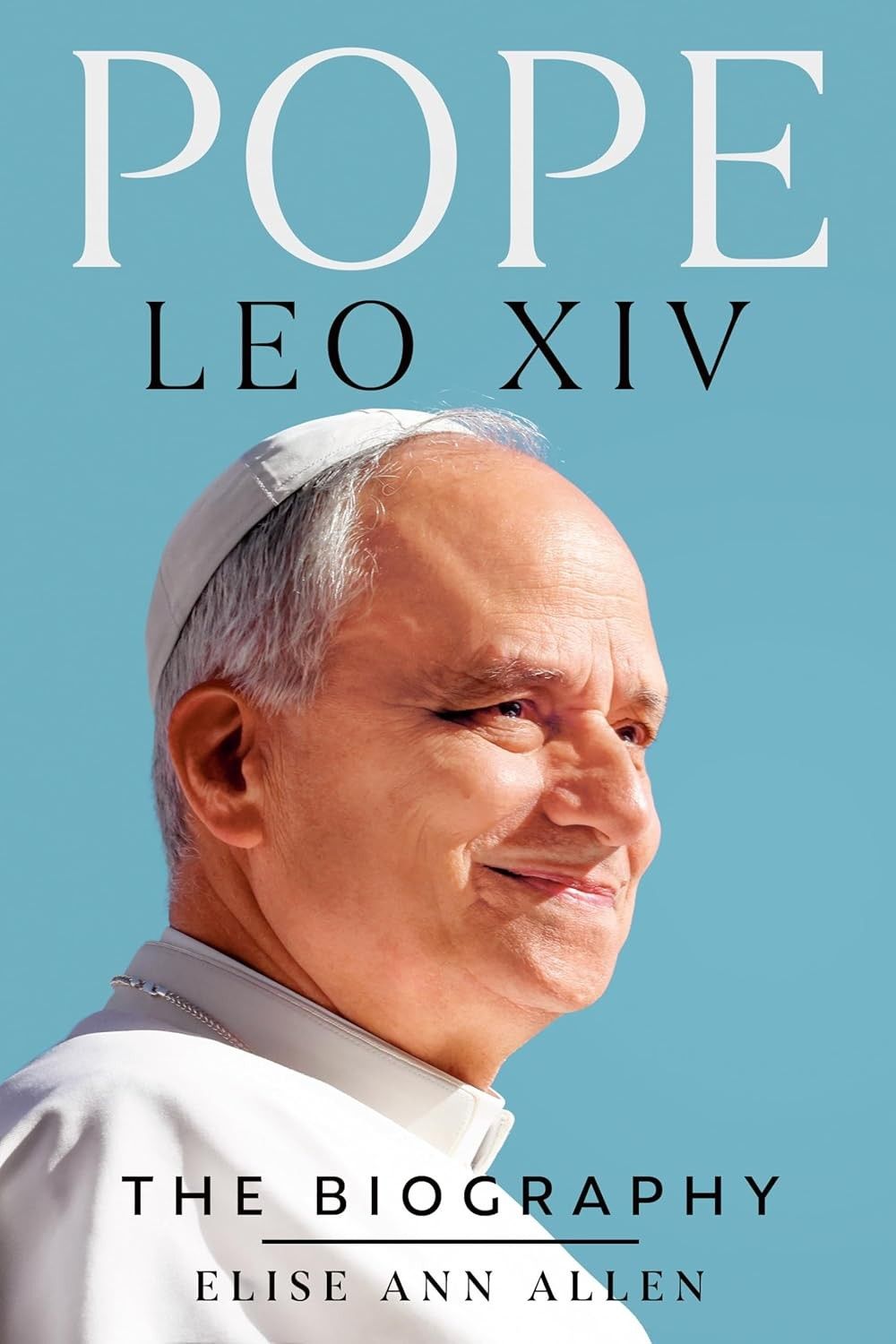

BOOK REVIEW: Pope Leo XIV: The Biography
By Elise Ann Allen/Penguin Random House Christian/Image
Reviewed by: Kenneth Dekleva
The Reviewer — Dr. Kenneth Dekleva served as a Regional Medical Officer/Psychiatrist with the U.S. Dept. of State from 2002-2016 and is currently the CEO of Blackwood Advisory Solutions LLC and Professor of Psychiatry, UT Southwestern Medical Center, Dallas, TX. He is also the author of The Negotiator’s Cross, The Last Violinist, and The Russian Diplomat’s Wife, and a new upcoming novel, The Expediter. The views expressed are entirely his own and do not represent the views of the U.S. Government, the U.S. Dept. of State, or UT Southwestern Medical Center.
REVIEW — Elise Ann Allen is a highly-regarded journalist and Rome correspondent for Crux, an independent news organization that covers the Catholic Church for Catholics and non-Catholics alike. Allen’s beat is the Vatican and she has traveled extensively with the late Pope Francis and Pope Leo XIV. In her superb, definitive biography of Pope Leo XIV, she paints a thoughtful, detailed, and revealing portrait of the man, Robert Prevost – the first American Pope - who is now the Vicar of Christ, detailing his background, actions, faith, global worldview, life experiences, and his inner life.
Many Cipher Brief readers may wonder, why is a biography of Pope Leo relevant to an audience of national security professionals? Such a question strikes me as akin to Stalin’s famous statement: “How many divisions does the Pope have?” My answer: 1.4 billion! More to the point, as Elise Allen points out, this Pope, who is fluent in English, Spanish, and Italian, is a truly global figure, as a statesman, diplomat, and leader of the world’s 1.4 billion Catholics. He posts daily on X and Instagram and his prayers, homilies, speeches, photos, videos, and world travels (most recently, a historic 11-day trip to Africa) are covered extensively by world media outlets and social media.
Observers also tend to forget that the Vatican has one of the world’s oldest and formidable diplomatic and intelligence services. The late Nazi hunter Simon Wiesenthal famously described the Vatican’s intelligence network as “the most effective intelligence service in the world.” In December 2025, when Pope Leo visited the headquarters of the Italian Intelligence Service, he noted that intelligence professionals are entrusted with “the serious responsibility of constantly monitoring the dangers that may threaten the life of the Nation, in order above all to contribute to the protection of peace.”
Pope Leo XIV: The Biography is framed at both ends by Allen’s extensive interviews – the first so granted -with Pope Leo since his election in May 2025. In them Pope Leo reveals his humanity, decency, humility, intelligence, kindness, service to others, and deep faith. In the first interview, when she asks, who is Robert Prevost, who is Pope Leo XIV, he answers: “Certainly, someone who has a deep appreciation for humanity.” He speaks of his own journeys, of God’s gifts, and his ability – especially as an Augustinian – to see the value and gift of life in others. In a later interview, he speaks of the value of, and God’s gift of friendship: “Friendship can truly change the world. Friendship is a path to peace.”
The book’s chapters initially trace the journey of Robert Prevost, from his humble Catholic upbringing in Chicago, to his enrollment as an Augustinian, his later university and graduate studies in America and Rome, and then to his life-changing role as a missionary priest in the poorest regions of Peru, where he served for two decades as a missionary priest, leader of the Augustinian Order, and later, as Bishop of Chiclayo.
The initial part of Allen’s book shows how Pope Leo’s early devotion to the Augustinian Order shaped his view of life, faith, and service. In Peru, it truly aligned with his personal views of service and faith, and of the Catholic Church’s evolving role in Latin America, shaped initially by the Second Vatican Council, liberation theology, and later, by the late Pope Francis’ views of ‘synodality,’ a vision of the Church as ‘walking together’ with its people, as collaborative and inclusive. Pope Leo’s years in Peru were shaped by his involvement in its poorest communities, serving them not only as a pastor, but as helper, guide, and friend, and guiding them through immense challenges due to poverty, terrorism, natural disasters, and political/economic instability. He developed a reputation as a priest willing to get his hands dirty, to grab a shovel or paintbrush, or to drive a truck for hundreds of miles to remote villages to minister to his flock.
These early chapters also highlight his moral, physical, and spiritual courage. The 1980s and 1990s were a time of vicious, cruel terrorism in Peru, perpetrated by the Shining Path and MRTA. Hundreds of thousands of Peruvian citizens lost their lives. Pope Leo and his fellow priests received death threats, and some were killed. Their parent order recommended that they leave Peru. But Pope Leo chose to stay. This courage is a side of him that warrants notice. For me, the chapters about Pope Leo’s life in Peru showcase many aspects of the man and his character. Like St. Augustine (as beautifully described in Peter Brown’s classic biography, Augustine of Hippo), Pope Leo lived in an age of rapid social, political, and economic change. And like Augustine, he too was ever-changing, both in his personal growth and in his response to circumstances surrounding him.
The book’s middle and later chapters, highlighting Pope Leo’s many years of service in Rome, as the Prior General of the Augustinian Order, and later, as the Prefect of the Dicastery for Bishops, describe his role as a key leader, noting his discipline, appetite for work, emotional intelligence, abilities as a listener, decision-making skills, fairness, judiciousness, and his favoring expansion of the roles of the laity and women in the church. These chapters emphasize Pope Leo’s ability to navigate numerous contemporary crises facing the church, including political, financial, and legal (e.g. sexual abuse). In hindsight, his election as Pope – as he was increasingly part of the late Pope Francis’ inner circle – appears pre-ordained, but as an American priest (who also holds Peruvian citizenship), such a historic election by the Vatican Conclave was never a foregone conclusion.
The last chapter of the book is a lengthy detailed interview conducted in July 2025, wherein Pope Leo speaks about his own life changed since being elected. He notes, “I am learning a lot about how the Holy See has had a diplomatic role in the world for many years.” He also notes his view of the difference between the voice of the Holy See in advocating for peace and its role as a potential mediator (which he saw as less realistic). But as the interview reveals, he understands that role and its implications, especially in Ukraine and Gaza (and most recently, Iran). In this vein, it’s worth recalling that the late Pope Francis had met (in Iraq) with Ayatollah Sistani in 2021, and that Iran’s Ayatollah Arafi had met (in Rome) with the late Pope Francis in 2022. So, as Pope Leo surely knows, there are diplomatic precedents for his promotion of peace and interfaith dialogue.
His initial diplomatic trips – to Turkey, Lebanon, and more recently, Africa - as well as his daily commentaries on Instagram and X, emphasize his nuance, spirituality, faith, and promotion of diplomacy (as well as interfaith dialogue) as solutions to the world’s conflicts.
The timing of Elise Allen’s English edition is auspicious, as Pope Leo has recently weighed in – at times vociferously - on the war between the United States and Iran, stating that President Trump should avoid a military solution, and rather utilize diplomacy to resolve this conflict. While some detractors have seen Pope Leo’s remarks as purely political, Pope Leo has repeatedly stressed that he will continue to preach the ‘Gospel of Peace’ with the entire world. Born and raised American, a priest and leader who spent decades in Peru and Rome (as well as traveling worldwide in his role as Augustinian Prior General, and now as Pope), observers will note what Elise Allen’s excellent biography reveals, and what his fellow Peruvians had noted: “This gringo is different.” Pope Leo is a citizen of the world, a courageous servant-leader, a Pope for all, and truly a global citizen. Given this, Elise Allen’s biography of him is a must read.
The Cipher Brief participates in the Amazon Affiliate program and may make a small commission from purchases made via links.
Sign up for our free Undercover newsletter to make sure you stay on top of all of the new releases and expert reviews.
Read more expert-driven national security insights, perspective and analysis in The Cipher Brief because National Security is Everyone’s Business