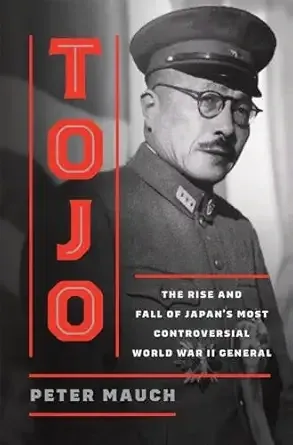

BOOK REVIEW: Tojo: The Rise and Fall of Japan’s Most Controversial World War II General
Peter Mauch / Belknap Press: An Imprint of Harvard University Press
Reviewed by: Jean-Thomas Nicole
Jean-Thomas Nicole — Jean-Thomas Nicole is a Policy Advisor with Public Safety Canada. The opinions expressed are those of the author and do not reflect the official policies or positions of Public Safety Canada or the Canadian government.
REVIEW — In Peter Mauch’s Tojo: The Rise and Fall of Japan’s Most Controversial World War II General, Hideki Tojo stands not merely as a man but as a fulcrum—an austere, driven bureaucrat through whom the pressures of a modern state were focused and amplified. Mauch renders Tojo as both agent and instrument, a figure shaped by institutions even as he wielded them, revealing how rigid incentives, coercive power, and narrowing strategic assumptions fused around one will and carried Japan, step by step, toward catastrophic war, capitulation, and defeat.
Dr. Peter Mauch is an Australian historian of modern Japan specializing in the Imperial Japanese Army and Navy and teaches at Western Sydney University
Tojo Hideki’s name remains shorthand for Japan’s wartime militarism and defeat, but Mauch’s core contribution is to show that the more instructive—and unsettling—story is not a melodrama of a single “dictator.” Instead, it is the story of an unusually capable political operator who learned to exploit a fragmented decision system, centralize authority through bureaucratic mastery, and apply a total-war conception of state power that fused mobilization, policing, and war leadership.
At the center of Mauch’s portrait is Tojo as a leader defined by administrative competence and institutional positioning. Born in 1884 and educated through Japan’s elite military pipeline, Tojo rose through postings in the Army Ministry and other key organs that sat at the junction of policy, personnel, mobilization, and statecraft.
He became prime minister in October 1941 after a career spent in the machinery of military government, then served until July 1944, when battlefield reversals and political collapse forced his resignation. Arrested in 1945 and executed in December 1948, Tojo’s trajectory frames the book’s larger arc: the ascent of militarized governance and its violent, ultimate collapse.
Mauch’s most important interpretive move is to steer readers away from two familiar extremes: Tojo as omnipotent autocrat or Tojo as a colorless bureaucrat swept along by forces beyond his control. In this account, Tojo is powerful precisely because he is not operating in a clean chain of command. He is effective inside a dispersed, overlapping architecture where responsibilities are split across services and ministries, and where rivalry and process ambiguity can be manipulated by a determined operator.
Mauch presents Tojo as a master administrator and a bruising political fighter—someone who could “act” like a dictator because he understood how to concentrate leverage through appointments, portfolio accumulation, and the management of upward information.
This bureaucratic skill is matched—though not redeemed—by Tojo’s “vision,” which Mauch frames as permanent readiness for total war. Tojo’s strategic horizon is not merely battlefield tactics; it is the state itself as a weapons system. He champions national mobilization, an expanded security apparatus, and a garrison-state mentality in which politics, economics, ideology, and internal order are subordinate to war preparation and war execution. In this view, coercion is not an emergency measure but a governing principle: Tojo’s signature becomes the use of the kenpei (military police) as a tool to suppress dissent and enforce compliance, producing a chilling internal stillness that may look like unity while degrading the feedback loops a state needs for sound strategy.
Mauch also situates Tojo’s rise within the Imperial Army’s factional politics and the broader problem of command discipline. Tojo’s career is shaped by internal factional conflict—most famously the split between the kōdōha and tōseiha currents—and by the recurrent pattern of insubordination and autonomous initiative, particularly in continental theaters.
Here, readers well-versed in contemporary Japanese history may recall that the kōdōha (“Imperial Way”) and tōseiha (“Control”) represented, respectively, emperor-centered spiritualism and bureaucratic modernism oriented toward total war. Tojo was firmly in the latter camp.
The book treats Japan’s path to war as inseparable from this institutional culture: clandestine networks, bureaucratic maneuver, and the normalization of “independent action” create repeated escalation opportunities while weakening civilian control.
For a national security readership, this is one of the book’s most contemporary lessons: fragmentation and rivalry do not merely slow decision-making; they can accelerate it—by making it easier for actors to create faits accomplis that later become “strategic reality.”
Manchuria and Manchukuo serve as the crucible where Tojo’s model of security governance is tested and refined. In Manchukuo, Tojo’s remit spans internal security, policing, surveillance, and public order, and he becomes centrally involved in the region’s state-building and economic development projects.
Mauch presents this period as more than a colonial footnote: it is a laboratory for the fusion of political control, industrial planning, and coercive enforcement under military primacy—an experience that later informs how Tojo governs Japan at war.
The book’s road-to-war narrative emphasizes strategic miscalculation, under resource and timeline pressure, and it shows how Tojo’s governing approach intersects with Japan’s external constraints. Mauch highlights the interaction of expansionist aims in China and Southeast Asia with growing international pressure, embargo dynamics, and the internal logic of “deadlines” that compress choice into a narrow band of perceived necessity.
Japan’s war leadership, as depicted here, is shaped by an enduring mismatch between operational planning and the political-economic realities of industrial conflict—especially against the United States. Tojo’s decisions emerge less as irrational impulses than as the culminating product of an institutional worldview. Once war begins, Tojo’s strengths as an operator become, in Mauch’s telling, part of the problem. His accumulation of portfolios and centralization of authority can look like “getting things done,” but it also produces overload and brittleness, while reinforcing coercive methods at home.
As Japan’s fortunes turn—major setbacks and strategic collapse culminating in the loss of confidence that forces Tojo from office in July 1944—Mauch’s narrative underscores a grim pattern familiar to students of wartime governance: centralization can accelerate decisions, but it cannot manufacture resources, reverse battlefield realities, or permanently suppress institutional contradictions. The same system that elevates a bureaucratic predator can also consume him when outcomes no longer align with the promises that justified his ascent.
In the final act—surrender, arrest, and trial—Mauch portrays Tojo as both defiant and instrumental. After Japan’s defeat, Tojo becomes a focal point for responsibility and memory. At the Tokyo Trial, he is depicted as insisting on the emperor’s innocence while accepting responsibility in ways that serve both personal honor and the political project of insulating the imperial institution.
Executed in December 1948, Tojo nonetheless continues to shape Japanese war memory: scapegoated by many, contested by a few, and reappearing periodically as a symbol in debates such as the Yasukuni Shrine controversy. For intelligence and national security professionals, this section reads as a reminder that postwar justice is not simply retrospective—it is also forward-looking statecraft that influences civil–military norms, legitimacy narratives, and the social processing of defeat.
Mauch’s research base strengthens the book’s authority and will matter to Cipher Brief readers who value evidence over mythology. He draws on a wide array of Japanese-language materials, including Tojo memoranda, diaries and elite records, trial transcripts, and major official history compilations such as the Senshi sōsho series. That documentary depth enables a granular reconstruction of institutional dynamics—who knew what, when, and how decisions moved through overlapping nodes of power. The tradeoff is density: the elite-level detail and extensive documentation can feel heavy, and readers focused specifically on intelligence operations or civilian impacts may want more sustained treatment of those dimensions.
Even so, the larger payoff is clear: this is a biography that functions as a warning about how strategic catastrophe can emerge from an ecosystem—where coercion substitutes for truth-telling, rivalry substitutes for strategy, and mobilization becomes an end in itself.
The Cipher Brief participates in the Amazon Affiliate program and may make a small commission from purchases made via links.
Sign up for our free Undercover newsletter to make sure you stay on top of all of the new releases and expert reviews.
Read more expert-driven national security insights, perspective and analysis in The Cipher Brief because National Security is Everyone’s Business