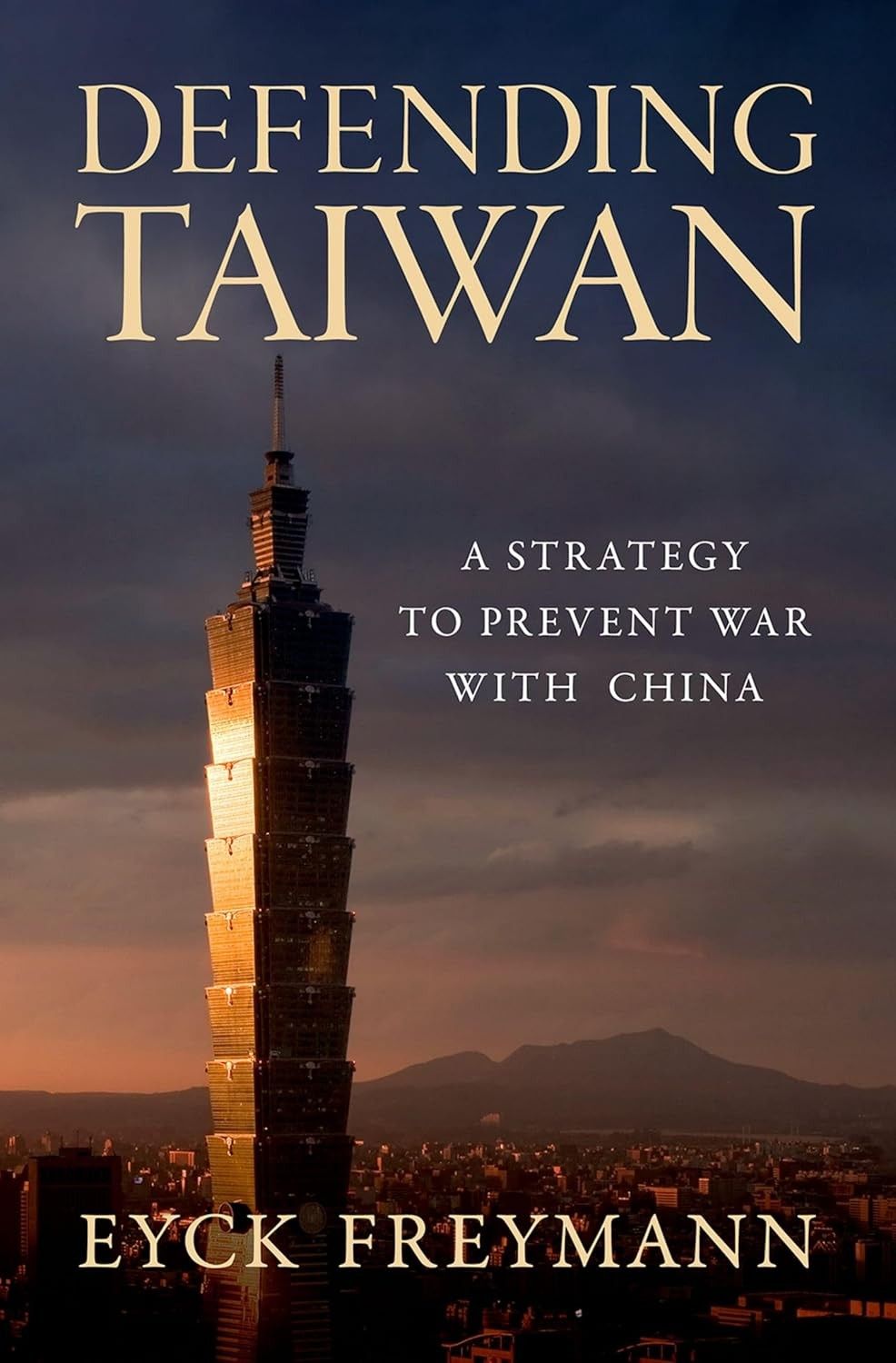


BOOK REVIEW: Defending Taiwan A Strategy To Prevent War With China
By Eyck Preymann / Oxford University Press
Reviewed by: Martin Petersen
The Reviewer: -- Martin Petersen is a CIA veteran, Asia expert, and a Cipher Brief Expert. He is the author of City of Lost Souls, a Mystery set in Shanghai in 1932. A sequel is expected in late 2026 or early 2027.
REVIEW — Recent years have seen a string of excellent books on the China challenge. Destined for War by Graham Allison (2017) explored the likelihood of war between the Unted States and China. The Long Game by Rush Doshi (2021) examined the challenge China presents to vital US interests. World on the Brink by Dmitri Alperovitch (2024) looks at the history of US-China relations since Nixon and offers some policy options. The Lost Decade by Blackwill and Fontaine (2024) also offers policy prescriptions but notes how difficult it will be to implement them. The Great Transformation by Westad and Chen (2025) does an excellent job of explaining how China has risen in the world. All received critical praise. Add Defending Taiwan to the list.
All books on US-China relations stress the centrality of the Taiwan issue. But Freymann examines this critical element in a depth and with a sophistication I have not seen elsewhere. The book is divided into three sections. The first focuses on the cross-strait situation from both Taiwan’s and the PRC’s point of view It also lays out in a succinct matter precisely what is at stake for US interests in both peacetime and in a crisis: financial and macroeconomic stability; breaking US and allied dependence on PRC production; the international economic system; the dominance of the dollar in international trade; and the US as a bulwark against further aggression by China or other hostile powers. US credibility and influence is on the line in the Taiwan Strait.
The second section looks at various scenarios in the “gray zone,” actions short of a direct military attack on Taiwan but designed to bring an “all-domain pressure campaign” on the island and by extension the United States. All-domain is an international political, economic, saber-rattling, and diplomatic campaign designed to isolate Taiwan and dissuade other states from coming to its aid. Freymann takes a close look at the maritime blockade option and analyzes several challenges the United States would face in breaking it, including resupply of the island and evacuating civilians. He does make point that attempts to resupply the island by sea or air would force China to backdown or attack the resupply effort. In this section Freymann also examines in some detail the very great challenges China would face in launching an amphibious invasion and blockade. Freymann concludes that it would be a very risky choice for China and that while it is still possible for the US, Taiwan, and allies to deter an invasion and blockade today, the trends in the cross-strait military balance are worrying.
The final section is the longest and most important for US policymakers and our allies, for Freymann (writing with Harry Halem and Hugo Bromley in some chapters) does not stop—as many books do—after saying in effect “you have a problem and you need to do something about it.” Section three looks at “The Pillars of Deterrence,” what is required politically, economically, militarily, and through coalition building to keep the tensions in the strait from evolving into open conflict. Freymann and Alperovitch are on the same page in emphasizing the importance of innovation, punishing China’s predatory economic practices, and decoupling to the degree possible the US economy from China’s.
A number of books state that there is no US “China policy,” at least in the sense that containment described the US-USSR competition and the Cold War. Freymann stresses that we have a policy, but that we need to be sophisticated and adept at applying it. It is the One China Policy. He calls it the first pillar of deterrence and goes on to discuss why it works and how we need to use it.
And he makes an important distinction, I believe, about where we are with China as opposed to the former Soviet Union (and now Russia). It is not entirely about President Xi, but Xi is driving hard on the Taiwan issue. Rather “To deter Xi, the United States needs its own integrated strategy that draws on every source of national power to preserve the peace.” (Emphasis is mine). Freymann did not say defeat China.
The Cipher Brief participates in the Amazon Affiliate program and may make a small commission from purchases made via links.
Sign up for our free Undercover newsletter to make sure you stay on top of all of the new releases and expert reviews.
Read more expert-driven national security insights, perspective and analysis in The Cipher Brief because National Security is Everyone’s Business