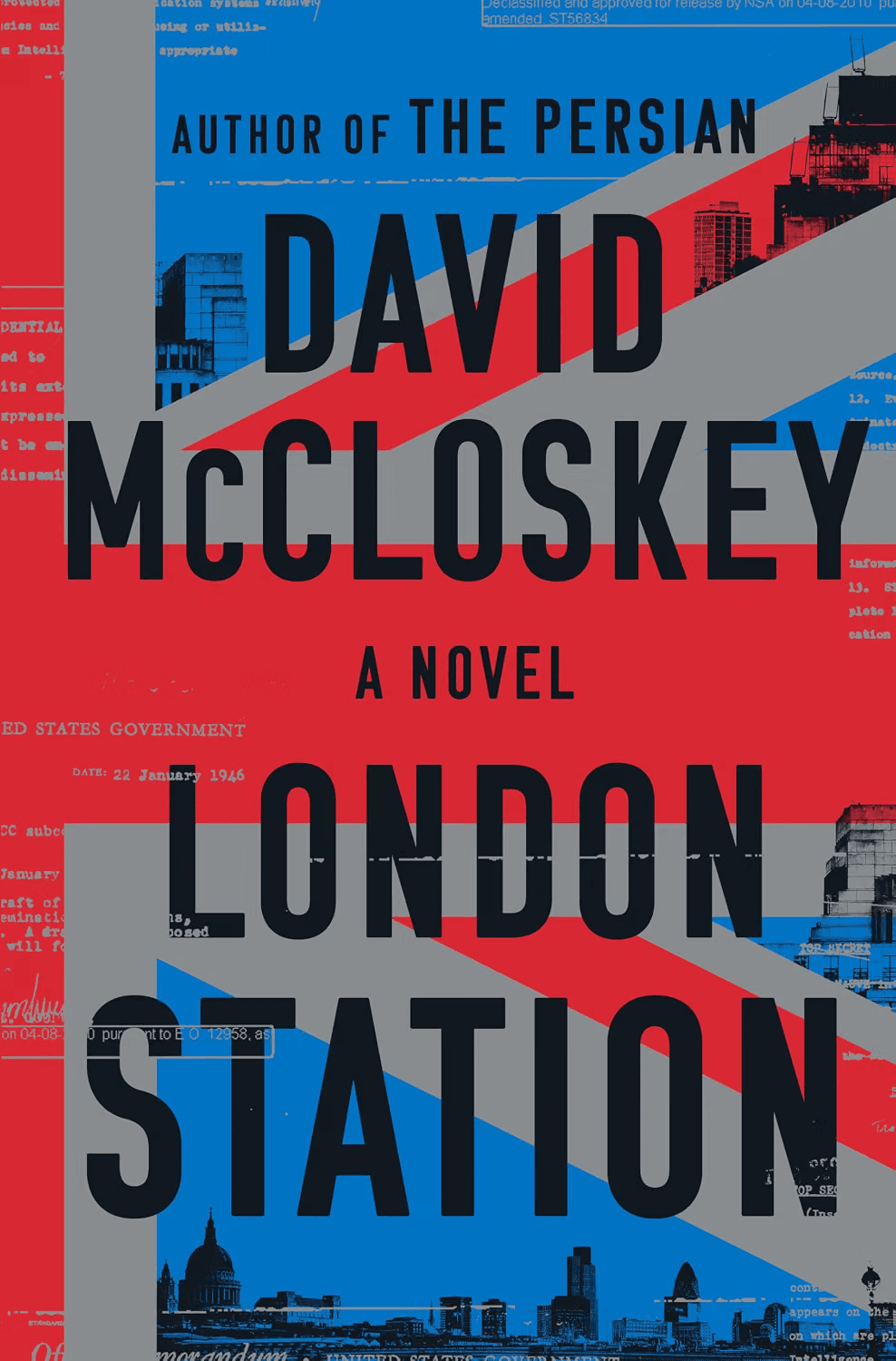

BOOK REVIEW: LONDON STATION
By David McCloskey / W. W. Norton & Company
Reviewed by: Heidi Vierow
The Reviewer — Heidi Vierow, PhD, is a retired CIA Clandestine Service officer, currently an Intelligence Strategy and Policy Advisor at MITRE.
REVIEW: The British Secret Intelligence Service (SIS or MI6) and CIA have worked, by and large, in tandem over the decades, especially since WWII. While the changing political climates in our countries, and in the past decade, have impacted the relationships between our countries, by and large the cooperation between these agencies has remained a key and steadfast one. In fact, it is known as a "special relationship."
In London Station, David McCloskey’s latest novel, this relationship is put to the test by a new administration in Washington, one that is reassessing the value of its allies. A corporate mindset and fiscal balance sheets devalue the need for HUMINT and operational strategies that draw on cooperation. Fans of McCloskey’s books will be pleased to see the return of Artemis Aphrodite Procter, the brash and recently sober case officer. The novel opens with Procter’s cold pitch of a Chinese target. She has a spectacular disguise failure on foreign soil in an operation lacking any of the expected coordination with London Station or SIS. This energetic opening launches the narrative threads of operational acts and the detailed planning that go into them as well as the importance of relationships with allies, specifically SIS. All the pieces need to be aligned beforehand to try to ensure that Murphy’s Law doesn’t intervene.
The operation underlying the novel’s plot takes place just after the U.S. has elected John Wood, MD, as president. He has chosen Bobby Jerome to be the director of the CIA (D/CIA). Jerome owns B.J. Lenore, the largest residential home builder in the U.S., and he has no national security or intelligence experience. A Texan with a no-holds-barred attitude, he has a crude style and tough businessman’s attitude, and he and the president are onside, their term for loyalty. Wood’s and Jerome’s goals include cutting through the bureaucracy in general and reshaping the agency in particular into a more efficient, corporate-modeled organization. Relationships be damned, even if they include nuanced, long-standing ones with the Brits.
For the director of the Directorate of Operations (DDO), Jerome selected an outsider to the CIA, Harry Kellman, a loyalist who is also his son-in-law and former executive vice president at his company. Kellman named as his special assistant Stu Bricker, a Lurch-like figure who takes orders but lacks the brains to evaluate or act with subtlety; he sees himself as a man of action. Adding to the tension, Jerome has yet to name a deputy director, so Kellman is anxious about who will fill the gap between him and Jerome.
Procter’s punishment for her failed op: to become chief of station (COS) London. Diplomacy and management fall low on her list of skills, and although the assignment gets her out of headquarters, this is most definitely not her dream job. Charlie Claire, the former COS, is unceremoniously fired after the D/CIA and DDO direct him to deny aid to SIS in a time-sensitive Iranian op. This causes SIS’s COS in Tehran, Ollie Welch, to lose his asset. Their rationale: the U.S. bears most of the burden and cost in this CIA-SIS relationship, and it is time to balance the scales. They are going to make the Brits pay, literally and figuratively. Despite Claire’s and Procter’s best efforts, headquarters knows what’s best for the field.
Through it all, Procter, despite her antipathy for management and ostensible inability to get along with people, has to explain to headquarters how things work in the real world. The irony is that, while she likes to be at the pointy end of the spear and deeply involved in operations, she understands both the need to work with everyone from liaison partners to headquarters elements to techies in the field, and how best to do it. In the process, she justifies and fights for these relationships throughout her tour, and she succeeds by and large, even if her demeanor is less than traditional.
Along with tradecraft and the decisions that go into strategizing and implementing good ops, McCloskey interweaves key topics from current headlines: China, Iran, reassessment of relationships with longstanding partners, introductions of new technologies, including AI. In addition, the issues of trust and betrayal run throughout the novel. Good ops rely on trusting partners within one’s team, station, headquarters elements, and other agencies and intelligence services. While the novel’s middle third drags a bit, the first and third sections are much more fast-paced with narrative surprises intermixed. It skewers the current U.S. political atmosphere with a sense of humor and underscores how the CIA accomplishes its mission.
The Cipher Brief participates in the Amazon Affiliate program and may make a small commission from purchases made via links.
All statements of fact, opinion, or analysis expressed are those of the author and do not reflect the official positions or views of the US Government. Nothing in the contents should be construed as asserting or implying US Government authentication of information or endorsement of the author’s views.