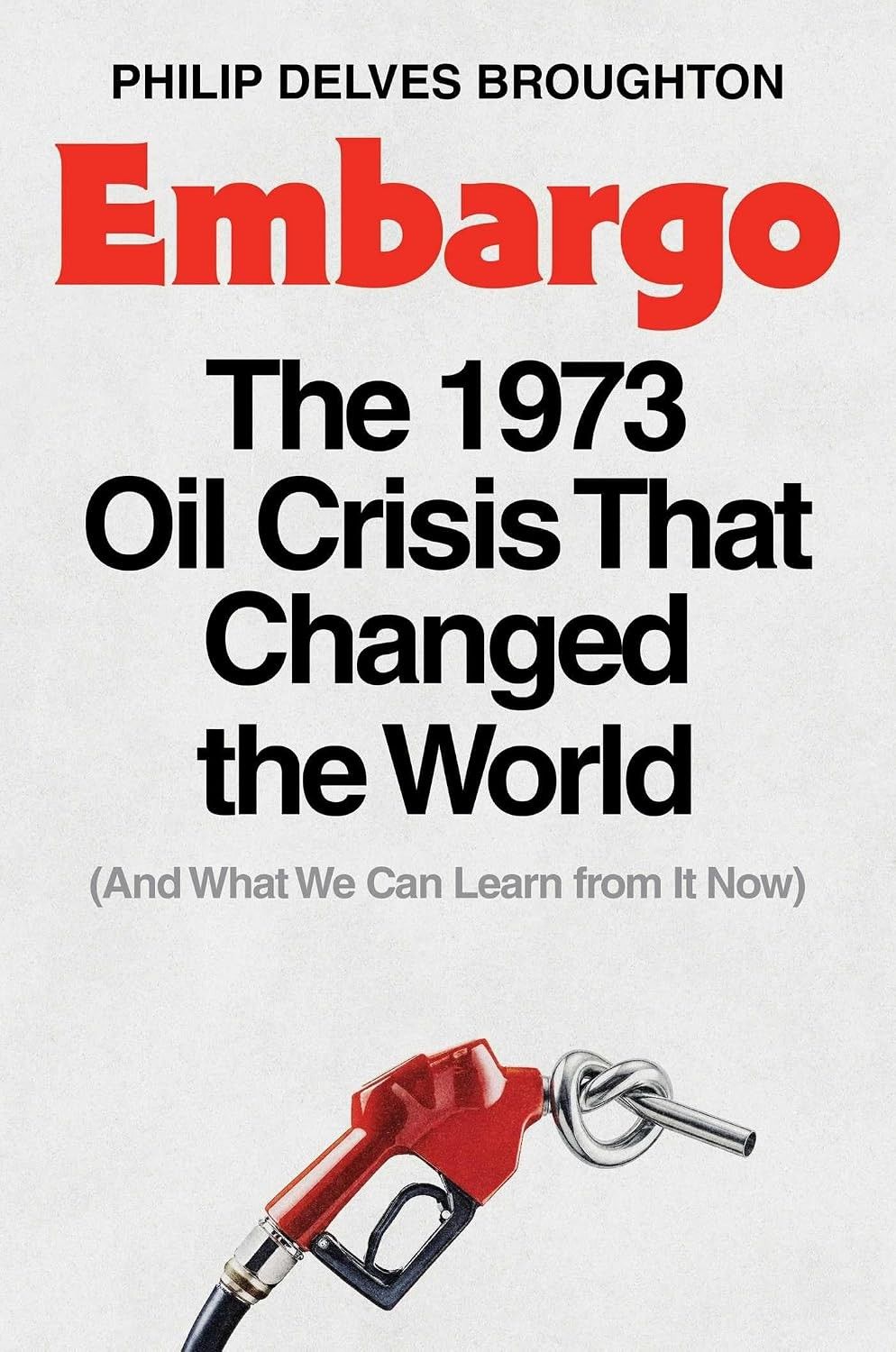

BOOK REVIEW: EMBARGO: THE 1973 OIL CRISIS THAT CHANGED THE WORLD (AND WHAT WE CAN LEARN FROM IT NOW)
By Philip Delves Broughton / Simon & Schuster
Reviewed by: Joseph Zacks
The Reviewer: Joe Zacks is the former Deputy Assistant Director of the CIA for Counterterrorism, the Co-founder and Managing Partner of Aardwolf Global Solutions and a Cipher Brief Subject Matter Expert.
REVIEW: As Iran’s recent weaponization of the Strait of Hormuz has sent oil and gas prices skyrocketing worldwide, Philip Delves Broughton’s Embargo: The 1973 Oil Crisis That Changed the World could not have come at a better time. It packs an awful lot into a relatively short book. At its crux are the U.S., European and Asian reactions to the Arab oil embargo of 1973. In a concerted effort to force the United States and Western European nations to abandon their support of Israel during the Yom Kippur War (the surprise attack on Israel launched by Egypt and Syria), Saudi Arabia spearheaded an Arab oil embargo against nations supporting Israel. The goal of the embargo was to force a political settlement to the conflict that entailed Israel’s return to its pre-1967 borders.
This politicization of oil caused a global geopolitical tsunami. European nations were quick to give in to Arab blackmail by renouncing support for Israel and even limiting U.S. military support flights to Israel. The United States, on the other hand, under President Nixon’s leadership and Secretary of State Kissinger’s relentless diplomatic efforts, was steadfast in its support of Israel. As distracted as President Nixon was by Watergate, he nevertheless was masterful at ensuring that there was no resounding Arab victory in 1973 that could have strengthened the Soviet Union’s position in the Middle East. By the same token, in order to preserve strategic balance, he was careful to prevent Israel from achieving a crushing victory over its adversaries. This ultimately paved the way for Egypt’s President Sadat to recognize Israel and sign a peace treaty that has endured for more than 47 years. Faced with the weaponization of oil, President Nixon allowed the U.S. to endure fuel shortages, high prices and long lines at the gas pumps. He promoted such energy-saving measures as a national speed limit and lower thermostat settings at home and in the office in order to achieve the geopolitical results he believed were in the ultimate interest of the United States.
Delves Broughton sets the stage for his account of the 1973 oil embargo with a concise yet sweeping tale of the emergence of Saudi Arabia as the leading oil-producing nation in the Middle East. He leads off with a compelling example of how great powers often miss great opportunities. In this case, the British and French governments both rejected Saudi King Ibn Saud’s request for a loan in return for the country’s mineral rights. To the United States benefit, this led the kingdom to sign an agreement in 1933 with the Standard Oil Company of California (SOCAL) granting “a concession for the exploitation of petroleum.” After five years of prospecting, SOCAL struck proverbial gold with the discovery of Well No. 7 at Dammam Dome. The rest is history: Saudi Arabia emerged as a major oil-producing nation and forged its lasting relationship with the U.S. By 1944, the American venture, by then jointly owned by SOCAL and Texaco, had been renamed the Arabian American Oil Company, ARAMCO.
The author weaves a brilliant story of Saudi Arabia’s development from a land of warring tribes into a major regional power in the Middle East. He describes the kingdom’s transformation from a country whose oil prices were dictated by corporate oil giants into one that set world oil prices, largely through its leadership of the Organization of the Petroleum Exporting Countries (OPEC), a cartel of oil producers. While Delves Broughton provides vivid portraits of many leading figures in ARAMCO, the Saudi royal court and international corridors of power, central to this fascinating story is his portrayal of King Faisal, the third son of Ibn Saud and third ruler of Saudi Arabia, and his shrewd Minister of Petroleum and Mineral Resources, Sheikh Zaki Yamani. Yamani held this position for 24 years and was perhaps most responsible for Saudi Arabia’s ability to control its destiny as an oil-producing powerhouse. He created a generation of Saudi oil engineers, technicians and executives able to wean the country from its dependence on Western management of its precious resource. King Faisal is portrayed as a complex yet visionary monarch who balanced respect for Saudi tribal and social norms with the country’s modernization. He was consumed by two great hatreds: communism and Israel. His disdain for and fear of the Soviet Union contributed to his decision to remain allied with the United States and ultimately lift the oil embargo.
As we survey today’s situation with Iran, Delves Broughton’s book draws compelling analogies to the 1973 oil embargo and the U.S. policy responses. Importantly, in the aftermath of the 1973 crisis, the U.S. began a decades-long shift from its over-reliance on Arab oil. It is hard to imagine, given the Iranian regime’s choking of shipping through the Strait of Hormuz, that we will not undertake significant reforms to our defense and energy policies once the current conflict ends.
The Cipher Brief participates in the Amazon Affiliate program and may make a small commission from purchases made via links.
All statements of fact, opinion, or analysis expressed are those of the author and do not reflect the official positions or views of the US Government. Nothing in the contents should be construed as asserting or implying US Government authentication of information or endorsement of the author’s views.