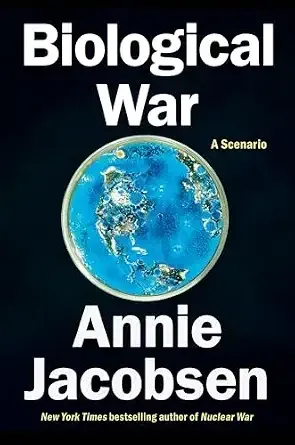

BOOK REVIEW: BIOLOGICAL WAR: A SCENARIO
By Annie Jacobsen / Dutton
Reviewed by: Heidi Vierow
The Reviewer — Heidi Vierow, PhD, a retired CIA Clandestine Service officer, currently is an Intelligence Strategy and Policy Advisor at MITRE.
REVIEW: Annie Jacobsen's Biological War: A Scenario lays out a complex narrative of the fallout of a possible global pandemic resulting from the inadvertent release of a contagious, genetically modified pathogen. This hypothetical situation would cause breakdowns in all sectors of society. In staccato sentences, she unfurls the fallout that would devastate the world in a rapid series of events. She considers tragic outcomes impacting healthcare, critical infrastructure, the military, the economy, and politics.
While this scenario could happen, there are drawbacks to her narrative that undercut the credibility and readability of her message. Jacobsen imagines the most extreme of extreme circumstances. For example, when she focuses on threats to critical infrastructure and nuclear facilities, every system fails at once, no back-up or safety mechanisms work, and all workers abandon their posts. Everything and everyone collapse simultaneously. Is this possible? Perhaps it is, but the circumstances are so far-fetched that the proposal loses credibility.
The callout boxes, labeled as history lessons, provide useful context for the fictional narrative. Jacobsen writes best in these sections. It is unclear, however, who her intended audience is. The explanations are often too rudimentary for people with several years of experience, and the scenarios are too detailed for someone new to what is essentially the narrative of a complex war game. Without the history lessons, the book could work as a novella, which may be a more effective delivery method for her message.
Jacobsen cites a variety of experts. Some she has interviewed, and others she quotes from secondary sources. Among her list of interviewees, some have not served in their respective positions and/or agencies and departments for more than two decades, but many of her secondary sources are more current. She does not explain why she selected her interviewees over more current experts. Newer is not necessarily better, but readers may find that the outdated information undercuts her message.
Her narrative style is exhausting to read. Short sentences, sentence fragments, and one-sentence paragraphs create choppy arguments. Unnecessary explanations clutter her text. For example, after a two-sentence paragraph explaining that NRO analysts examine satellite images, she follows with this conclusion: "They are looking for clues". Obvious explanations fill the text: "Whereas NRO watches, the NSA listens. One is the eyes, the other, the ears." A more tightly edited text would strengthen the readability of her hypothetical situations.
Jacobsen tackles a serious scenario. Unfortunately, her style and narrative tax readers' imaginations, and her message gets lost in the delivery.
***
All statements of fact, opinion, or analysis expressed are those of the author and do not reflect the official positions or views of the US Government. Nothing in the contents should be construed as asserting or implying US Government authentication of information or endorsement of the author's views.
The Cipher Brief participates in the Amazon Affiliate program and may make a small commission from purchases made via links.
Sign up for our free Undercover newsletter to make sure you stay on top of all of the new releases and expert reviews.
Read more expert-driven national security insights, perspective and analysis in The Cipher Brief because National Security is Everyone’s Business