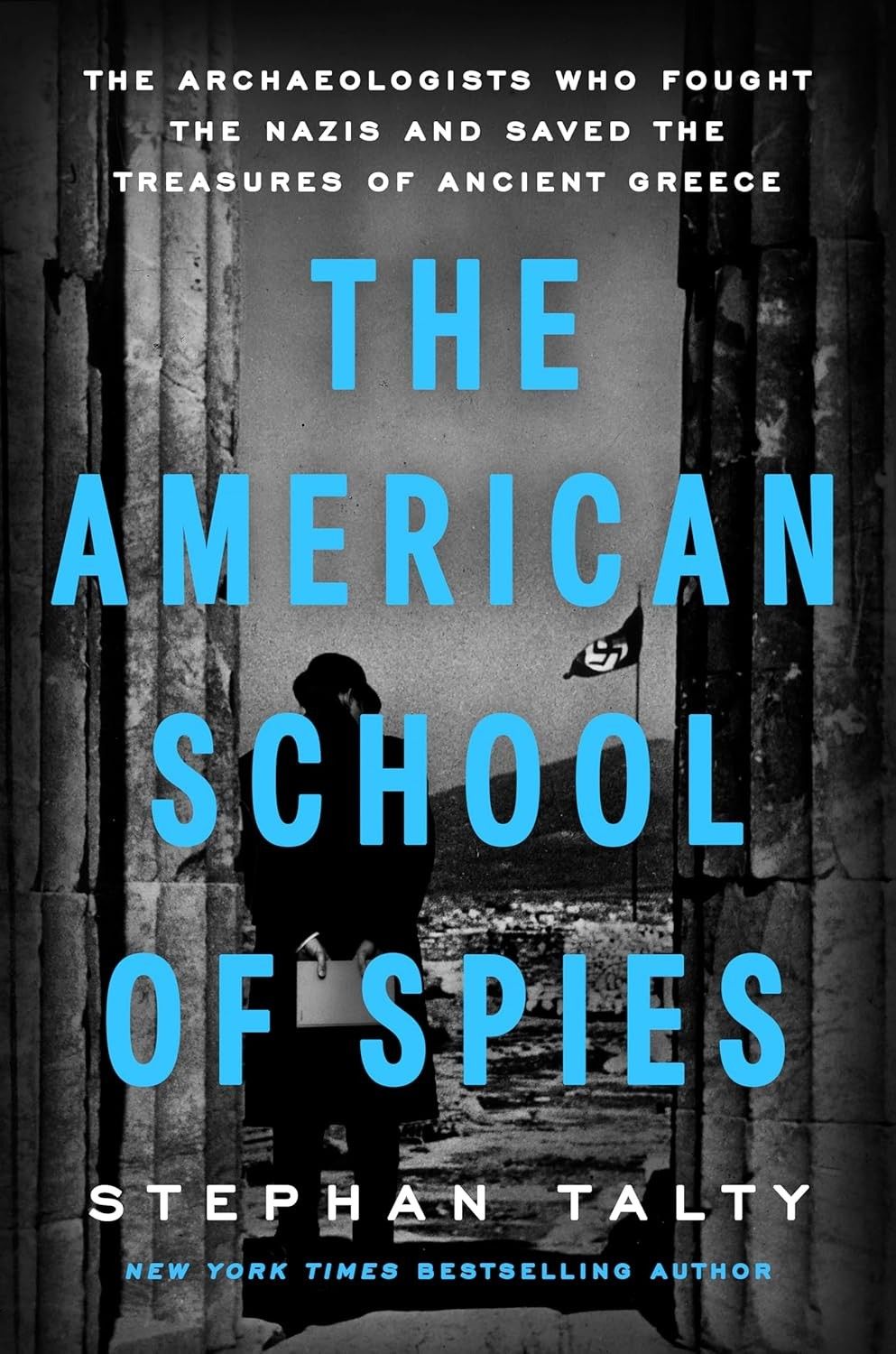


Book Review: The American School of Spies: The Archeologists Who Fought the Nazis and Saved the Treasures of Ancient Greece”
By Stephan Talty/Dutton
Reviewed by: Susan Gorgioski
The Reviewer: Susan Gorgioski is a writer who has worked in law and publishing in Australia. She is currently researching a novel set in WWII Shanghai
Review: As we commemorate the Allied invasion of the beaches of Normandy on 6th June 1944, where young men endured incredible hardship, fear and danger; Stephan Talty’s The American School of Spies is a timely peek into the covert machinations that took place behind enemy lines to ensure that the large battles and bombings that we remember were carried out successfully.
Talty’s book is a look into a little-known American operation that used American archaeologists, scholars and Greek Americans to thwart, deceive and ultimately, defeat the Nazis. The Nazis, driven by their well-documented desire to possess the great artworks of Europe, were determined to plunder ancient Greek relics in order to shore up and furnish definitive proof of the fact that Nazi Aryan philosophy could be traced back to ancient Greece.
This scheme was another brainchild of the inimitable William Joseph “Wild Bill” Donovan who was head of the Office of Strategic Services. The antiquities of ancient Greece were worth protecting, of course, but placing OSS agents into Greece would also give the OSS ears and eyes in the Balkan countries.
Recruiting for the Greek Desk as it was known, took place among the upper tier of society as the men and women with the requisite knowledge in archaeology were graduates from the finer universities and came from wealthy families. One such man was Rodney Young. A wealthy Princeton graduate who had fallen in love with Greece and its ancient stories. He studied and worked at the American School in Athens until the start of the war. On his return to America, he was driftless and edgy, an intelligent man who didn’t fit his milieu. He was approached by the OSS and jumped at the chance to return to Europe and establish the Greek Desk.
Many extraordinary individuals who were scholars and scientists assisted and joined Rodney, but a standout was Dorothy Cox, an excavation architect and outstanding numismatist. I regret that Talty doesn’t offer greater examination of the people he writes about. They do come across as fictional characters so great was the match of personality to purpose.
Dorothy had worked for the Red Cross driving ambulances and at the American School in Athens. She spoke Turkish, Greek and French and from all accounts was an unusual and talented woman. She, seemingly, singlehandedly organized the Greek Desk and interrogated, interviewed, requisitioned, recruited; essentially carried out every task a covert, poorly funded, intelligence operation would require. How she did this in Cairo, in a Muslim country, in the middle of a war, deserves a book of its own.
The rivalry between the OSS Greek Desk and British MI6 is touched on but could have been examined in greater detail. The Balkans were a febrile breeding ground for rumor, lies and treachery. The Americans wished to preserve the ideals of democracy for Greece in the post-war period, (the Swastika flying above the Acropolis is a chilling image) while the British were keen to support the monarchy. This had interesting consequences for Greece postwar.
The Greek Desk needed soldiers, commandos, boots on the ground, like Helios Doundoulakis. He’d initially worked for the British SOE but came to the American Greek Desk. These American born Greeks were essential to the mission. They knew the language, culture, people; Greece was a small country, and many had relatives still living there. This was another one of Donovan’s intelligent strategic moves, convincing FDR to establish the 122nd Infantry Battalion. Rather than jailing immigrants from enemy countries, put them to use in the defense of America.
This dramatic and engaging story is told with pared back prose and economy. It is a fast-paced journey with many gems and a glorious cast of characters that seem as fantastical as the treasures they fought to protect. As for the archaeological treasures themselves: they were hidden where we should have suspected.