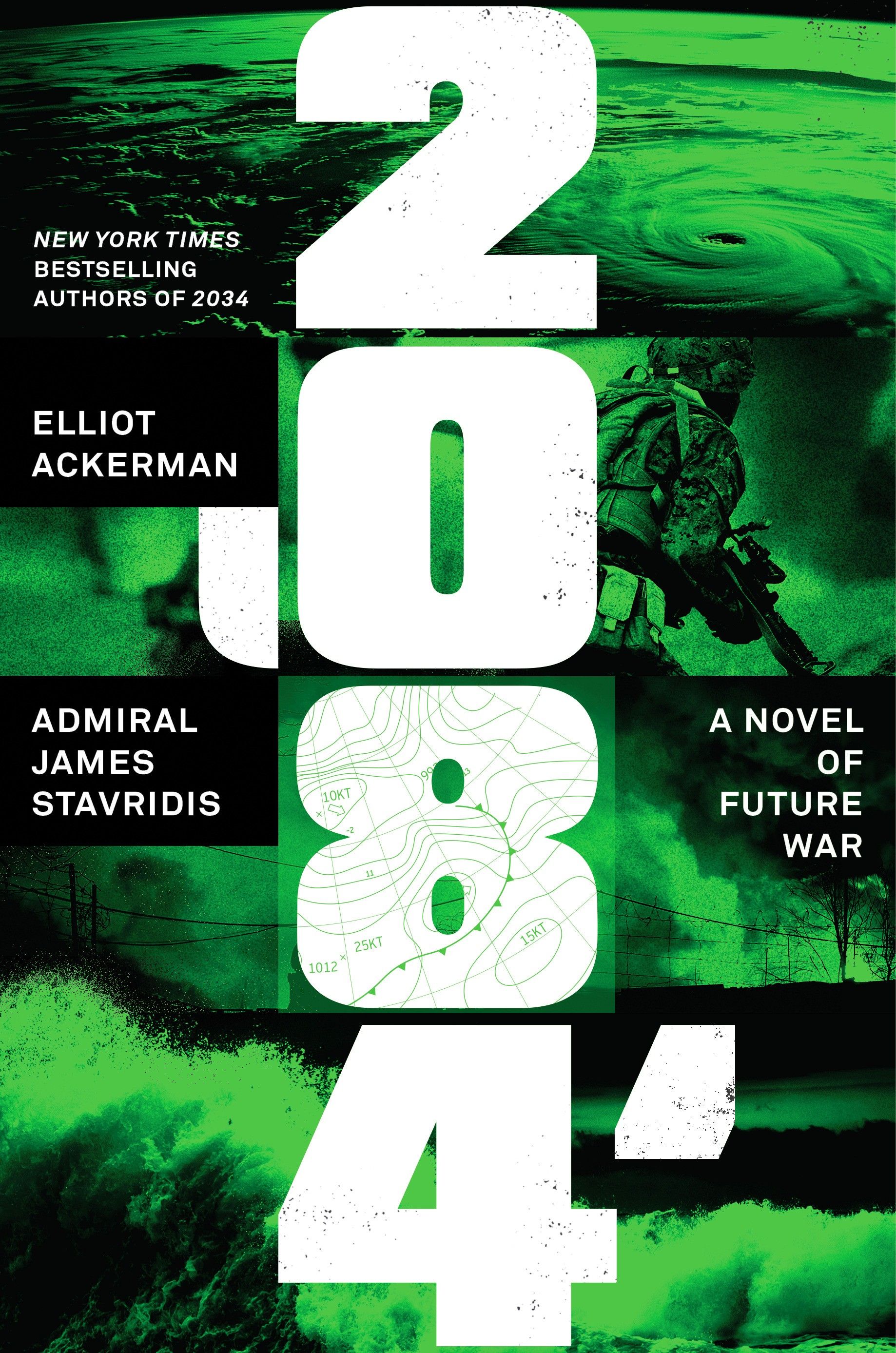

BOOK REVIEW: 2084: A Novel of the Climate War
By Elliot Ackerman and Admiral James Stavridis, USN / Penguin Press
REVIEWED BY: Joe Zacks
THE REVIEWER: Joe Zacks is the former Deputy Assistant Director of the CIA for Counterterrorism, the Co-founder and Managing Partner of Aardwolf Global Solutions, and a Cipher Brief Subject Matter Expert.
REVIEW: 2084: A Novel of the Climate War, co-authored by Elliot Ackerman and Admiral James Stavridis, is the third work of their “cautionary fiction” trilogy. I was quickly engrossed in this fast-paced book that deals with the pertinent issues that we are currently facing and will continue to face as a civilization—societal displacement resulting from climate change, shifting alliances and great power competition, artificial intelligence, sophisticated weaponry and advanced warfare. Juxtaposed to these challenges is a story of human behavior and decision-making.
In 2084, human-induced climate change has created the Reparationist alliance among the equatorial nations of Indonesia, Nigeria, and Brazil, bent on resettling the majority of its population in the northern hemisphere land masses of the United States. Having failed to reach an agreement with the Consortium powers of China and the United States, the Reparationists amass a powerful naval armada replete with futuristic hypersonic missiles and drones and launch a devastating surprise attack on mainland U.S. This sets the stage for an epic sea and air battle between the Reparationists and Consortium employing not only extremely sophisticated weaponry but also powered (on the Reparationist side) by an artificial intelligence engine called Beginner’s Mind. This AI instrument is run out of India, which has allied itself with the Reparationists. Beginner’s Mind is responsible for developing the strategic, operational, and tactical plans for the Reparationist war against the Consortium.
Without revealing who wins the final showdown between the Reparationists and Consortium, it is worth noting that AI alone cannot mandate or guarantee one side’s ultimate success in battle. Just as it is today, the humans responding to the plans developed by Beginner’s Mind are the ones who ultimately drive success or failure on the battlefield. At a pivotal moment, Joko, the Indonesian leader of the Reparationist armada, has a flash of brilliance informed by decades of naval experience and significantly tweaks the feint planned by Beginner’s Mind. He does this because of his own situational awareness and understanding of how the Consortium would interpret and react to the AI-derived deception. He then correctly interprets geography to protect his fleet from a man-made super storm that is employed as a weapon of mass destruction. Despite all the sophisticated weaponry and AI, human decisions remain the game changers in this suspenseful novel.
Shifting alliances is another theme of the book. While the authors mention that in a previous era the U.S. and China fought one another, in this novel they are initially allied. Yet following the Reparationists’ surprise attack on the United States, China begins to hedge its bets on the next round of fighting, and at the last minute it abandons its alliance with the U.S. Similarly, in 2084, Florida is portrayed as having seceded from the United States and is initially allied with the Reparationists. By the end of the book, it is fighting in partnership with the Consortium. Much of Florida as we know it today is under water, decimated from the effects of climate change, and the United Nations is seen as ineffective in preventing or mediating the conflict between the powers. In other words, it is status quo when it comes to the UN.
As a former operations officer at the CIA, I was heartened to see that HUMINT played a decisive role in the final battle. A critical piece of intelligence provided by a human is acted on in a decisive manner and generates a string of events that Beginner’s Mind could neither anticipate nor account for in its complex algorithms and calculations.
While the book portrays a world far different than the one we live in today, the authors maintain some constants. Florida may largely be underwater and the equatorial nations in harrowing shape, but Brooks Brothers on Connecticut Avenue is still going strong and the Gymkhana Club in New Delhi remains an outpost of the Indian elite. Good to know that some things never change.
*All statements of fact, opinion, or analysis expressed are those of the author and do not reflect the official positions or views of the US Government. Nothing in the contents should be construed as asserting or implying US Government authentication of information or endorsement of the author’s views.
The Cipher Brief participates in the Amazon Affiliate program and may make a small commission from purchases made via links.
Sign up for our free Undercover newsletter to make sure you stay on top of all of the new releases and expert reviews.
Read more expert-driven national security insights, perspective and analysis in The Cipher Brief because National Security is Everyone’s Business