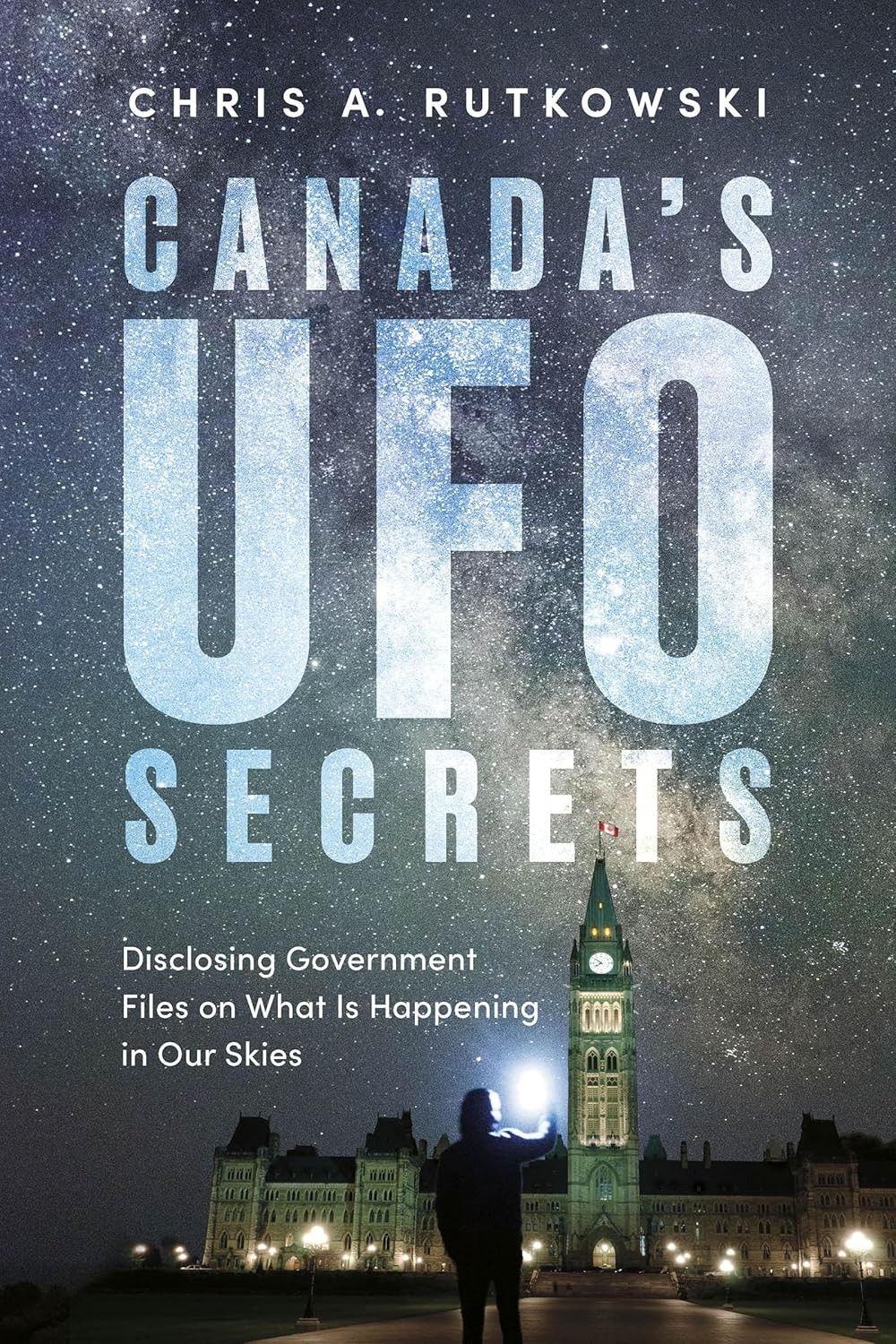

BOOK REVIEW: Canada’s UFO Secrets: Disclosing Government Files on What Is Happening in Our Skies
By Chris A. Rutkowski / Dundurm Press
Reviewed by: Jean-Thomas Nicole
The Reviewer — Jean-Thomas Nicole is a Policy Advisor with Public Safety Canada. The opinions expressed are those of the author and do not reflect the official policies or positions of Public Safety Canada or the Canadian government.
REVIEW: Chris A. Rutkowski’s Canada’s UFO Secrets: Disclosing Government Files on What Is Happening in Our Skies is not an exercise in mythology. It is a careful, document‑driven account of how Canada’s federal machinery has received, routed, investigated, and often de‑stigmatized reports of unidentified aerial phenomena for more than three‑quarters of a century.
For Cipher Brief readers, its value lies less in “sightings” than in the anatomy of a national security system that—at its best—treats the unexplained as an airspace governance problem to be triaged, not trivialized. In other words, how does the Canadian government manage information about UFOs?
Rutkowski, self-defined as “Canada’s UFO guy,” is a long‑time science writer who has investigated Canadian reports since the 1970s and, for a period, informally received official cases from Transport Canada and the Department of National Defence (DND). His most notable books includeThe Canadian UFO Report, a national bestseller, and Canada's UFOs: Declassified.
His central thesis is straightforward: Canada has taken UFOs seriously, albeit inconsistently, through a mosaic of authorities—National Research Council (NRC), Royal Canadian Mounted Police (RCMP), DND/NORAD, and Transport Canada—with Canada often more transparent than its reputation suggests. He favors evidence over speculation and keeps the extraterrestrial question offstage.
As a result, we learn progressively, and surprisingly, that Canada’s role in UFO investigations and research has indeed been significant and has made an impact on international efforts to understand the phenomenon over time. Unlike the high level of classification in the United States, official documents about UFOs in Canada have been easy for diligent researchers to obtain and examine.
The book is structured as a chronological‑thematic tour through archives and committees rather than a string of campfire tales. Early chapters trace an unexpectedly deep documentary record—from a 1662 Jesuit entry to the NRC’s “Non‑Meteoric Sightings File”—and then pivot to post‑war parliamentary scrutiny when MPs began pressing ministers about aerial unknowns in earnest.
In 1967, UFO incidents Falcon Lake and Shag Harbour galvanized public attention and forced interagency coordination, with records showing both diligent search activity and official restraint in public releases. The case studies are presented less as mysteries than as case files that reveal how Ottawa balanced public curiosity, privacy law, and national security equities.
The bureaucratic story is the point. Rutkowski maps the hand‑offs: NRC’s historical intake and cataloguing; RCMP’s on‑the‑ground canvassing; DND’s advisory and operational roles; and, crucially, Transport Canada’s continuing use of “UFO” in pilot incident logs (CADORS), reflecting an aviation safety framing rather than a culture‑war label. He recounts the period when his office was an informal recipient of government‑originated reports—a practice later ended as optics and Access‑to‑Information and Privacy (ATIP) pressures mounted—using that episode to illustrate how ad hoc workarounds emerge when policy lags practice.
The last few chapters, covering 2017–2025, will be the most relevant to Cipher Brief readers. After U.S. revelations reignited global media attention, Canadian ministers received briefings and committee chairs demanded clarity on responsibilities. Then came February 2023: a Chinese high‑altitude balloon over North America, followed by smaller objects near Alaska, Yukon, and Lake Huron.
Rutkowski reconstructs Canada’s actions through memos and hearing transcripts, explaining radar re‑calibration, the logic of “abundance of caution,” and the practical impossibility of recovering confetti‑like debris after a Sidewinder missile intercept at altitude in winter terrain. The point is not drama; it is process—and the fact that “unknowns” are routinely logged, correlated, and, where feasible, closed.
If there is a policy lodestar here, it is the Sky Canada Project led by the Office of the Chief Science Advisor. Rather than chase “proof,” it asks how Canada should standardize public intake, align interagency triage, publish anonymized statistics, and collaborate internationally—recommendations that mirror the book’s own practical prescriptions. The through‑line is aviation safety and sovereignty: an intake that routes drones, balloons, bolides, and the truly anomalous without ridicule, delay, or stove piping.
The book’s strongest feature is its documentary spine. Rutkowski quotes ministers at the dispatch box, reproduces interoffice memoranda, and nails down timelines from CADORS entries and DND/NORAD correspondence. He also performs valuable myth‑busting. The 1950’s Project Magnet and Project Second Storey—often presented online as Canada’s hidden crash‑retrieval programs—were, in the records, modest exercises in geo-magnetics and a short‑lived committee respectively, not national efforts to reverse‑engineer exotic craft. The result is a cleaner evidentiary landscape for professionals who simply need to know which files, forms, and authorities exist.
The limitations are baked into the domain. Like any historical investigation, the narrative relies heavily on archived documents and witness reports; modern, multi‑sensor datasets are scarce and often classified. Some episodes are constrained by privacy redactions or ATIP delays, and the author’s former role as an informal recipient of government reports—forthrightly discussed—will invite readers to weigh independence and access together. Yet the book registers these constraints, treats unknowns as unknowns, and avoids grandiose inferences.
For practitioners, the implications are concrete. First, Canada would benefit from a single public intake portal with a published playbook for routing cases to the appropriate agencies, depending on observed characteristics and operational risk. Second, a light‑touch interagency MOU—formalizing rapid deconfliction of bolides, balloons, and drones—could reduce rumor, Freedom of Information churn, and duplication. Third, routine publication of anonymized quarterly statistics and after‑action summaries would build public trust without disclosing sources and methods. Rutkowski’s narrative demonstrates that Canada already possesses the building blocks; what is needed is connective tissue and a cadence.
Cipher Brief readers will also note the binational thread. NORAD is the setting for several pivotal scenes, and the 2023 incidents underscored the reality that detection, decision, and, when necessary, kinetic action often unfold within joint command. In that sense, the book functions as a Canadian companion to U.S. debates: a reminder that “UAP governance” is neither myth hunting nor mere public affairs. It is air defense, aviation safety, and interagency management under democratic oversight.
It is clear, light on rhetoric, and heavy on records, with notes and indices that will serve researchers and staff alike. The bottom line is sober and useful: most cases resolve into the ordinary; a minority do not; and the health of the system is measured by how quickly, cleanly, and transparently the difference is determined. And yes, there is a remote possibility that some UFOs might be extraterrestrial spacecraft. But let us be real about this: It is an exceedingly small possibility.
The key message is that UFOs deserve study because they spark genuine scientific curiosity. As Rutkowski suggests, these sightings—whatever we call them—are a global, long‑lasting mystery that divides experts and the public over whether they’re real physical events or psychological or social ones. That debate alone justifies examining the reports, since they can reveal something meaningful about our shared humanity and our understanding of the world and the universe.
The Cipher Brief participates in the Amazon Affiliate program and may make a small commission from purchases made via links.
Sign up for our free Undercover newsletter to make sure you stay on top of all of the new releases and expert reviews.
Read more expert-driven national security insights, perspective and analysis in The Cipher Brief because National Security is Everyone’s Business