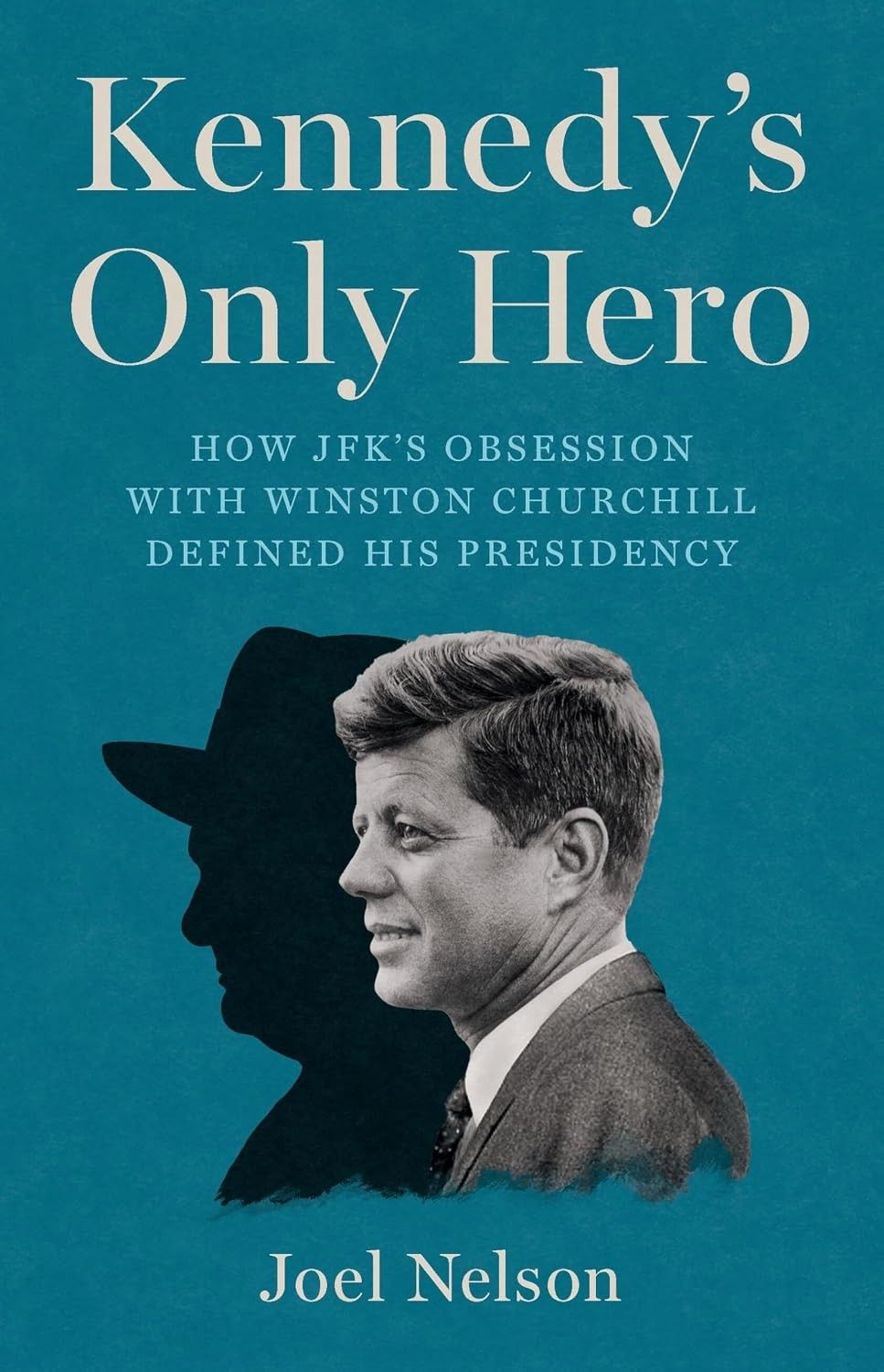

BOOK REVIEW: Kennedy’s Only Hero: How JFK’s Obsession with Winston Churchill Defined His Presidency
By Joel Nelson/ Public Affairs, New York
Reviewed by: Jean-Thomas Nicole
The Reviewer: Jean-Thomas Nicole is a Policy Advisor with Public Safety Canada. The opinions expressed are those of the author and do not reflect the official policies or positions of Public Safety Canada or the Canadian government.
Joel Nelson’s Kennedy’s Only Hero is a remarkably ambitious and deeply researched work that occupies a fascinating space between political biography, intellectual history, and the study of leadership. At its core lies a deceptively simple question: how did Winston Churchill shape the mind and presidency of John F. Kennedy? Nelson’s answer is both nuanced and compelling. He argues that Churchill was not merely an admired historical figure in Kennedy’s imagination, but the central model through which Kennedy came to understand politics, history, rhetoric, and his own role in public life. The result is a first book that sheds fresh light on one of the twentieth century’s most scrutinized presidents while simultaneously offering a sophisticated meditation on the power of political heroes.
Joel Nelson is a British writer and historian. He is a former Kennedy Scholar and assistant editor at Foreign Affairs. The principal achievement of Kennedy’s Only Hero is the way it reframes Kennedy’s life through the lens of influence. Historians have long examined Kennedy’s upbringing, his family’s ambitions, his wartime experiences, and his rise to power, yet Nelson demonstrates that Churchill’s presence ran like a continuous thread through every stage of Kennedy’s development. From childhood onward, Kennedy immersed himself in Churchill’s writings, finding in them not only lessons about statecraft but a template for self-creation. Nelson persuasively shows that Churchill became for Kennedy a figure of aspiration, discipline, and moral purpose—a distant mentor whose influence was exercised through books and ideas rather than personal contact.
The book is especially strong in its treatment of Kennedy’s intellectual formation. Nelson meticulously traces how Kennedy absorbed Churchill’s works and adapted their lessons to his own circumstances. Far from presenting Kennedy as a passive admirer, he reveals him as an active student of Churchillian thought. Kennedy’s famous Harvard thesis, later published as Why England Slept, emerges as a direct engagement with Churchill’s own analysis of Britain’s failures before the Second World War. Similarly, Kennedy’s later literary efforts, his political speeches, and even aspects of his governing philosophy bear the unmistakable imprint of Churchill’s approach to history and leadership.
What makes this argument particularly persuasive is Nelson’s command of detail. Drawing upon letters, memoirs, manuscripts, speeches, and archival sources, he reconstructs the intellectual dialogue Kennedy continued with Churchill across decades. The evidence rarely feels forced. Instead, Nelson carefully accumulates examples that collectively demonstrate how deeply Churchill’s influence penetrated Kennedy’s thinking. By the time Kennedy assumes the presidency, the reader no longer sees Churchill as a peripheral inspiration but as one of the hidden architects of Kennedy’s political identity.
Another major strength of the book lies in its treatment of rhetoric and language. Both Churchill and Kennedy are remembered as masters of public speech, and Nelson illuminates the relationship between their respective styles with considerable skill. He shows how Kennedy admired Churchill’s ability to frame political struggles in moral and historical terms and sought to replicate that capacity in his own addresses. The famous cadence of Kennedy’s speeches, their appeals to sacrifice and public duty, and their recurring emphasis on courage, vigilance, and democratic responsibility all appear in a richer light after Nelson’s analysis. The book does not claim that Kennedy merely imitated Churchill; rather, it demonstrates how Kennedy adapted Churchillian methods to the conditions of the Cold War and the expectations of American political culture.
Equally compelling is Nelson’s exploration of how personal identity and political leadership intersect. Kennedy’s admiration for Churchill extended beyond ideas and words into habits, mannerisms, and modes of self-presentation. Nelson examines Kennedy’s efforts to model aspects of his personal discipline, intellectual style, and even recreational routines after Churchill’s example (napping and painting). Such details might seem trivial in isolation, but Nelson uses them effectively to illustrate a broader theme: leadership is often a process of conscious self-fashioning. Kennedy was not simply born into greatness; he actively constructed a public and private identity informed by his reading of Churchill’s life.
The book reaches its greatest analytical depth when it moves from biography to statecraft. Nelson argues that Churchill’s lessons shaped Kennedy’s understanding of power, deterrence, and international responsibility. Nowhere is this more evident than in the discussion of the Cuban Missile Crisis. Kennedy’s determination to combine firmness with negotiation, strength with restraint, is interpreted through principles he had absorbed from Churchill’s writings. Nelson does not oversimplify the relationship or suggest that Churchill provided a blueprint for every decision. Instead, he demonstrates that Churchill furnished Kennedy with an intellectual framework through which he evaluated crises and measured leadership itself.
Importantly, the book avoids the trap of becoming a celebratory account of hero worship. Nelson acknowledges the limitations of Churchill as a model and recognizes the areas where Kennedy diverged from his hero. On domestic issues, particularly civil rights and aspects of social policy, Churchill offered little guidance for a modern American president. Kennedy’s political context required him to confront challenges that Churchill had neither faced nor anticipated. These distinctions strengthen Nelson’s argument by ensuring that the relationship remains historically credible rather than overly deterministic.
One of the more poignant aspects of the narrative concerns the relationship that never truly existed. Despite Kennedy’s lifelong admiration for Churchill, the two men never developed a meaningful personal connection. Their attempted meeting failed to produce the encounter Kennedy had long imagined. Nelson treats this episode with sensitivity, emphasizing its symbolic significance. Churchill’s greatest influence on Kennedy was exerted not through conversation but through writing, memory, and example. The episode serves as a subtle reminder that ideas can shape lives more profoundly than personal relationships.
The book’s prose is consistently elegant and accessible. Nelson manages the challenging task of presenting extensive historical research without sacrificing narrative momentum. His writing possesses both clarity and sophistication, allowing complex historical arguments to unfold naturally. The work also benefits from its balanced tone. While clearly sympathetic to both of its principal figures, it avoids hagiography and remains attentive to complexity and contradiction.
If there is a weakness, it lies in the sheer abundance of evidence presented. At times, Nelson’s determination to trace Churchill’s influence can feel exhaustive. Some readers may occasionally wonder whether every parallel requires such extensive documentation. Yet this criticism is minor when weighed against the overall strength of the work. Indeed, the accumulation of detail underscores the seriousness of Nelson’s scholarship and reinforces the credibility of his thesis.
Finally, Kennedy’s Only Hero is far more than a dual study of Kennedy and Churchill. It is a thoughtful examination of how political leaders are shaped by the figures they admire, how historical memory informs decision-making, and how individuals seek models of greatness during moments of uncertainty. Nelson has produced a work of considerable intellectual depth and narrative power—one that offers fresh insights into both Kennedy’s presidency and the enduring legacy of Churchill. For readers interested in leadership, history, and the transmission of ideas across generations, this book is an illuminating and highly rewarding achievement.
The Cipher Brief participates in the Amazon Affiliate program and may make a small commission from purchases made via links.